
It’s Not the Machines, It’s the Marketing: Why Tiruppur’s Sustainability Story Isn’t Reaching the World — and How Blockchain and a Fashion Week Could Fix That
A cluster that treats 130 million litres of wastewater a day and runs on a renewable surplus is still fighting to be believed. Tiruppur’s leadership increasingly says the problem isn’t the plant floor — it’s the pitch.
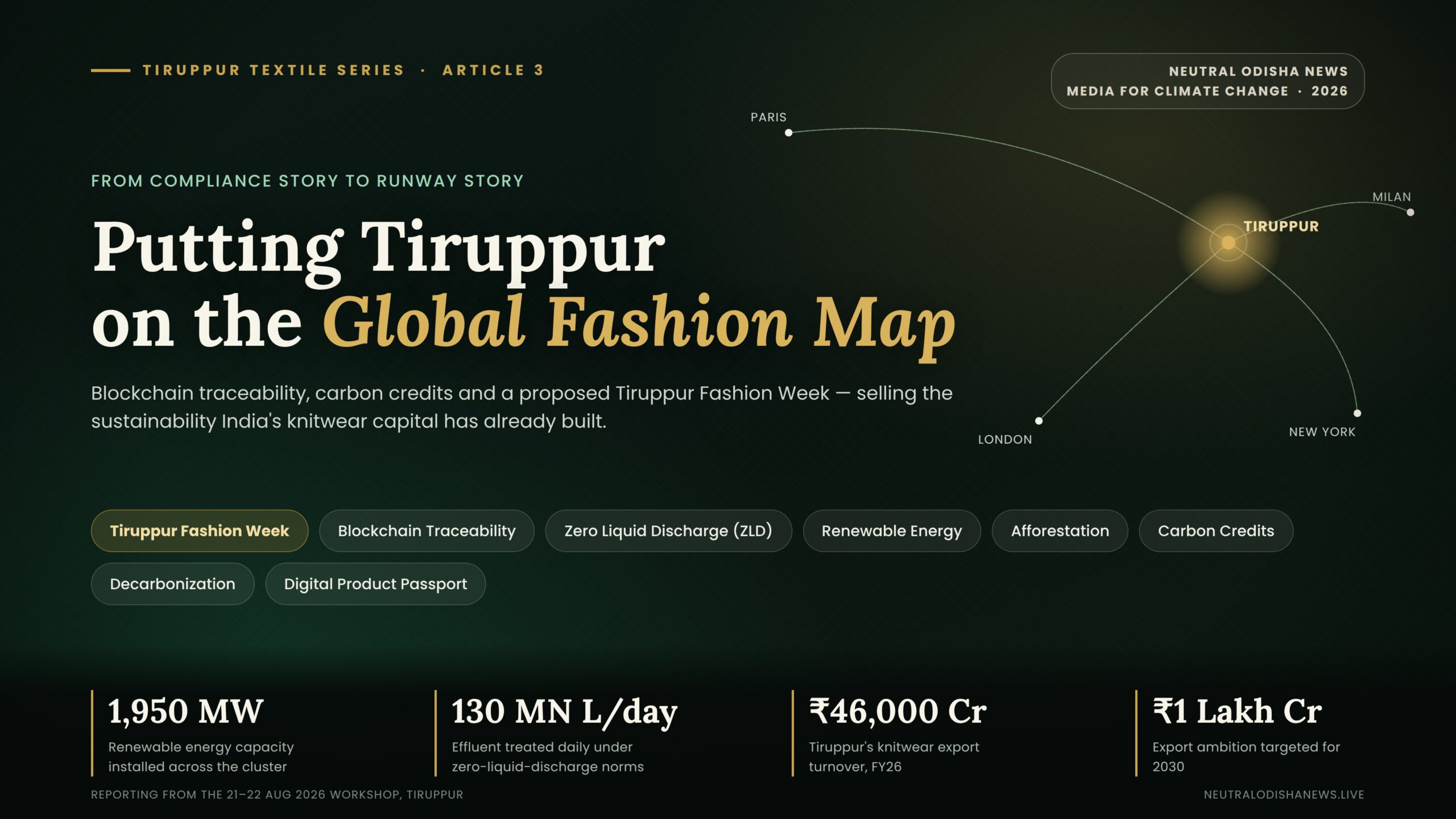
Here is the paradox at the heart of India’s knitwear capital: a cluster that treats 130 million litres of wastewater a day to zero-discharge standard, runs on a renewable-energy surplus large enough to power a small city, and has planted 2.2 million trees in under a decade — is still fighting, in 2026, to be believed.
That was the uncomfortable subtext running through several sessions of the two-day “Media for Climate Change: Future Ready for Global Markets” workshop held in Tiruppur on 21–22 August 2026, organised by Auroville Consulting with the Tiruppur Exporters’ Association (TEA), SIDBI, Guidance Tamil Nadu, MCCI and the UK High Commission. And it points to a conclusion the cluster’s own leadership is increasingly willing to say out loud: Tiruppur’s problem is not, at this point, an operational one. It is a branding problem.
An infrastructure story nobody outside the industry knows
Consider what Tiruppur has actually built. Eighteen Common Effluent Treatment Plants and sixty Individual Effluent Treatment Plants recycle roughly 96 percent of the cluster’s effluent — a zero liquid discharge system TEA General Secretary N. Thirukkumaran has described as making Tiruppur the world’s only environmentally and socially governed textile cluster of its scale. Renewable generation across the cluster, at close to 1,950 MW against roughly 350 MW of actual consumption, makes Tiruppur a net exporter of clean electricity to the Tamil Nadu grid. Circularity is not theoretical either: on the Knit Show floor, delegates saw Global Recycled Standard-certified fabric from local mills like Dhivyam Fabrics, built explicitly around the pitch of “recycled fabrics for a sustainable future” — while one major spinning unit in the cluster is reported to recycle roughly 5.5 million PET bottles a day into recycled polyester staple fibre, entirely without water-based dyeing.
None of that is a secret inside the industry. Almost none of it is known outside it. Ask a consumer in London or Berlin buying a “sustainable” T-shirt where the underlying compliance infrastructure actually sits, and Tiruppur will not come up — even though, on the evidence presented at this workshop, it arguably should.
Why “prove it” beats “trust us” — and why Tiruppur still isn’t being paid for proof
The stakes on CBAM and the EU’s Digital Product Passport (DPP) were made explicit at the workshop: global buyers are moving from taking sustainability claims on faith to demanding verified, traceable, item-level data. TEA’s M. Anand — who, notably, chairs the association’s own Branding, Sustainability & Business Promotion Subcommittee — told delegates that despite Tiruppur’s infrastructure lead over clusters like Surat, Ludhiana and Kolkata, that lead has not yet converted into pricing power. Buyers are still, in many cases, unwilling or unable to pay a premium for compliance that exists on the ground but isn’t yet packaged into a form global markets can verify at a glance.
That gap — between what is real and what is legible to a buyer scanning a supply chain in seconds — is precisely where branding and technology, not more effluent-treatment capacity, do the work.
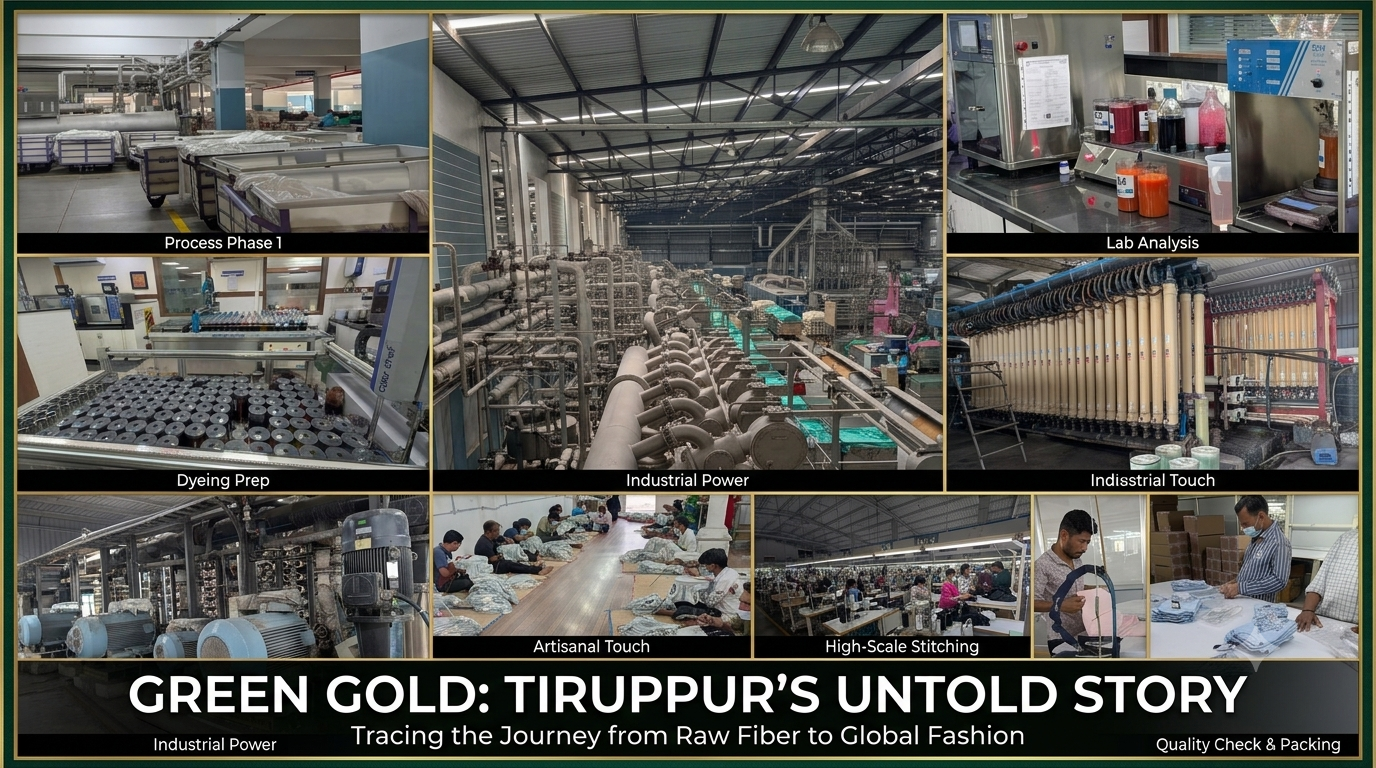
Blockchain as the missing translation layer
The technology panellists and workshop organisers pointed to is blockchain-based traceability: tagging each unit of textile — a roll of fabric, a batch of yarn, a finished garment — with an immutable, verifiable record of its water footprint, its energy source, and its compliance history as it moves through dyeing, spinning, cutting and stitching. Done properly, this is not a marketing gimmick; it is precisely the kind of item-level, auditable data that DPP-style regulation is going to require anyway. The difference is that a blockchain-tagged garment carries its own proof, rather than asking a buyer, a customs officer or a compliance auditor to take an exporter’s word for it.
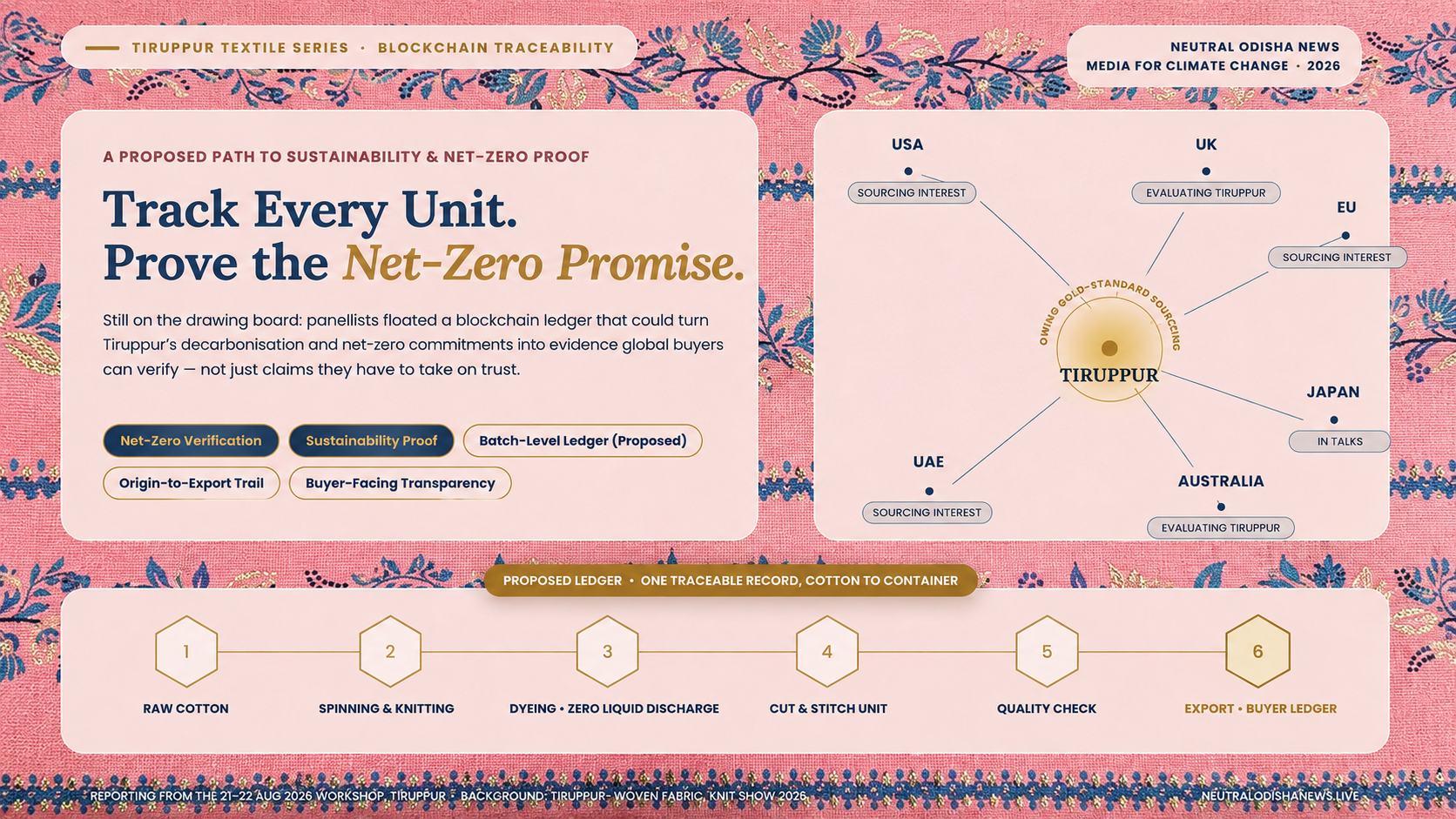
Framed that way, blockchain tagging becomes a mechanism for something bigger than compliance paperwork: a route for Tiruppur’s units to actually earn and trade carbon credits tied to verified, unit-level decarbonisation, rather than leaving that value uncaptured. It would let a buyer anywhere in the world scan a single garment and see, transparently, the treated water, the renewable power and the reforestation embedded in its production — turning Tiruppur’s existing infrastructure into a marketable, tradeable asset instead of an internal cost the cluster has absorbed largely alone.
This is no longer only about winning the next order. It is about the kind of planet the next generation inherits. Sentiment echoed by exporter-association and treatment-plant representatives across the workshop’s panel sessions
The Tiruppur Fashion Week idea
The most visible piece of the branding fix under discussion at the workshop was the boldest: a proposed Tiruppur Fashion Week, explicitly modelled on Paris and Milan, that TEA is understood to be planning as a platform to put the cluster’s sustainability credentials directly in front of global buyers, media and consumers — rather than leaving that story to filter out through trade data and factory audits nobody outside the industry reads.
It is, on its face, an unlikely pairing: Milan’s runways versus Tiruppur’s CETPs. But the logic is straightforward. Paris and Milan fashion weeks do not sell clothes directly; they sell narrative, and that narrative sets prices for an entire industry for the following year. Tiruppur, on the numbers presented at this workshop, has a genuinely rare narrative to tell — a mass-manufacturing hub that decarbonised before the world demanded it. A Tiruppur Fashion Week, if it materialises as planned, would be the cluster’s first serious attempt to control that narrative itself, on its own turf, rather than leaving it to be discovered — or not — by outside auditors and buyers.
The bet
What emerged across the workshop’s panels was a cluster that has essentially finished the harder half of its transition — the capital-intensive, court-mandated, decade-long infrastructure build — and is only now turning seriously to the easier, cheaper half: telling the story in a form the rest of the world can verify, trust and pay for. Blockchain traceability and carbon-credit mechanisms would supply the proof. A fashion week would supply the platform. Whether Tiruppur can execute both before other clusters close the infrastructure gap — and before global buyers stop waiting for anyone to ask nicely — may end up mattering as much to its INR 1-lakh-crore export ambition as any treatment plant built so far.
What Fixing the Brand Would Actually Cost
Talk to Tiruppur’s leadership long enough and a number keeps coming up: INR 1 lakh crore, the cluster’s export ambition for 2030, up from an FY26 base of roughly INR 46,000 crore. In dollar terms, at INR 95.5 to the dollar, that is a climb from about $4.8 billion to $10.5 billion. What almost never comes up is a second number: what it would actually cost to make the rest of the world believe that number is worth paying a premium for.
The comparison that matters isn’t with another textile cluster. It’s with what the West already spends to make a place, a product or a name mean something globally — and that spending runs into the hundreds of millions to billions of dollars, not the tens of lakhs a typical trade-show marketing budget runs to.
The reality check: government support for an entire national fashion week — Australian Fashion Week 2026’s direct funding from the NSW government — totals about $750,000. That is roughly what one mid-tier athlete charges for a handful of sponsored social posts. A fashion week alone, funded at that scale, does not put a cluster on the world map. It takes sponsorship-scale money to do that — which is exactly why Tiruppur’s branding conversation cannot stop at “let’s also do a fashion week.”
A 13-Step Plan, and What Each Step Actually Costs
Costed against those real-world benchmarks, here is what a credible, decade-scale branding push for Tiruppur would look like — what it costs, who plausibly pays, and what it buys.
-
1. Cluster-wide blockchain/DPP traceability platform
Scaling the EU’s TRICK-project model — a working blockchain traceability platform for a few dozen firms, built for $10.4M — to Tiruppur’s 14,000-plus units means platform build, integration and multi-year support.
-
2. Subsidised onboarding for small, unbranded units
Most of Tiruppur’s units are small job-work operations that cannot absorb compliance-tech costs alone. Without subsidy, the DPP transition risks hollowing out the cluster’s small-unit base.
-
3. Item-level digital ID / blockchain tagging, phased by value tier
Applied first to certified and branded export lines rather than all units at once, ramping toward full coverage by 2030.
-
4. A marquee global sports or cultural sponsorship
Not IOC TOP tier to start. A realistic entry point is an “official sustainable-materials partner” category with a major federation or league — closer to a mid-tier Wimbledon deal than a FIFA top-tier one.
-
5. Tiruppur Fashion Week, built to international-buyer standard
Modelled on Copenhagen’s professionalised, sustainability-certified format rather than a local trade show — real buyer delegations, real media presence, real venue infrastructure.
-
6. Two to three global sustainability-fashion ambassadors
Credible figures with a genuine sustainability story — not mega-celebrity fees, but a serious multi-year commitment.
-
7. Documentary and editorial storytelling — explicitly not performance marketing
International documentary partnerships, Davos/Cannes-adjacent presence, embedded journalism access of the kind this workshop itself provided.
-
8. Permanent “Tiruppur Verified” showrooms in demand-market cities
New York, Milan, Paris, Tokyo — a standing physical presence rather than a once-a-year trade-show booth.
-
9. Cluster-wide certification scale-up
GRS, OEKO-TEX and Higg Index alignment across thousands of units, not just the flagship exporters already certified.
-
10. Carbon-credit MRV infrastructure, tied to the same ledger
Measurement, reporting and verification built into the traceability platform, so decarbonisation claims and traceability claims are one system, not two.
-
11. Legal and IP protection for the brand marks
“Tiruppur Verified” and “Tiruppur Fashion Week” registered and defended as globally trademarked, geographical-indication-style marks.
-
12. A design-school and brand-management training pipeline
So the cluster produces its own storytellers and brand managers over time, rather than permanently importing outside agencies.
-
13. A blended-finance vehicle to spread the load
TEA cess + Tamil Nadu government + SIDBI + export credit agencies + potential EU-aligned grants — the TRICK project shows the EU already funds exactly this kind of tooling — plus buyer-side co-funding for the traceability layer, since it serves buyers’ own compliance needs too.
Rolling It Up
The first five years — platform, subsidy, one sponsorship cycle, one ambassador programme, one showroom network, one fashion-week build-out — land in the $350–600 million range. Sustained over a full decade, with sponsorship renewals, an expanded showroom footprint and full-cluster tagging coverage as the export base grows toward $10.5 billion, cumulative spend plausibly crosses $1–1.5 billion — the order of magnitude that “putting a cluster on the world map” actually costs, judged against what IOC, FIFA and Wimbledon sponsors already pay for that kind of visibility.
Short-Term Pain, Long-Term Case
Short term (1–3 years): cost-heavy, revenue-thin. Visibility and buyer conversations pick up, DPP and CBAM compliance becomes provably real for a subset of certified lines, and there is no meaningful movement yet in the aggregate INR 46,000-crore figure. This is a loss-leader phase — the same shape as any national tourism or place-branding campaign in its early years.
Long term (5–10 years): if sustained, even a modest 5–10 percent “verified sustainable” price premium on a $10.5 billion 2030 export base is $500 million to $1 billion in additional annual export value — dwarfing the cumulative marketing spend, and the actual economic case for doing any of this. The long-term prize is Tiruppur entering the same conversation as Prato or Guimarães: a place name that itself signals verified, sustainable origin, rather than an anonymous supplier city treated as one of thirty replaceable rows in someone else’s Digital Product Passport.
📸 Photo & video archive from this workshop
Ground-level photographs and video from both days, including the Knit Show exhibitor floor referenced above.
- Full Textile Industry Field-Visit Album — Day 2, all three site visits combined
- Dyeing Unit Visit — Jeyavishnu Clothing Pvt Ltd
- Water Treatment Plant Visit — Veerapandi CETP
- Exporter / Manufacturing Unit Visit — Esstee Exports India Pvt Ltd
- Knit Show / Knit Fair Gallery
Readers and partner publications needing full-resolution copies can write to neutralodishanews@gmail.com — INR 30 for access to any single folder above, or INR 99 for all-access across the full workshop archive. This nominal charge goes towards drive storage and picture-server maintenance.
Sources for the Cost & Branding-Plan Estimates
Figures above are benchmarked against publicly reported sponsorship, funding and project-cost data, cited below, with extrapolations to Tiruppur’s scale clearly presented as estimates rather than official figures.
- SportsPro — IOC TOP programme sponsorship value per four-year Olympic cycle. sportspromedia.com
- Forbes — FIFA World Cup 2026 sponsorship and brand-spend figures. forbes.com
- GlobalData — FIFA sponsorship tier valuations. globaldata.com
- B&T — Wimbledon’s Barclays sponsorship deal value. bandt.com.au
- CORDIS (European Commission) — TRICK project: EU-funded blockchain textile-traceability pilot, budget and duration. cordis.europa.eu
- Roster — Brand-ambassador fee benchmarks. getroster.com
- NSW Government (Investment NSW / Create NSW) — Australian Fashion Week 2026 government funding commitment. nsw.gov.au
- Al Anchand — USD/INR reference exchange rate, 28 August 2026 (INR 95.5252 = $1), used to convert cluster export figures to dollar terms. alanchand.com