at Dharamgarh
found at residence
caught red-handed
from the system
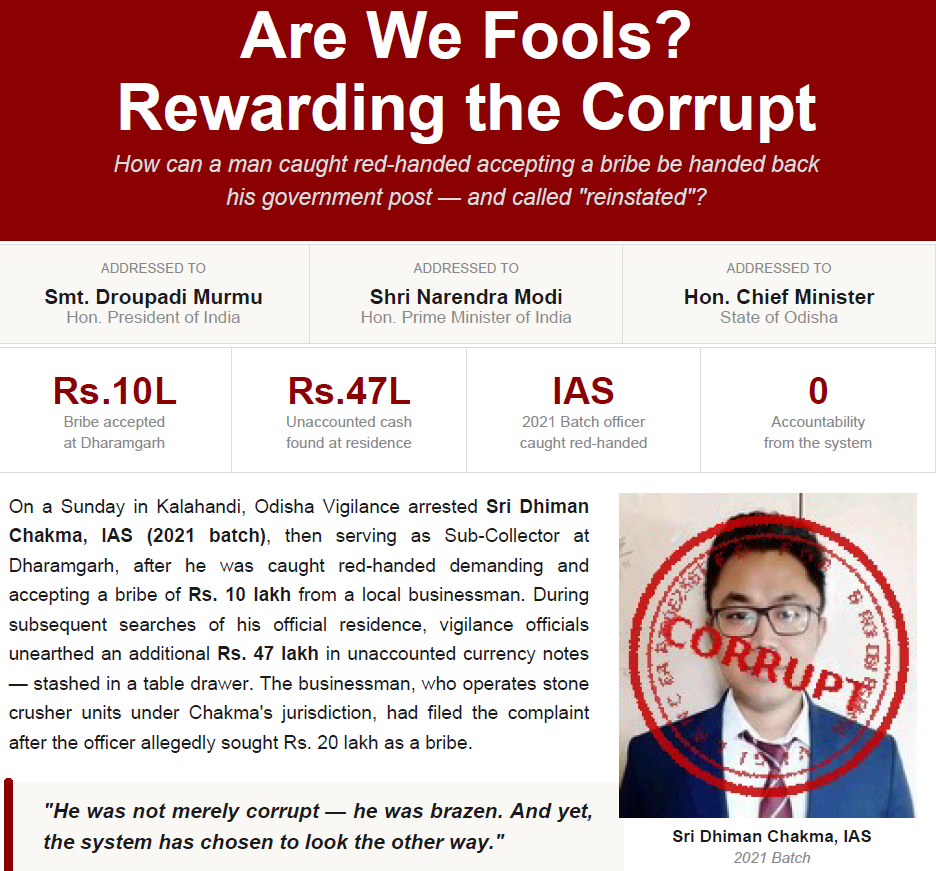
On a Sunday in Kalahandi, Odisha Vigilance arrested Sri Dhiman Chakma, IAS (2021 batch), then serving as Sub-Collector at Dharamgarh, after he was caught red-handed demanding and accepting a bribe of INR 10 lakh from a local businessman. During subsequent searches of his official residence, vigilance officials unearthed an additional INR 47 lakh in unaccounted currency notes — stashed in a table drawer. The businessman, who operates stone crusher units in areas under Chakma’s jurisdiction, had filed the complaint after the officer allegedly sought INR 20 lakh as a bribe.
“He was not merely corrupt — he was brazen. And yet, the system has chosen to look the other way.”
That evidence alone should have been the end of Sri Chakma’s government career. Instead, we are told he has been reinstated. We — the citizens of Odisha, the taxpayers who fund every government salary, every official vehicle, every quarter where that INR 47 lakh was found — are asked to accept this as normal procedure.
We refuse. We cannot accept it. And we will not be silent.

Revenue & D.M. Dept., Odisha
Arrested by Odisha Vigilance
Corruption is not an isolated act. An officer who has already shown willingness to exploit his position will carry that habit wherever the government posts him next. Whichever department receives Sri Chakma will become susceptible — its files, its contracts, its public, its trust — all at risk. Reinstatement is not a second chance. It is a second victim.
Our state remains backward not despite corruption, but because of it. Roads that do not reach villages, schools that do not receive funds, farmers who cannot access relief — these are the downstream consequences of every bribe taken by an official in a position of power. When a government reinstates such an officer, it does not merely fail one case. It tells every corrupt official in every district that the consequences are temporary, manageable, and survivable.
“In a country fighting for its future, punishing corruption with a short suspension — and rewarding it with reinstatement — is a betrayal of every honest citizen.”
Laws exist for imprisonment. The Prevention of Corruption Act carries provisions for rigorous imprisonment. If ever there was a case that called for their full application, this is it. Yet instead of the full weight of law, Sri Chakma faces restoration to service. This is not justice. This is governance in reverse.