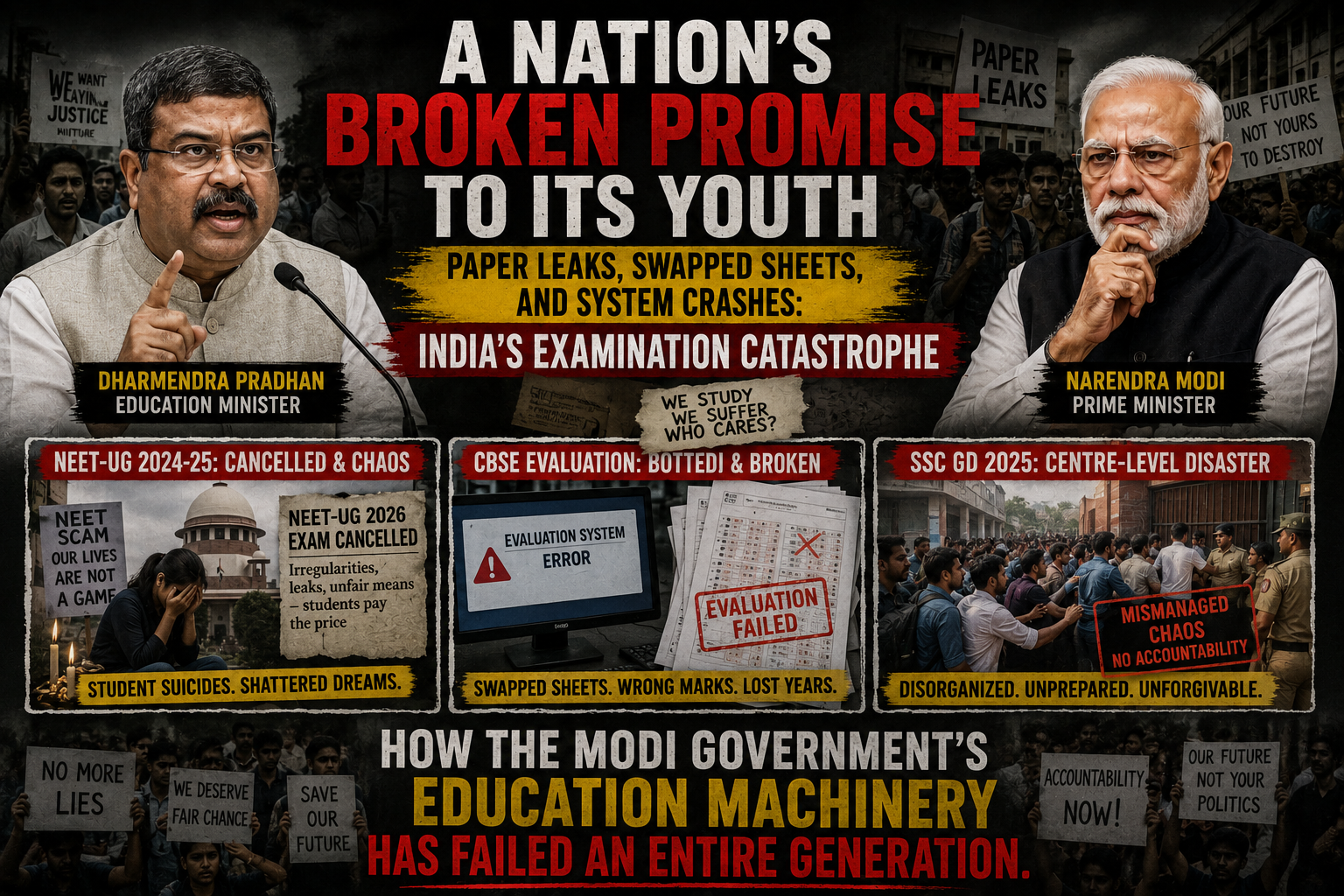
Paper Leaks, Swapped Sheets, and System Crashes: India’s Examination Catastrophe
From NEET-UG 2026’s cancelled exam and student suicides, to CBSE’s botched digital evaluation, to SSC GD’s centre-level chaos — how the Modi government’s education machinery has failed an entire generation.
India’s examination system is not merely broken — it is in a state of active collapse. In the span of a single month, the country has witnessed the cancellation of its largest medical entrance exam over a paper leak, a digital evaluation fiasco that has left lakhs of Class 12 students questioning whether their answer sheets were even checked correctly, and the disruption of a major government recruitment exam across multiple cities due to overcrowding and server failures. Each of these crises would be a scandal in its own right. Together, they form an indictment of a government that has treated education governance as an afterthought while making grand promises to its youth.
The common thread connecting the NEET-UG 2026 paper leak, the CBSE On-Screen Marking debacle, and the SSC GD Constable exam chaos is institutional negligence at the highest levels. And standing at the apex of this negligence is Union Education Minister Dharmendra Pradhan, a man who has perfected the art of denial in the face of overwhelming evidence, and a Prime Minister whose government has repeatedly failed to reform the very testing agencies it controls.
I. NEET-UG 2026: A Repeat Offender With No Remorse
The Leak That Wasn’t Supposed to Happen — AgainOn 3 May 2026, over twenty lakh medical aspirants sat for the NEET-UG examination across thousands of centres under what the National Testing Agency called “full security protocols.” Within hours, the protocols proved worthless. A chemistry teacher in Sikar, Rajasthan, named Shashikant Suthar, noticed a PDF being forwarded on phones disguised as a “guess paper.” Upon closer analysis, the questions, their sequencing, and even the ordering of options matched the official question paper exactly. The paper had leaked.
By 12 May, the NTA was forced to officially cancel the examination — a staggering admission of failure for the sole gateway to medical and dental undergraduate education in India. The CBI was called in, arrests followed, and among those nabbed was a Pune school principal who allegedly shared examination content with students for money. A key accused, Shubham Khairnar, was remanded to judicial custody after the CBI told a Delhi court that he was “actively involved” in leaking questions before the test even began.
But the human cost of this institutional failure cannot be reduced to court dates and FIRs. At least three students have taken their own lives in the aftermath of the paper leak. The Congress party, citing a fifth student suicide, demanded Pradhan’s immediate resignation. The Indian Youth Congress marched toward the minister’s residence, calling the government a “Leak-ocracy” — a term that stings precisely because of how accurate it is.
The Supreme Court’s observation deserves to be read, re-read, and tattooed on the walls of the Ministry of Education. Because this is not the first time. In 2024, the NEET-UG paper leak triggered a nearly identical crisis — arrests in Bihar, a CBI investigation, nationwide outrage. The Radhakrishnan Committee was set up to recommend reforms. Recommendations were made, and Pradhan himself admitted in 2026 that “there was a breach somewhere in the chain of command despite implementing the Radhakrishnan committee’s recommendations.” This is not a confession of bad luck. It is a confession of systemic failure — of recommendations that existed on paper while the actual paper was being sold to the highest bidder.
And what was the Education Minister’s posture in 2024, when the storm first hit? He told reporters there was “no corruption” and “no proof of paper leak” — this while Bihar police had already extracted confessions from those who had leaked the paper in advance. When the opposition asked “Whom to trust — NTA or Bihar police?”, Pradhan had no answer. Two years later, with another cancelled exam, more arrests, more suicides, and more devastation, the minister’s playbook has not changed. The only thing that has changed is the year.
The NTA: A “Credible” Body That Keeps Failing
The NTA, which Pradhan once called “a very credible body,” has now presided over confirmed or alleged paper leaks in NEET-UG 2024, UGC-NET 2024, JEE-Main 2021, and NEET-UG 2026. The United Doctors Front has filed a plea in the Supreme Court demanding the NTA’s outright dissolution. The Court has issued notices to the Centre and the NTA, setting the stage for what could become a landmark reckoning. Yet the government continues to defend the agency, offering the same tired promises of “enhanced security” that ring hollow after every fresh scandal.
Pradhan’s latest offering — the announcement that NEET will shift to a computer-based test from 2027 — is an admission that the pen-and-paper model is fatally compromised. But it also raises an uncomfortable question: if this solution was available, why wasn’t it implemented after 2024? How many more leaked papers and lost lives did it take for this government to act?
II. CBSE’s On-Screen Marking: A “Foolproof” System That Fooled Everyone
Digital Dreams, Analog NightmaresWhile the NEET scandal made national headlines, another crisis was quietly unfolding — one that affects the nearly 17 lakh students who appeared for the CBSE Class 12 board examinations in 2026. This year, CBSE introduced its On-Screen Marking system with considerable fanfare. Physical answer sheets would be scanned and evaluated digitally. Examination Controller Dr. Sanyam Bhardwaj championed the move as a way to “eliminate totalling errors, minimise human intervention, and accelerate result declaration.” The board was so confident in its automation, in fact, that it originally declared post-result verification of marks entirely unnecessary.
That confidence has now collapsed spectacularly.
The trouble began when a Delhi student named Vedant Shrivastav discovered that the scanned Physics answer sheet uploaded to the CBSE portal under his name did not contain his handwriting. The answers were not his. The writing style was not his. Someone else’s answer sheet had been evaluated under his name — and, by implication, his answers had been evaluated under someone else’s. A second student, Sanjana, raised an identical complaint about her Chemistry answer sheet, having received a shockingly low 11 out of 70 marks. She, too, found that the uploaded document did not match what she had written.
CBSE was eventually forced to acknowledge the mix-up, sending Vedant his correct answer sheet via email. But the board’s admission opened a Pandora’s box that it cannot close. As news reports have noted, if Vedant received the wrong answer sheet, then whose answer sheet was he given? And who received his? For a system evaluating lakhs of students, even a few mismatches call into question the integrity of the entire examination ecosystem.
The problems extend well beyond individual mix-ups. Students across the country have reported blurred scans that are illegible, portal crashes and payment gateway failures when trying to access their answer sheets, prolonged delays despite having paid the revaluation fee, and scanned scripts that contain pages belonging to other students. Social media is flooded with complaints. One student asked publicly: “CBSE should give a clear answer — will the remaining photocopies be uploaded, or do students simply not matter after payment?”
The irony is staggering. A system introduced to improve transparency has become the single largest source of opacity. A system meant to eliminate errors has introduced new categories of errors that did not exist before. And the board’s initial decision to abolish post-result verification — presumably because “digital is always right” — meant that students who noticed discrepancies had no formal recourse until public outrage forced CBSE to reverse course.
Meanwhile, CBSE’s response to teachers who dared to discuss the system’s flaws publicly? Legal threats. The board warned teachers of “legal action” for sharing “misleading” or “factually incorrect” information on social media. Silencing critics is, apparently, easier than fixing the system.
Where Was the Pilot? Where Was the Audit?
Any responsible rollout of a digital evaluation system affecting 17 lakh students would involve rigorous piloting, stress-testing, and independent auditing. There is no public evidence that any of this was done with adequate thoroughness. The OSM system was deployed at full scale in its very first year, with no fallback mechanism and no parallel physical verification. This is not reform — it is recklessness. And it happened under the watch of an Education Ministry that is too busy managing political crises to manage the country’s education infrastructure.
III. SSC GD Constable Exam 2026: Chaos at the Ground Level
Overcrowded Centres, Crashed Servers, and Broken PromisesIf NEET represents the failure of examination security and CBSE represents the failure of digital implementation, the SSC GD Constable Examination 2026 represents something more primal: the failure to even get candidates into a functioning examination hall.
On 25 May 2026, multiple exam shifts were cancelled across Kanpur, Muzaffarpur, Gorakhpur, Prayagraj, Lucknow, Dhanbad, and Moga after a cascade of infrastructural failures. In Kanpur, a “major clerical oversight” meant that the number of candidates assigned to the Shrimati Ramkali Iqbal Bahadur Online Centre in Maharajpur far exceeded its actual seating capacity. Candidates who had traveled from neighbouring districts — spending money they often cannot afford on train tickets, lodging, and food — arrived to find absolute pandemonium. In Lucknow and Prayagraj, server crashes rendered computer terminals useless. In Dhanbad and Moga, malfunctioning systems disrupted tests mid-session.
Candidates staged protests. The SSC, in its now-familiar routine, promised rescheduled examinations and fresh admit cards while saying nothing about the systemic failures that caused the mess in the first place.
SSC Selection Post Phase 13 exams marred by mass cancellations and technical failures under vendor Eduquity — previously blacklisted in 2020. Students protest at Jantar Mantar; police lathi-charge teachers and aspirants.
SSC CGL exam controversy: Dhanbad server manager arrested for tampering with systems to enable cheating. Candidates told to “move mouse for answers.”
SSC GD Constable exam cancelled at multiple centres across at least four cities. UP STF exposes cheating racket charging candidates INR 4 lakh each. INR 50 lakh in cash recovered.
And now, layered atop the logistical chaos, comes a fresh cheating scandal. The Uttar Pradesh Special Task Force has exposed an alleged paper-leak and cheating racket linked to the SSC GD examination, arresting individuals who charged candidates around INR 4 lakh to help them clear the exam. During the operation in Greater Noida, the STF recovered approximately INR 50 lakh in cash, along with laptops, mobile phones, and documents related to the recruitment examination.
This is the examination system that decides who gets to serve in India’s paramilitary and border security forces. These are not abstract policy discussions — these are the careers and livelihoods of lakhs of young Indians from economically disadvantaged backgrounds, many of whom spend years preparing for a single shot at a government job. The government’s failure to provide them with even a functional examination hall is an insult of the highest order.
IV. The Buck Stops Nowhere: Pradhan, Modi, and the Culture of Impunity
Denial, Deflection, and the Absence of AccountabilityWhat binds these three crises together is not just institutional failure — it is the deliberate absence of accountability at the political level. Dharmendra Pradhan’s tenure as Education Minister has been defined by a single reflex: deny, deflect, and delay until the news cycle moves on.
In 2024, when Bihar police had confessions from NEET paper leakers, Pradhan told reporters there was “no evidence of paper leak.” When the UGC-NET paper was confirmed to have leaked on the Darknet, he called it an “isolated incident.” In 2026, with another NEET exam cancelled and the Supreme Court expressing “despair” at the lack of lessons learned, his response was to chair a “high-level meeting” — the bureaucratic equivalent of sending thoughts and prayers.
The opposition’s demand for Pradhan’s resignation is not merely political theatre. In any functioning democracy, a minister who presides over three consecutive years of examination scandals — affecting medical admissions, school-leaving certificates, and government recruitment — would be expected to take responsibility. The fact that Pradhan remains in his position is a statement, not about his competence, but about the Modi government’s priorities. Examination integrity, it seems, is simply not important enough to warrant political consequences.
And the Prime Minister himself? Narendra Modi, who built his brand on promises to India’s youth — skill development, digital transformation, a “New India” — has been conspicuously silent as the testing infrastructure his government controls has failed, year after year, in ways that are both predictable and preventable. The NTA reports to his government. The CBSE falls under his Education Ministry. The SSC is a central government body. There is no state government to blame, no opposition-ruled institution to point fingers at. This failure belongs entirely to the Centre.
It is telling that even the ABVP — the RSS-affiliated student organisation, hardly an opposition voice — has been forced to demand a high-level inquiry into SSC mismanagement. When your own ideological family is publicly calling out your failures, the depth of the crisis is self-evident.
V. A Broken Contract with India’s Youth
India conducts more high-stakes examinations than perhaps any other country on earth. Crores of young people stake their futures — their sense of self-worth, their family’s hopes, their very survival in a brutally competitive economy — on the integrity of these tests. The government’s failure to protect that integrity is not a technical lapse. It is a moral failure.
A medical aspirant who spent two or three years preparing for NEET, only to learn that the paper was being sold on WhatsApp hours before the exam, has been robbed — not of marks, but of faith. A Class 12 student who discovers that someone else’s answer sheet was graded under her name has been told, in the most visceral way possible, that the system does not see her. An SSC aspirant who traveled 200 kilometres on a borrowed bus fare, only to be turned away from a centre that had assigned more candidates than it could seat, has received a message about how much this government values his dreams.
Three institutions. Three categories of failure. One pattern of governance that prioritises announcement over implementation, optics over infrastructure, and political survival over accountability. The students of India deserve better. They deserve an NTA that can secure a question paper. They deserve a CBSE that can scan an answer sheet correctly. They deserve an SSC that can count the number of seats in a room. And they deserve a government — and a minister — willing to be held responsible when these elementary tasks are not performed.
Until that changes, every grand speech about “demographic dividend” and “Viksit Bharat” is just that — a speech, echoing through empty examination halls.