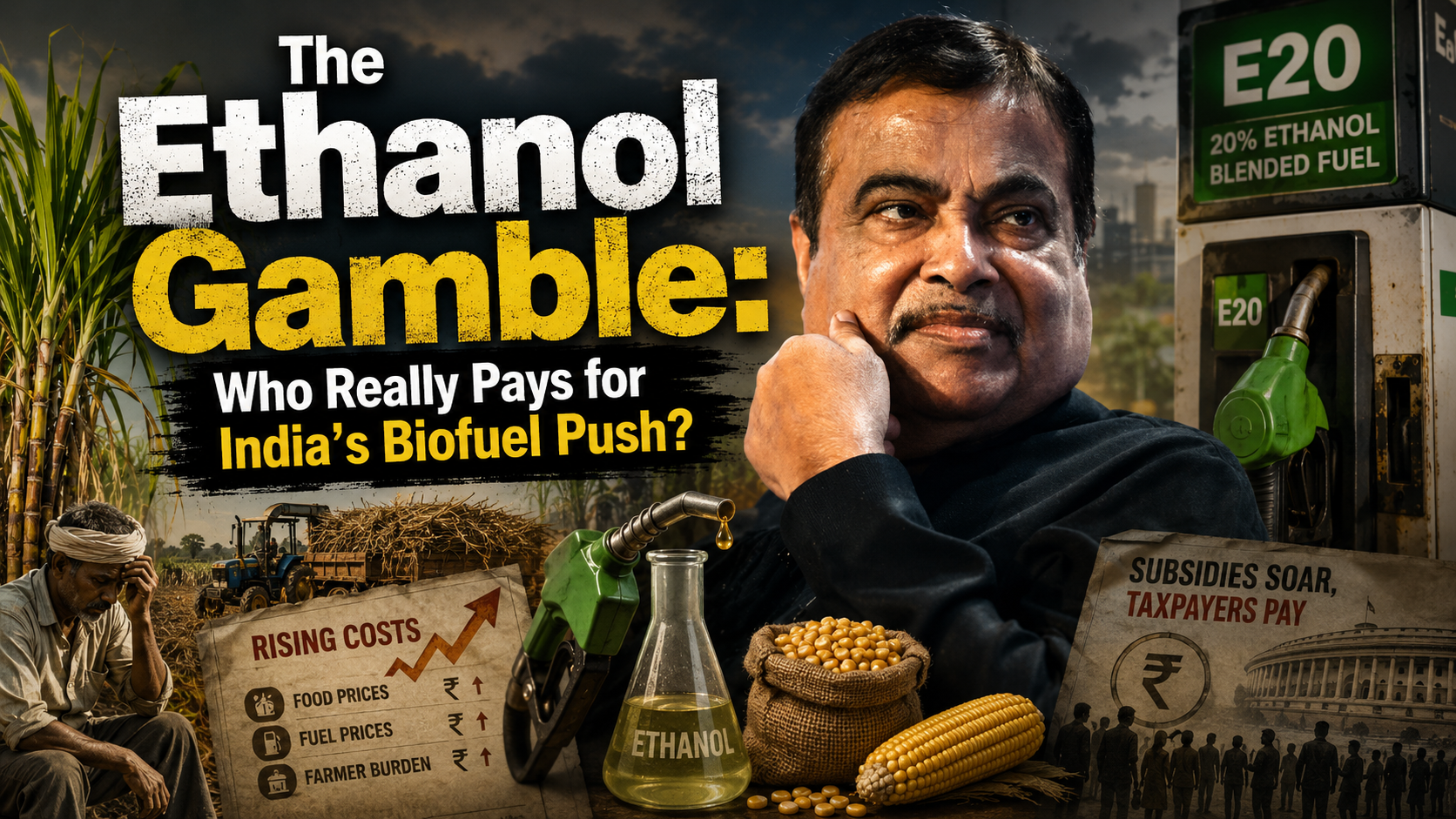
A look at the technical costs of E20 fuel, the economic case the government makes for it, and the conflict-of-interest controversy that has followed Road Transport Minister Nitin Gadkari’s family into the headlines.
A Policy That Arrived Ahead of Schedule
In April 2025, India rolled out E20 petrol — a blend of 20% ethanol and 80% petrol — nationwide, five years ahead of the original 2030 target set under the National Policy on Biofuels. The government has called it a landmark achievement: proof that India can move fast on energy security and decarbonisation at the same time. Officials say the programme has already saved the country roughly INR1.06 lakh crore in crude oil import costs and avoided tens of millions of tonnes of carbon emissions over the past decade.
But for millions of vehicle owners, especially those driving cars and two-wheelers bought before 2023, the rollout has felt less like a triumph and more like an imposition. Since the switch, driver forums and social media have filled with complaints about rough idling, hard starts, clogged filters, and fuel bills that don’t add up the way they used to. And running quietly alongside the technical debate is a political one — over who, besides the exchequer, is actually profiting from India’s ethanol boom.
What Ethanol Actually Does to an Engine
The core technical problem is simple chemistry: ethanol carries roughly 30% less energy per litre than pure petrol. Burn a litre of E20 and you are, on a straight energy basis, burning less “fuel” than a litre of pure petrol — which is why mileage takes a hit.
How big a hit depends on the vehicle:
- Newer, E20-compatible vehicles (broadly, those manufactured after March 2023, with engine management systems, fuel-system materials and injector calibration designed for the blend) typically see mileage drop by around 1–4%. The Petroleum Ministry itself has conceded a dip “of 1% to 2%” in newer vehicles.
- Older vehicles, calibrated only for E5 or E10, can see reductions of up to 6% or more, along with a second, less publicised problem: ethanol is hygroscopic — it absorbs moisture from the air. Over time this can corrode metal fuel-system components, degrade certain rubber and plastic seals and gaskets not designed for alcohol contact, and encourage phase separation in the tank (where water and ethanol settle out from the petrol), all of which shorten the working life of fuel pumps, injectors and carburettors in unadapted engines.
- Two-wheelers, which dominate India’s vehicle fleet, are considered particularly exposed because of smaller tanks, simpler fuel systems and, in many cases, older engine designs still on the road.
To be fair to the government’s technical case, this isn’t the whole picture. Ethanol has a higher octane rating than petrol, which resists engine “knocking” and can, in engines actually designed for it, allow for higher compression ratios and marginally better combustion efficiency — this is part of why ethanol is used in high-performance racing fuel. Auto industry voices note that this upside is largely theoretical for India’s existing fleet today: it requires engines purpose-built for higher ethanol blends, which most vehicles on Indian roads are not. Two major two-wheeler manufacturers and at least one large fuel retailer have publicly warned that pre-2023 vehicles may need fuel-system retrofits, and that any resulting damage would be at the owner’s risk. The Petroleum Ministry, for its part, has said its internal studies found no major engine damage and that insurance validity is unaffected by using E20.
The practical upshot for the average owner: more frequent refuelling, a non-trivial risk of long-term wear in older vehicles, and a maintenance burden that falls on the consumer, not the policymaker.
The Government’s Case: Saving Precious Dollars
None of this is being pushed for its own sake. The economic logic the government presents is straightforward and, on its own terms, hard to dismiss.
India imports somewhere in the region of 85% of the crude oil it consumes, at an annual cost the government has put at around INR 22 lakh crore. That is an enormous, recurring drain on foreign exchange reserves, and it leaves India’s economy exposed every time global crude prices spike — a vulnerability that has been on painful display amid recent volatility linked to Middle East tensions. Every litre of petrol replaced by domestically produced ethanol, made from sugarcane, maize, and surplus or damaged foodgrain, is a litre that doesn’t have to be paid for in dollars to an oil exporter.
The government layers three arguments on top of the import-substitution case:
- Energy security — reducing dependence on a handful of oil-exporting nations and volatile shipping routes.
- Emissions — ethanol burns more cleanly than petrol, and officials point to Delhi’s air-quality crisis, where a large share of pollution is attributed to fossil-fuel combustion, as a reason to accelerate the switch.
- Farm income — a guaranteed, government-backed market for sugarcane, maize and grain diverted to ethanol production, which ministers present as a direct income boost for farmers.
Each of these is a legitimate policy goal. The question that has increasingly dogged the programme is not whether ethanol blending serves the national interest, but whether it has also been engineered — deliberately or otherwise — to serve some very particular private interests along the way.
The Gadkari Family Question
Nitin Gadkari, the Union Minister for Road Transport and Highways, has for years been the single most visible and vocal champion of ethanol blending in India — notable partly because ethanol procurement and pricing actually fall under the Ministry of Petroleum and Natural Gas, not his own ministry. He has repeatedly promoted ethanol and flex-fuel vehicles in public appearances, framing it as a solution that would simultaneously cut fuel costs, support farmers, and clean the air.
That advocacy has collided with a set of facts about his own family’s businesses that opposition politicians say cannot be waved away as coincidence.
Two companies have come under sustained public scrutiny:
- Cian Agro Industries & Infrastructure Ltd, majority-owned and managed by Gadkari’s son Nikhil Gadkari (reports describe his shareholding at more than 60%).
- Manas Agro Industries, where his other son, Sarang Gadkari, is a director.
The numbers cited by Congress leader Pawan Khera, who has led the political charge, are eye-catching. He has alleged that Cian Agro’s revenue jumped from around INR 18 crore in June 2024 to roughly INR 523 crore by June 2025 — with some later reports putting the figure even higher, near INR 1,200 crore by 2026 — alongside a stock price surge Khera put at over 2,100% within months of the E20 rollout. Khera has also cited a jump in the company’s quarterly profit from roughly INR 10 lakh to around INR 52 crore. Demanding a Lokpal inquiry, he summed up the opposition’s case with a pointed line: the father sits in government making the policy, while the sons make the money.
Independent market-research commentary has added a technical wrinkle to the story: analysts at Finshots have pointed out that Cian’s public filings don’t clearly break out how much of its revenue actually comes from ethanol specifically, as opposed to its other listed businesses (sugar distilleries, power generation, infrastructure, and healthcare), and have flagged inconsistencies in the company’s cash flow statements relative to its balance sheet.
Gadkari’s response has been direct and consistent. He has stated that Cian Agro was established well before the ethanol blending policy existed, that its ethanol output accounts for less than 0.5% of India’s total ethanol supply, and that neither tender allocation nor pricing for ethanol falls within his ministry’s authority — those decisions, he notes, sit with the Petroleum Ministry and are made through an established tender process involving 500–550 supplying industries nationwide. He has challenged critics to prove specific harm from the policy and has suggested a “petrol lobby” is stoking exaggerated fears about E20.
It is worth being precise about where things stand: as of mid-2026, this remains a political allegation, not a proven finding. No Lokpal probe, judicial inquiry or regulatory investigation has substantiated a direct causal link between Gadkari’s policy advocacy and his sons’ company performance. What is independently verifiable — through stock exchange filings and company disclosures — is the scale and timing of Cian Agro’s growth, which coincided closely with the ethanol programme’s acceleration. What remains contested is why that growth happened, and whether ministerial influence played any role in it.
Why the Coincidence Is Hard to Ignore
Set aside intent for a moment and look only at the structure of the situation, because that’s really what’s fuelling public suspicion:
- The minister most publicly associated with promoting ethanol vehicles and flex-fuel technology is not the minister responsible for ethanol procurement policy — which is either an odd allocation of advocacy energy, or, critics argue, a convenient way to shape public opinion and demand without direct fingerprints on the tender process itself.
- The E20 target was moved up by five years, a pace even some auto industry insiders and the government’s own think tank, NITI Aayog, had cautioned against without first fixing consumer-facing issues like price differentials and tax incentives — recommendations that were largely not implemented before the accelerated rollout.
- A company run by the minister’s son grew its revenue by more than twenty-fold and its share price by over 2,000% in the exact window the policy was being aggressively pushed nationwide — a pattern that, fairly or not, is precisely the shape a conflict of interest would take if one existed.
- The costs of the policy — reduced mileage, fuel-system wear, retrofit expenses — are diffuse and borne by tens of millions of ordinary vehicle owners, each absorbing a small, largely invisible hit. The gains, if the opposition’s allegations are accurate, are concentrated in a small number of hands. That asymmetry — dispersed cost, concentrated benefit — is the classic signature of a policy captured by private interest, whether or not that capture is what actually happened here.
None of this proves wrongdoing. Correlation between a policy’s rollout and a connected company’s stock performance is not evidence of causation, and Gadkari’s rebuttal — that the company predates the policy and represents a fraction of a percent of national supply — is a genuine, checkable defence, not a deflection. But the opacity in Cian Agro’s own disclosures, flagged by independent analysts rather than political opponents, is the detail that keeps this story alive rather than letting it die as ordinary opposition noise.
The Larger Pattern: Diverting Grain in a Grain-Insecure Country
There is a second, less politically charged but arguably more consequential problem sitting underneath the corruption headlines: India is diverting sugarcane, maize and foodgrain into ethanol production at a moment when its own food security math is far from settled. Estimates suggest India will need to scale food production from around 354 million tonnes in 2024–25 to roughly 480 million tonnes by mid-century just to feed its population. Meanwhile, sugarcane and paddy — both water-intensive crops — are being encouraged for fuel use in a country already grappling with acute water stress in several agricultural belts. Nobody in government has yet published a rigorous study weighing the long-term food-security and water-security costs of the ethanol drive against the import-substitution savings it delivers. That gap in the government’s own homework is, in some ways, a bigger governance failure than any single family’s stock portfolio.
Where This Leaves the Ordinary Vehicle Owner
Strip away the politics and the picture for a regular car or bike owner is this: E20 is now the default fuel at Indian pumps, mileage will very likely take a modest hit, and if your vehicle predates 2023 you are carrying meaningfully more risk of fuel-system wear than the government’s public messaging tends to emphasise. Insurance coverage is unaffected, according to both insurers and the Petroleum Ministry, so that particular fear can be set aside. But the choice of E20 or nothing — unlike Brazil’s ethanol market, which offers consumers a genuine price-linked choice between blends — has not been extended to Indian consumers, a structural gap that independent commentators have specifically flagged as something India could learn from.
The government’s import-substitution and energy-security arguments are real and defensible on their own economic logic. The conflict-of-interest allegations around the Gadkari family are serious, politically live, and not yet resolved one way or the other by any independent authority. Both things can be true at once — a policy can serve a genuine national interest and still have produced windfall gains for people close to power, without either fact cancelling out the other. What the public is owed, and has not yet received, is an independent accounting of both.
This article presents the ethanol blending debate as of July 2026, including allegations made by opposition politicians and the minister’s public responses to them. Where claims are contested — such as the conflict-of-interest allegations against Minister Gadkari’s family — both the allegation and the rebuttal are presented; neither has been independently adjudicated by a court, the Lokpal, or a regulatory body at the time of writing.