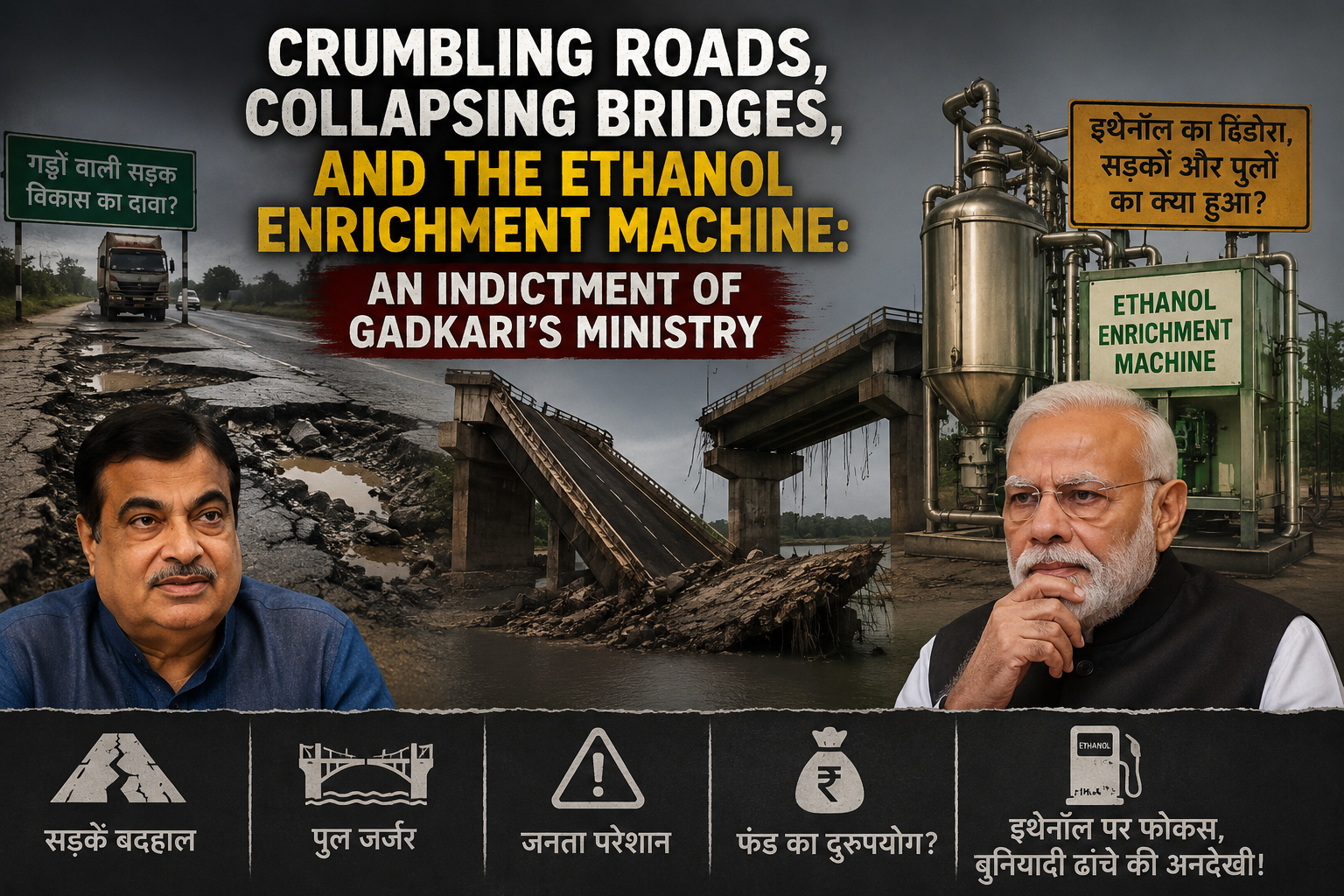
Crumbling Roads, Collapsing Bridges, and the Ethanol Enrichment Machine: An Indictment of Gadkari’s Ministry
India’s bridges kill on the day they are inaugurated, its potholes claim five lives every single day, and the Transport Minister’s son’s ethanol company saw a 30-fold revenue surge — all under one government’s watch.
There is a grim, almost farcical quality to the state of India’s road and bridge infrastructure under the Modi government. Bridges collapse before they are inaugurated. National highways develop craters within months of being laid. Potholes kill at a rate that would qualify as a public health emergency in any other democracy. And presiding over this catastrophe is Nitin Gadkari — the Union Minister for Road Transport and Highways — a man who is simultaneously hailed as a “performer” within the ruling party while the roads his ministry oversees literally swallow citizens whole, and whose family has become spectacularly wealthy from the very ethanol policy he champions from the ministerial chair.
This is not a story of one failure. It is a story of systemic rot — of bridges built with substandard material by politically connected contractors, of a government that counts kilometres of road constructed while ignoring the quality of every single one of them, of a green fuel policy that has enriched the minister’s sons while damaging the engines of millions of Indians, and of an institutional culture where no one, at any level, is ever held accountable.
I. Bridges That Kill: India’s Infrastructure of Death
Collapse First, Investigate LaterOn 9 July 2025, a portion of the Gambhira Bridge — a 40-year-old structure spanning the Mahisagar River and connecting the Vadodara and Anand districts of Gujarat — collapsed, sending two trucks and a rickshaw plunging into the river below. Twenty-two people were killed. Footage from the scene showed a tanker teetering at the shattered edge of the bridge, rescue teams pulling bodies from the water, and a community left shattered. Prime Minister Modi called the incident “deeply saddening” and expressed condolences — the same empty ritual that follows every such disaster, a ritual that has been performed so many times it has lost any trace of sincerity.
Barely a month earlier, on 15 June 2025, an iron bridge collapsed at a tourist spot over the Indrayani River in Pune, Maharashtra, killing at least two people, injuring 32, and sweeping tourists into a swollen river. Six were hospitalised in critical condition. A global audience watched, once again, as India’s infrastructure failed catastrophically at the most mundane of moments — a weekend picnic.
But perhaps nothing captures the absurdity of India’s bridge-building enterprise more perfectly than Bihar. The state recorded over a dozen bridge collapses in 2024 alone. The Agwani-Sultanganj bridge over the Ganga in Bhagalpur district has now collapsed three separate times — the structure that was supposed to be completed in 2019 fell in 2022, again in 2023, and a third time in August 2024. Reconstruction resumed in June 2025 under a new 18-month deadline. Videos of each collapse went viral, raising questions about corruption in material procurement and the awarding of contracts to politically favoured firms. In Araria, a brand-new INR 12-crore bridge over the Bakra River collapsed in June 2024 — before it was even inaugurated. In a separate incident in the same district, another bridge built in 2022 collapsed in November 2025, its pillar simply sinking into the river.
According to a 2020 study, over 2,130 bridges collapsed in India across four decades, and the rate shows no signs of declining. The pattern is depressingly consistent: hurried tenders issued to meet election promises, corruption in material procurement, pressure to finish projects before polls, and then, after the collapse, a cycle of probes that go nowhere. Engineers are suspended. Committees are formed. And then a new contract is awarded, often to the same set of firms, and the cycle begins again.
And where is the minister in all of this? Gadkari’s MoRTH is responsible for the development and maintenance of national highways. He has, to his credit, acknowledged construction defects — in March 2025, he openly criticised civil engineers and consultants for preparing flawed Detailed Project Reports, calling them “primary culprits” behind India’s high fatality numbers. But acknowledging a problem in a Rajya Sabha speech is not the same as fixing it. After a decade in office, the question is not whether Gadkari can diagnose the disease; it is why, with all the power of the Union government behind him, the disease keeps getting worse.
II. The Killing Fields: India’s Pothole Epidemic
Five Deaths a Day, Every Day, for Five YearsIf bridge collapses are the dramatic headline-grabbers, potholes are the silent, daily killers — the unglamorous, relentless reality of India’s road infrastructure. And the numbers, provided by Gadkari himself to Parliament in February 2026, are staggering.
Between 2020 and 2024, pothole-related road accidents killed 9,438 people across India. That is an average of roughly five deaths every single day, for five straight years. The annual death toll climbed steadily — from 1,555 in 2020 to 2,385 in 2024, a 53 per cent increase. Over the same period, 23,056 pothole-related accidents were reported, resulting in 19,956 injuries, of which 9,670 were classified as “grievous” — meaning permanent disability, loss of limb, or life-altering damage.
Uttar Pradesh alone accounted for more than 54 per cent of all pothole fatalities, with 5,127 deaths in five years. In 2024, the state recorded 1,369 pothole-related deaths — more than half the national total. Punjab recorded North India’s highest death toll, with 414 fatalities. These are not accidents in the conventional sense. They are the predictable consequence of chronic institutional neglect.
Gadkari’s standard defence is jurisdictional: the Centre is responsible for national highways, while state governments maintain roads within their territories. This is technically accurate and politically convenient. But the argument collapses under scrutiny. The Centre’s own national highways are not immune — the Delhi-Jaipur NH-48 and the Amritsar-Jamnagar Economic Corridor have both faced public criticism for poor surface quality, forcing the ministry to publicly promise a shift in focus from quantity to quality in 2025. A newlywed couple died on the Delhi-Meerut Expressway in January 2025 after hitting a poorly designed divider. Days later, a truck fell into a 50-metre-deep valley on NH-63 in Karnataka, killing ten.
The government spent INR 7,071 crore on road repairs and maintenance in 2025. Road accident deaths that same year exceeded 1.77 lakh — the highest in the world. This is not a country that is short on spending. It is a country that is catastrophically short on accountability for how that money is spent, who receives the contracts, and what happens when the work is substandard.
Quantity Over Quality: The Road-Building Mirage
The Modi government frequently trumpets its highway construction record — the national highway network has grown from 91,287 km in 2014 to 1.46 lakh km in 2025. This is presented as proof of transformative governance. But what does it mean to build 56,700 km of new national highways in a decade if those highways develop cracks within months, if the maintenance contracts are awarded to firms that do shoddy work, and if the ministry’s own audits — conducted by NHAI, NHIDCL, BRO, and third-party reviewers — consistently identify defects? It means you have built a longer road to the same destination: a country where infrastructure looks impressive in a government presentation and falls apart under the wheels of a two-wheeler rider navigating home at night.
III. The Ethanol Enrichment Machine: When Policy Becomes a Family Business
The Father Writes the Policy, the Sons Cash the ChequesOf all the controversies surrounding Nitin Gadkari’s tenure, none cuts closer to the bone than the ethanol story — because it is not merely about incompetence or neglect, but about what the opposition has called a “textbook conflict of interest” involving the minister’s own family.
The facts, as laid out in parliamentary questions, corporate filings, and media investigations, are these: India’s ethanol blending programme, championed personally and vigorously by Gadkari since 2014, mandated a 20 per cent ethanol blend in petrol (E20) — a target the country hit in 2025, five years ahead of schedule. The policy was framed as a green initiative to reduce fossil fuel dependence, cut oil imports, and lower carbon emissions. All laudable goals.
But the principal beneficiaries of this policy, according to Congress and multiple financial analysts, include CIAN Agro Industries & Infrastructure Limited — a company managed by Gadkari’s son, Nikhil Gadkari — and Manas Agro Industries, run by his other son, Sarang. Both companies are in the ethanol and sugar-to-fuel business.
CIAN Agro’s financial trajectory has been extraordinary. The company’s revenue surged from approximately INR 17 crore in Q1 FY24 to over INR 510 crore in Q1 FY26 — a roughly 30-fold increase. Consolidated sales rose from about INR 171 crore in FY24 to approximately INR 1,029 crore in FY25, with trailing twelve-month sales touching around INR 1,522 crore. Profits jumped from almost negligible levels — INR 10 lakh in early 2024 — to over INR 52 crore. The company’s stock price soared from around INR 40 in August 2024 to over INR 2,000 on the BSE by late 2025, a rise of more than 1,700 per cent. At one point, shares hit upper circuit limits for twelve consecutive trading sessions.
Gadkari aggressively lobbies for ethanol production, promising ethanol from municipal waste and wood-based products. Petrol and diesel prices, he says, will fall to INR 55 and INR 50 respectively.
CIAN Agro announces MoU to pursue ethanol production using captured CO₂. The pivot from edible oils to ethanol coincides precisely with the E20 policy’s nationwide rollout.
CIAN Agro’s revenue explodes from INR 171 crore to INR 1,029 crore. Manas Agro Industries, run by brother Sarang, is absorbed as a subsidiary. The company acquires sugar and molasses traders to build an ethanol empire.
Congress demands a Lokpal probe, alleging “conflict of interest.” Gadkari dismisses the allegations as the work of “a powerful import lobby.” Share price crosses INR 2,000.
Congress spokesperson Pawan Khera was blunt: “The father drafts the policy, the sons cash in on it.” He pointed out that while Gadkari had originally promised ethanol from municipal waste and wood-based products, not a single litre had been produced from these sources in seven years. Of the roughly 672 crore litres produced, over 56 per cent came from sugarcane and 38 per cent from food grains. Khera alleged that sugarcane-based ethanol was being promoted because Gadkari’s associates and the RSS have business interests in Maharashtra sugar mills.
Gadkari’s response? He likened himself to “a tree that bears fruit” and said, “The tree that bears fruit is the one people throw stones at.” He denied taking “a single penny from any contractor” and claimed the controversy was manufactured by vested interests in the fossil fuel import business. His sons’ business activities, he said, were “independent and legitimate.”
The opposition has dared Prime Minister Modi to order a Lokpal probe. No such probe has been announced.
The Collateral Damage: Engines, Mileage, and the Consumer
The ethanol story has a second, equally troubling dimension — the impact of E20 fuel on millions of vehicles and their owners. India’s aggressive ethanol blending programme was rolled out without adequately addressing a fundamental problem: millions of cars and motorcycles sold before March 2023 — when E20-compatible vehicles officially entered the market — were designed for fuel blends of 5 or 10 per cent ethanol. They are now being forced to run on 20 per cent ethanol, with E20 becoming the only option at nearly all fuel stations.
The consequences have been documented in surveys, consumer complaints, and now even Supreme Court filings. A recent Business Today survey found that one in two petrol vehicles sold before 2023 has experienced a drop in mileage with E20. Owners report lower fuel efficiency, rough idling, hard starts, and clogged filters. Industry experts have raised concerns about corrosion, weakening of seals and gaskets, fuel-line deterioration, injector damage, and accelerated long-term stress on engines not designed for high ethanol blends. An Indian insurer announced that engine damage from using the wrong fuel blend would not be covered by insurance — leaving consumers entirely exposed.
A PIL has been filed in the Supreme Court highlighting the damage, seeking direction for clear labelling of ethanol content at all petrol pumps and demanding that consumers be informed about ethanol compatibility at the point of dispensing. The PIL noted that unlike the United States and the European Union, where ethanol-free petrol remains widely available and pumps clearly display ethanol content, India offers only ethanol-blended fuel with no disclosure of composition. The Society of Indian Automobile Manufacturers has acknowledged a 2-4 per cent mileage drop, while framing it as “not a safety risk” — cold comfort for a two-wheeler rider in rural India whose monthly fuel budget has just increased by a meaningful margin.
What makes this particularly galling is the distributive injustice. The people most affected by E20 — owners of older two-wheelers, small cars, and budget commuter vehicles — are overwhelmingly from India’s lower-middle and working classes. They did not choose this fuel. They were given no option, no warning, and no compensation. Meanwhile, the minister’s sons operate companies whose revenues have exploded precisely because of the volume of ethanol being blended into the nation’s fuel supply. The policy enriches the family. The policy damages the consumer’s engine. There is no version of this story that is acceptable in a democracy that claims to serve the common citizen.
IV. The Accountability Vacuum: Gadkari, Modi, and the Infrastructure Myth
When Quantity Becomes the Alibi for QualityNitin Gadkari occupies a peculiar position in the Modi government’s narrative. He is, by common consensus, one of the more “effective” ministers — a man who “gets things done.” This reputation rests primarily on the headline number: the kilometres of highway built. And it is true that India’s national highway network has expanded significantly. But effectiveness measured solely by quantity is the logic of a government that confuses output with outcome, construction with governance, and inauguration with accountability.
Under Gadkari’s tenure, 9,438 people died because of potholes. Bridges collapsed before inauguration. A bridge over the Ganga fell three times. Consumer vehicles suffered engine damage from a policy that enriched his own family. The ministry he leads oversaw the Delhi-Meerut Expressway where a newlywed couple died from a design flaw, and the NH-63 in Karnataka where ten people fell to their death from a road that disintegrated. His own ministry’s audits — by NHAI, NHIDCL, BRO, and third-party reviewers — have consistently identified construction defects across the network. He admitted as much to the Rajya Sabha in April 2025, blaming engineers and consultants. But those engineers and consultants work within a system he has overseen for over a decade. The buck, if it stops anywhere, stops at his desk.
And yet, no consequence follows. No minister resigns over bridges that collapse before they are opened. No Lokpal investigates the extraordinary financial trajectory of a minister’s son’s company. No independent audit is commissioned to examine why ethanol from waste and wood — the original promise — was quietly abandoned in favour of sugarcane-based ethanol that happens to benefit the minister’s business associates. The government’s response to every crisis follows the same script: express sadness, order a probe, form a committee, and wait for the news cycle to move on.
Prime Minister Modi’s own role cannot be divorced from this record. The Bharatiya Janata Party has built its electoral brand around infrastructure — highways, expressways, bridges, and “Viksit Bharat.” The PM inaugurates projects with elaborate ceremonies. He claims credit for every kilometre. But the quality crisis, the pothole deaths, the bridge collapses, and the ethanol controversy are all, in the final analysis, his government’s responsibility. Gadkari reports to him. The MoRTH is a central ministry. The ethanol blending programme is a flagship initiative. There is no opposition state government to blame, no historical legacy to invoke. This is a decade-old government running a decade-old ministry, and the results are measured in the thousands of lives lost and the millions of engines damaged.
V. The Road Not Maintained
There is an old bureaucratic joke in India: the government builds roads to generate commissions, and then repairs them to generate more commissions. It is meant to be funny. It is, increasingly, just an accurate description of how things work.
A country that aspires to be a $5-trillion economy cannot run on roads that kill 1.77 lakh people a year. A country that calls itself a rising superpower cannot have bridges that collapse three times in three years. A country whose Prime Minister lectures the world on green energy at international summits cannot force its citizens to burn fuel that corrodes their engines, while the policy architect’s family becomes fabulously wealthy from the same programme. A country that speaks of transparency and zero corruption cannot refuse to investigate a minister whose son’s company went from INR 17 crore in revenue to over INR 500 crore in a single year, riding the exact policy the father mandated.
The Modi government’s infrastructure story is not a story of transformation. It is a story of two parallel realities. In one — the one that appears on election hoardings and government advertisements — India is building the world’s largest road network, pioneering green fuel, and racing toward a modern, connected future. In the other — the one experienced by the truck driver navigating a national highway at 3 AM, the motorcyclist who hits a pothole on a state road and never comes home, the two-wheeler owner whose engine seizes because the only fuel available is corrosive, and the family waiting for a bridge that has now fallen into a river for the third time — India’s infrastructure is a betrayal, paid for with public money and human lives.
Nitin Gadkari builds roads. He counts them carefully. He announces them loudly. What he does not do — what this government does not do — is ensure that they hold up under the weight of the people they are supposed to serve. That gap — between the road that is built and the road that survives — is the gap between governance and spectacle. And it is a gap that, for 9,438 families who lost someone to a pothole, and for the parents in Gujarat who buried their children after a bridge gave way beneath them, can never be closed by another press conference, another probe, or another record-breaking highway inauguration.