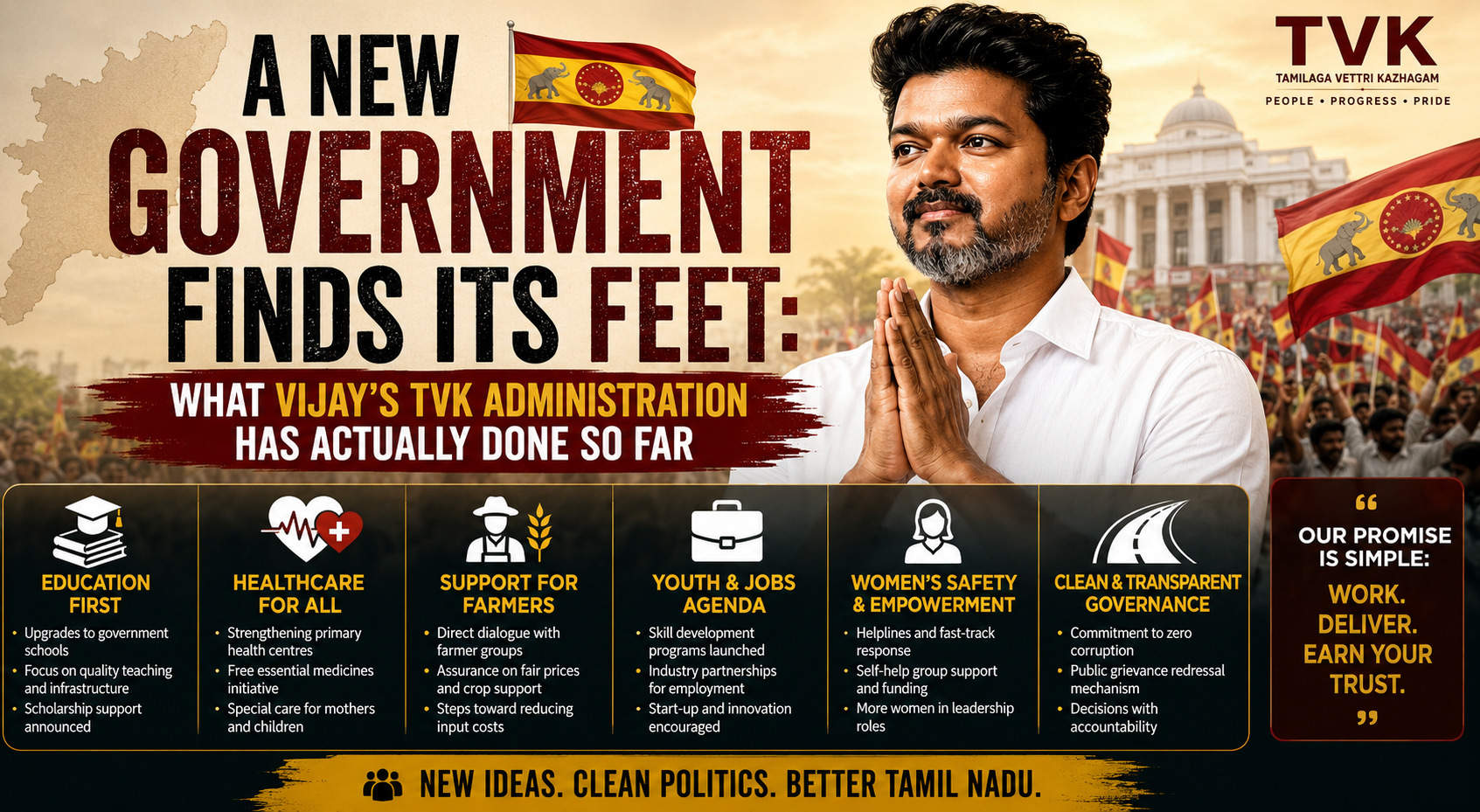
When C. Joseph Vijay was sworn in as Tamil Nadu’s Chief Minister on 10 May 2026, it wasn’t just a change of face — it was the first time since 1967 that a non-Dravidian party had led the state, ending nearly six decades of DMK–AIADMK dominance. That alone made the Tamilaga Vettri Kazhagam (TVK) government one of the more closely watched administrations in recent Tamil Nadu history. Two months in, it’s worth taking stock of what has actually landed — separating the concrete governance steps from the campaign rhetoric.
Acting on day one
Vijay’s cabinet didn’t wait to settle in before signing its first orders. Within hours of the oath-taking ceremony, the government put its name to several commitments it had campaigned on:
- 200 units of free electricity for eligible households was signed into effect the same day.
- Singapen Sirappu Athiradi Padai, a dedicated all-women special task force, was set up to speed up response to harassment complaints — a direct answer to one of TVK’s central campaign promises on women’s safety.
- Anti-drug task forces were ordered into motion almost immediately, backed later by public anti-drug drives led by Vijay himself.
Whatever one thinks of the politics, moving on manifesto commitments on the first day in office is a real signal of intent, not just a talking point.
A published roadmap, not just promises
On 5 June 2026, the cabinet released the Vetri Tamizhagam Vision Document — a 436-scheme roadmap organised into ten “pillars” drawn loosely from sections of the Tirukkural, covering everything from Tamil identity and social security to women’s welfare, farmer support, education, healthcare, and infrastructure. Putting a numbered, structured document into the public domain — rather than leaving delivery vague — gives citizens and journalists something concrete to hold the government accountable to, which is itself a notable departure from how manifestos are usually treated after an election.
Among the welfare measures building on this framework is the Madhippumigu Magalir Thittam, which raises the direct cash transfer to women heads of households from the earlier ₹1,000 scheme to ₹2,500 a month, extending coverage to the more than 1.15 crore existing beneficiaries and new additions besides.
A coalition that has largely held together
Governing as a coalition — with the Congress, VCK, IUML, CPI and CPI(M) all lending support to a party that didn’t exist before February 2024 — was never going to be simple. That the government expanded its cabinet smoothly on 21–22 May, inducting ministers from across its coalition partners without the alliance fracturing, is a reasonable early sign of political management, whatever the individual controversies ministers have since faced (more on that below).
The honest picture
Two months is far too short a window to judge any government’s full record, and it would be dishonest to pretend otherwise. What can be said fairly is this: the Vijay administration moved unusually fast on a handful of concrete, campaign-linked commitments — free electricity, a women’s safety task force, and a published, numbered policy roadmap are not nothing — while also stumbling, like most new governments, on law-and-order communication and on vetting its own ranks. Whether the early momentum on delivery outlasts the controversies is the real question Tamil Nadu voters, and the opposition, will be watching over the coming months.