When the screen fades to black, the credits don’t roll for everyone.
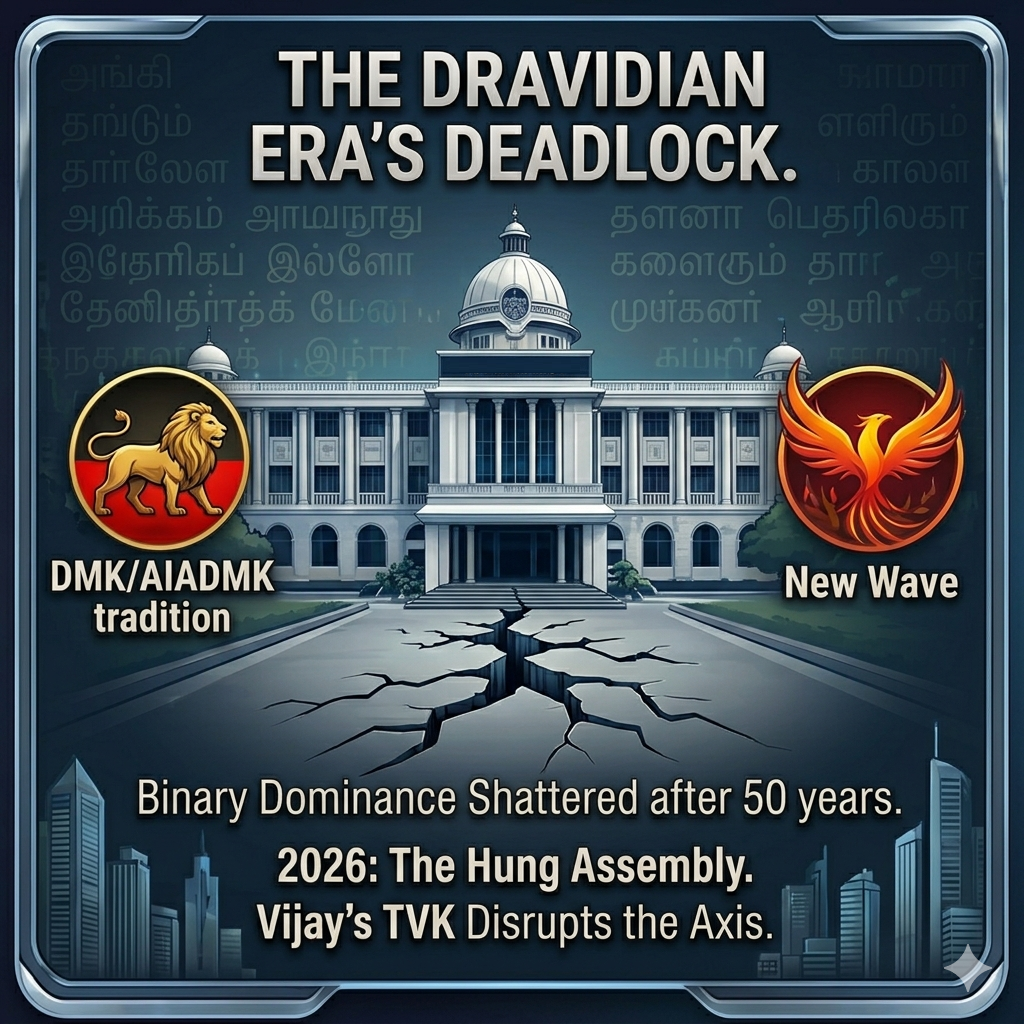
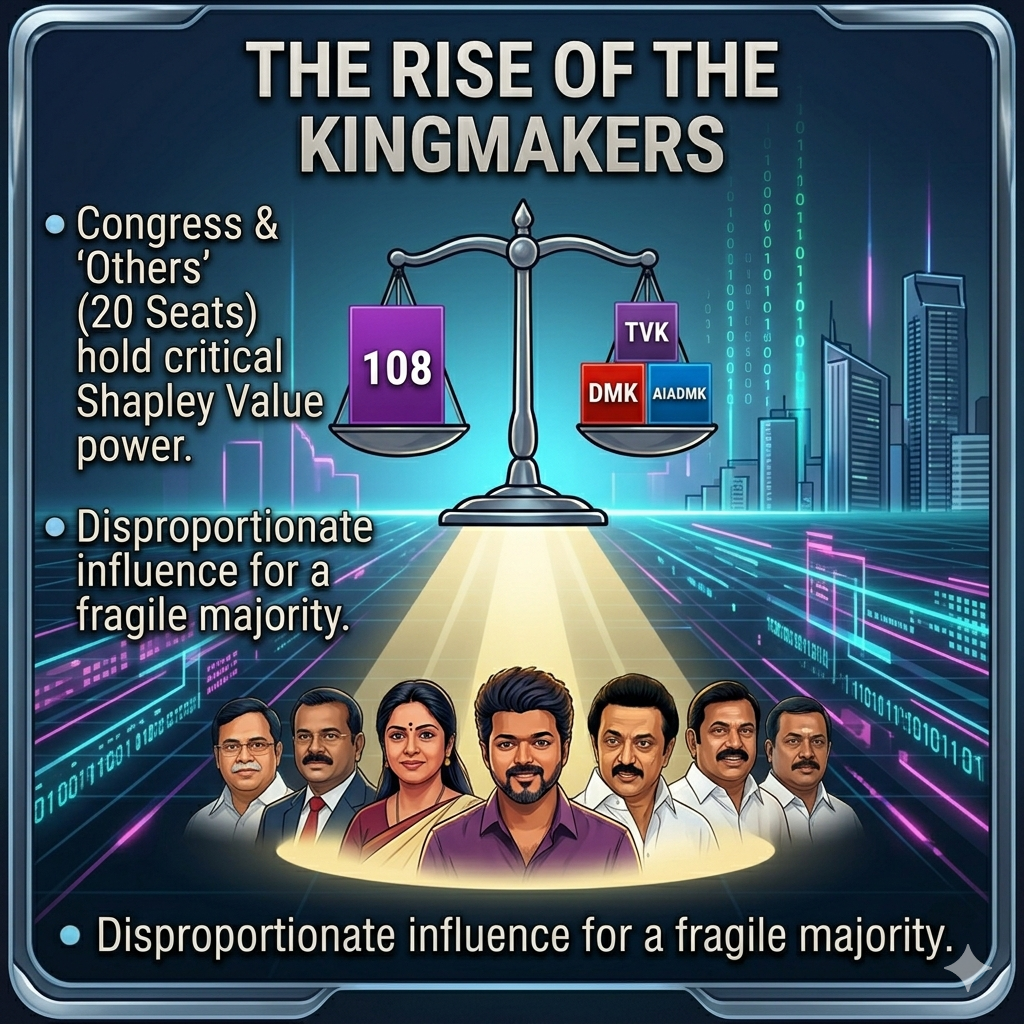
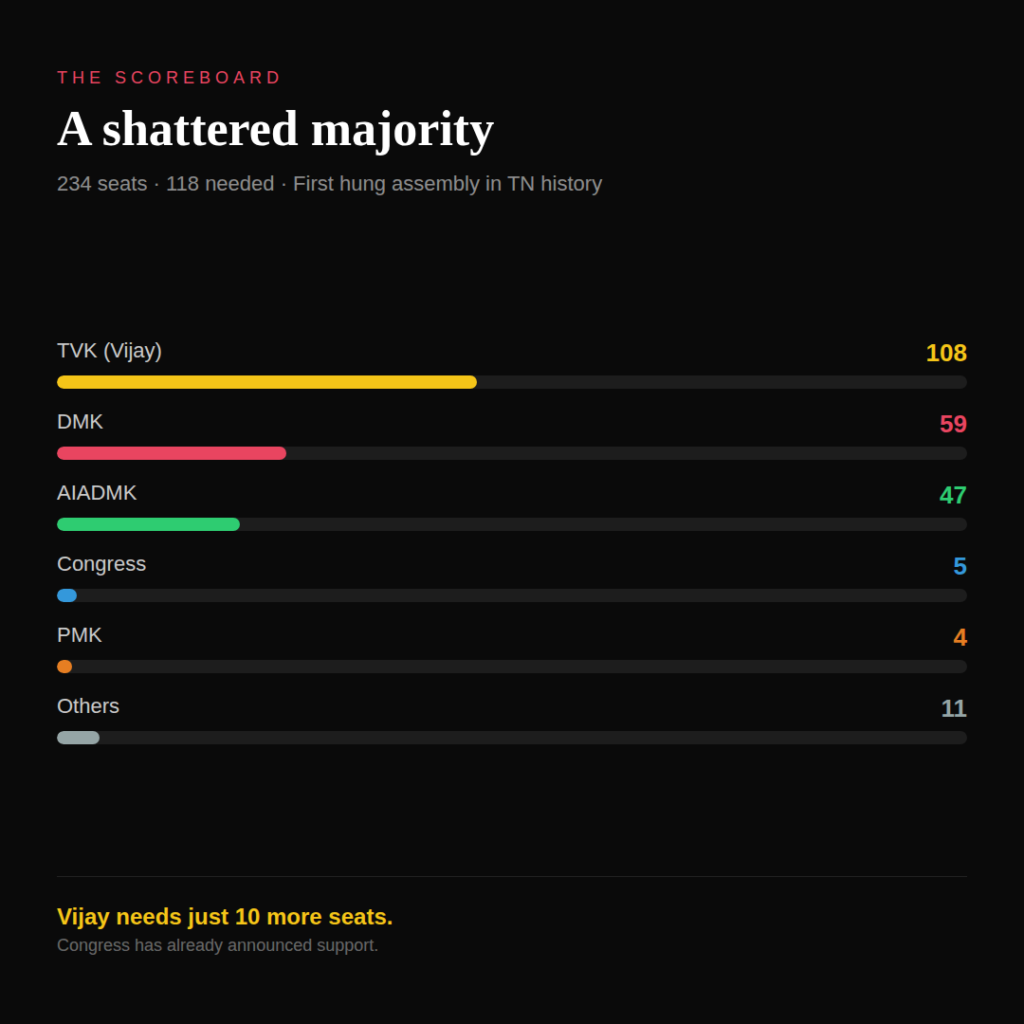
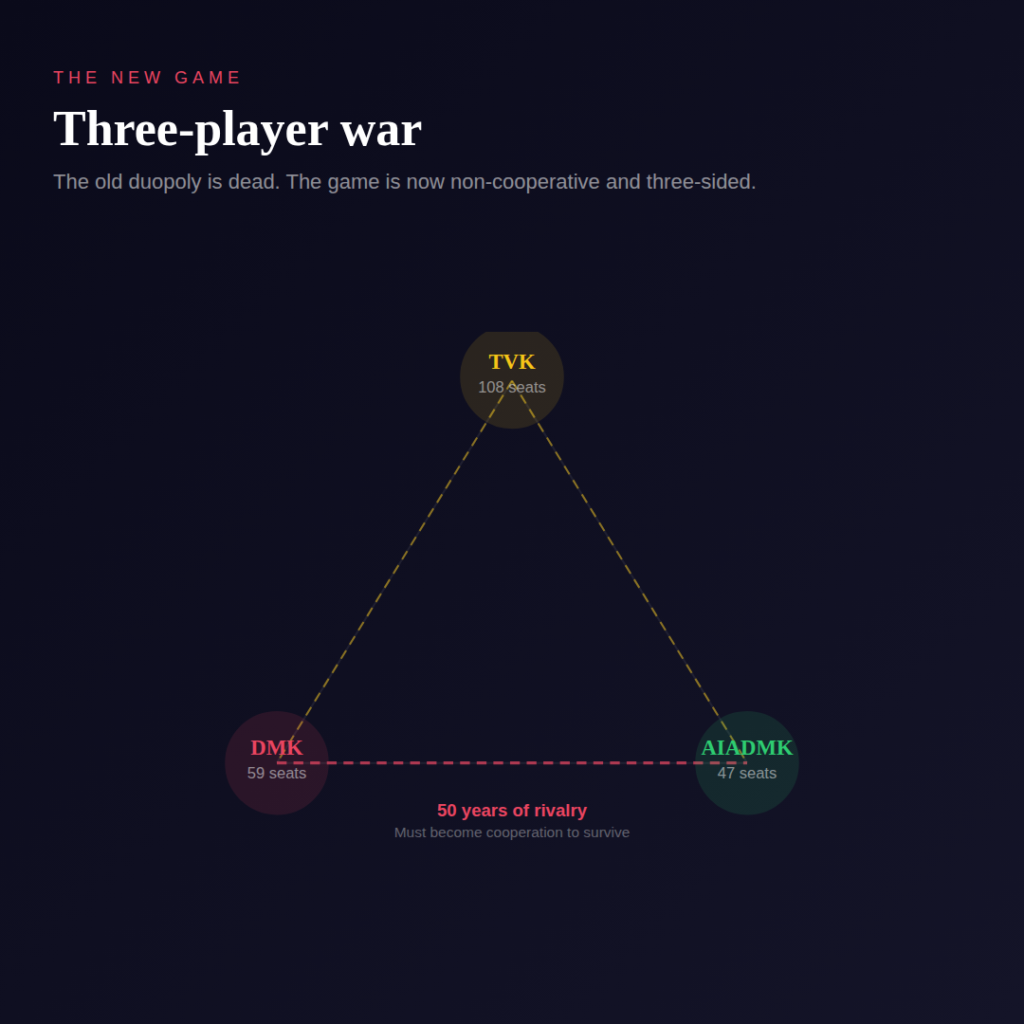
On May 4, 2026, Tamil Nadu did something it had never done in its modern democratic history: it returned a hung assembly. For a state that has delivered decisive, alternating mandates between two Dravidian giants for nearly six decades, the very concept of a fractured verdict felt alien. But the numbers are unambiguous. Vijay’s Tamilaga Vettri Kazhagam, contesting its very first election, has won 108 of 234 seats. The DMK, which swept 159 seats just five years ago, has been reduced to 59. The AIADMK, already weakened before the election, sits at 47. The Congress has formally announced support to TVK, likely pushing Vijay past the 118-seat majority mark.
This isn’t a setback. This is a species-level event.
And the question confronting every Dravidian strategist right now isn’t “how do we win next time?” It’s something far more primal: do we survive at all?
Game Theory — the mathematical study of strategic decision-making among competing actors — offers a framework that cuts through the noise of punditry. It doesn’t care about sentiment or legacy. It only asks: given the incentives, what is the rational move? And more importantly, what happens when rational actors refuse to make it?
The Scoreboard That Changed Everything
Before we get to the theory, let’s sit with the data. In Tamil Nadu’s 234-seat assembly, the magic number is 118.
| Alliance / Party | Seats Won |
|---|---|
| TVK (Vijay, solo) | 108 |
| DMK | 59 |
| AIADMK | 47 |
| Congress (INC) | 5 |
| PMK | 4 |
| VCK | 2 |
| CPI(M) | 2 |
| CPI | 2 |
| IUML | 2 |
| BJP | 1 |
| DMDK | 1 |
| AMMK | 1 |
Vijay needs just 10 more seats. The Congress, with its 5 seats, has already extended support. The arithmetic is nearly done.
But arithmetic only tells you who governs today. Game Theory tells you who governs for the next thirty years.
Why Thirty Years? The MGR-Jayalalithaa Theorem
This isn’t hyperbole. It’s a pattern with near-perfect historical consistency.
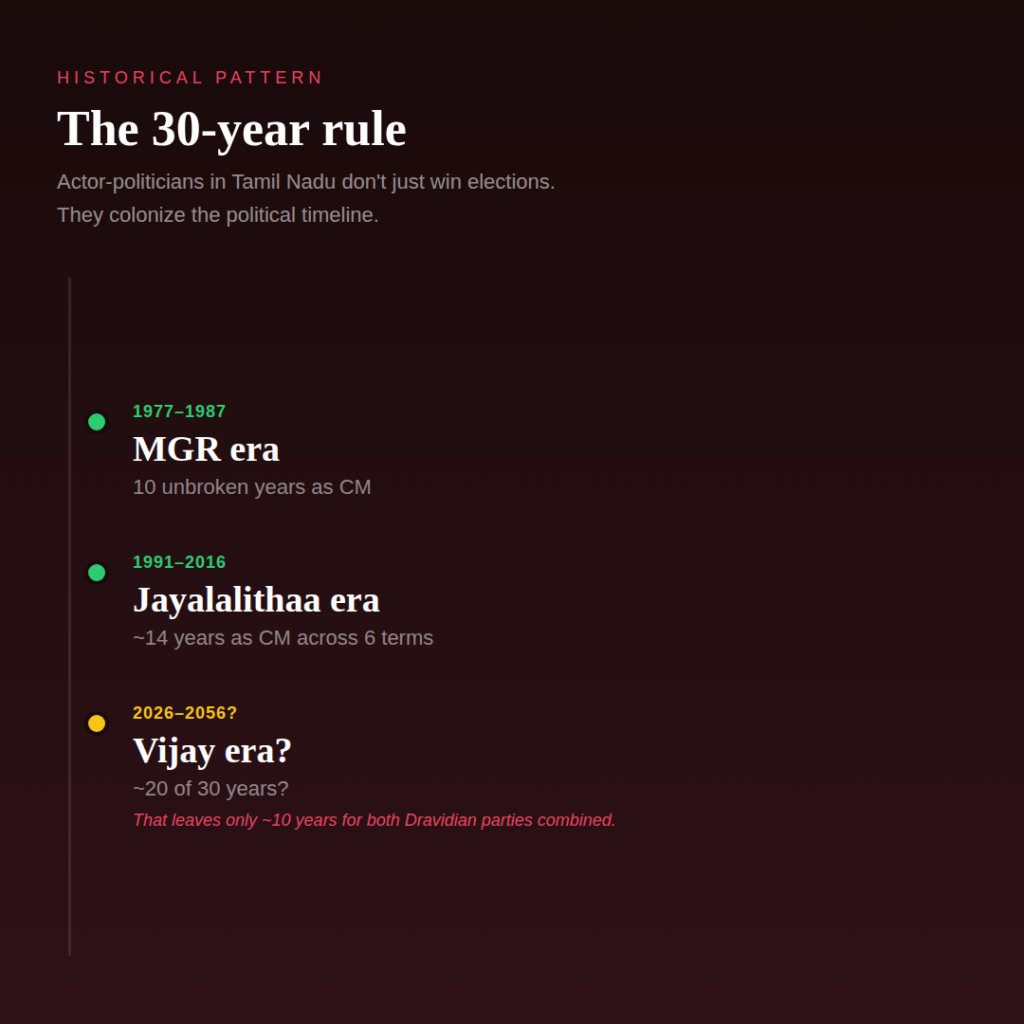
When M.G. Ramachandran — a massively popular actor — founded the AIADMK and won power in 1977, he didn’t just win one election. He ruled Tamil Nadu continuously until his death in 1987. Ten unbroken years. His political protégée, Jayalalithaa, then inherited the AIADMK’s machinery and served as Chief Minister six times between 1991 and 2016 — roughly 14 of those 25 years in actual power. Together, the MGR-Jayalalithaa continuum dominated Tamil Nadu politics for nearly 40 years from the moment MGR first won.
The pattern is clear: a charismatic actor-politician in Tamil Nadu doesn’t just win an election. They colonize the political timeline. They become the default. The youth who are 18 today will be 48 before they know any other dominant force. The cadres who migrate early get rewarded; those who stay loyal to the old guard get left behind.
If Vijay governs Tamil Nadu starting in 2026, the historical model suggests TVK will hold power for roughly 20 of the next 30 years. That leaves just 10 years — fragmented, intermittent, and likely as a junior partner — for both Dravidian parties combined.
If Vijay is somehow stopped from governing? The Dravidian parties retain access to all 30.
This is the asymmetry that makes 2026 not just an election, but a fork in the road between survival and extinction.
The Prisoner’s Dilemma: Why the DMK and AIADMK Can’t Stop Fighting (But Must)
The most famous construct in Game Theory is the Prisoner’s Dilemma. Two suspects are held in separate cells. Each can either cooperate with the other (stay silent) or defect (betray). The paradox: individual rationality leads both to defect, even though mutual cooperation would leave them both better off.
For 50 years, the DMK and AIADMK have been in a perpetual state of defection. They file cases against each other. They poach cadres. They brand each other as existential threats. This made sense in a two-player system, where the only way to gain was to take from the other.
But the game has changed from two players to three. And in a three-player Prisoner’s Dilemma, mutual defection between two players doesn’t just weaken them — it hands the game to the third.
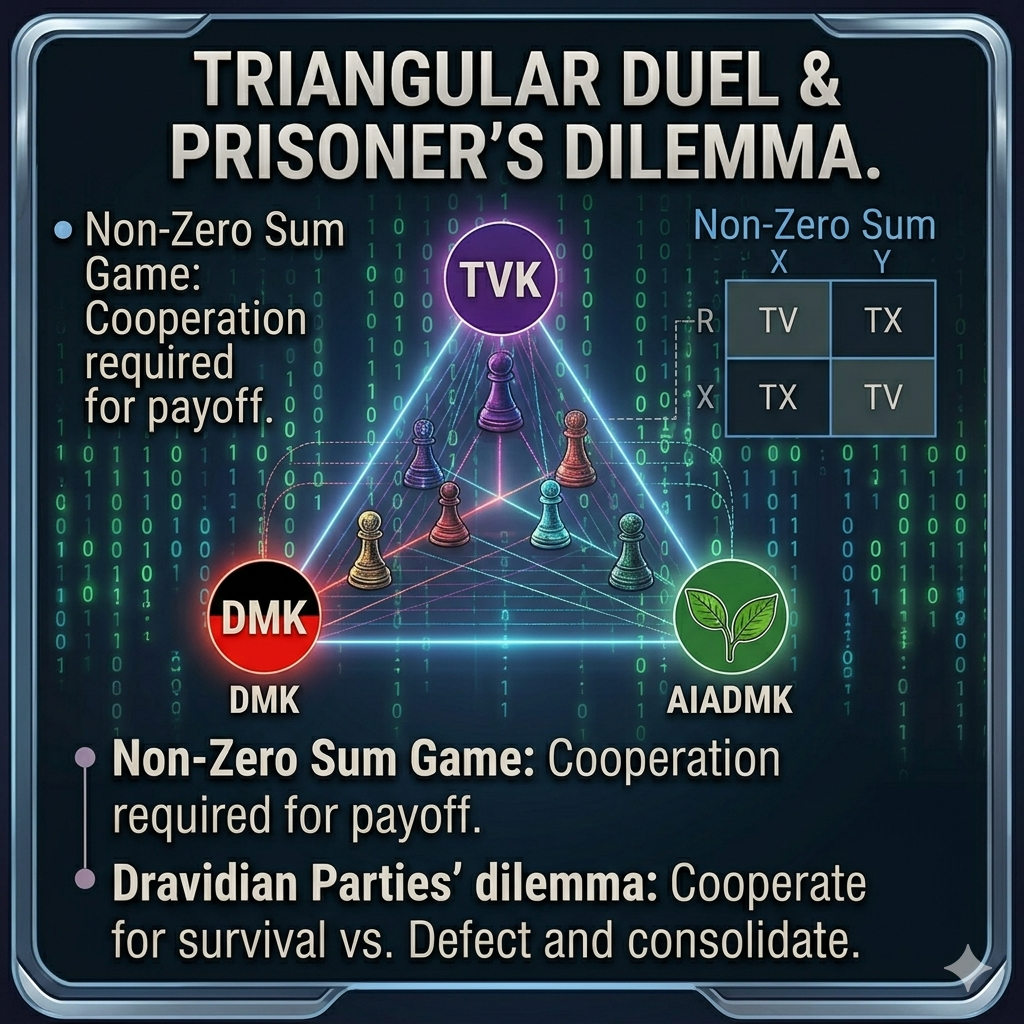
Consider the payoff structure:
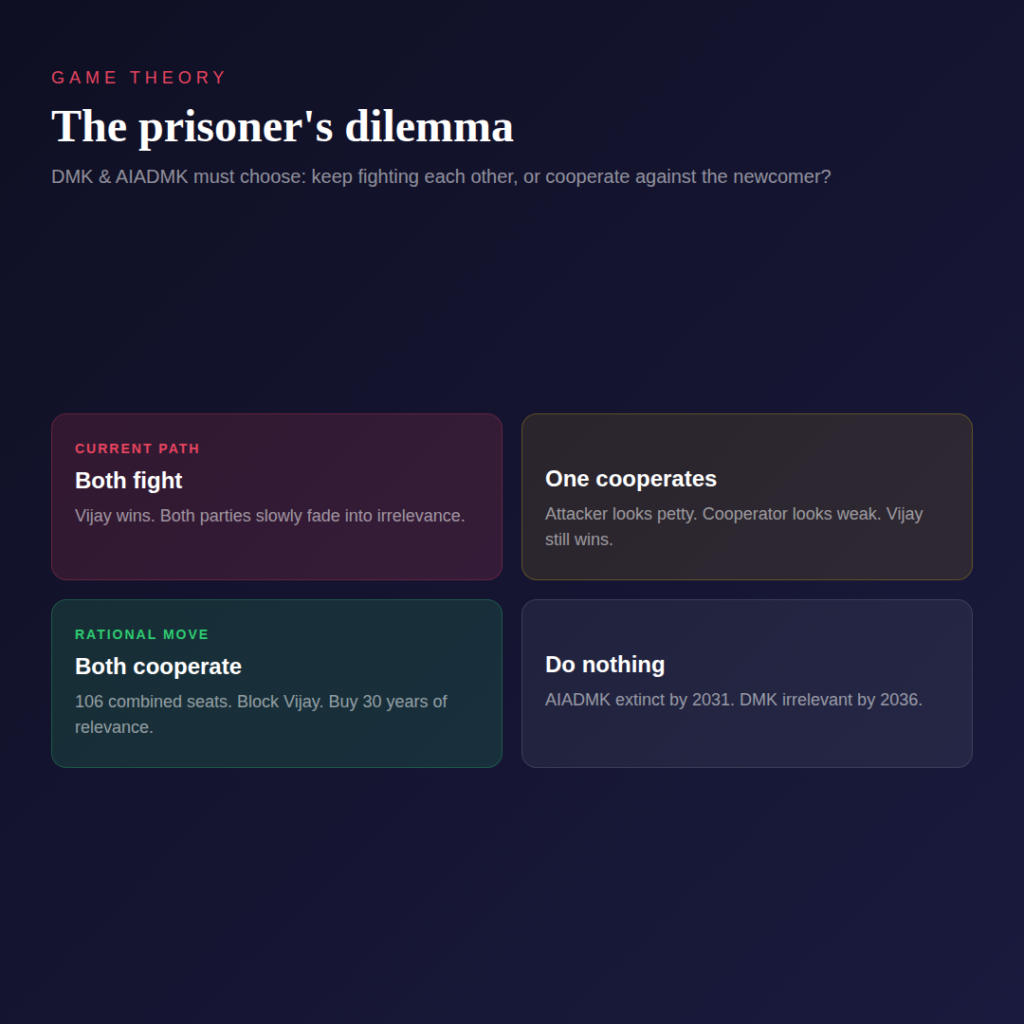
Scenario A — Both Dravidian parties continue attacking each other: The Dravidian vote remains split. TVK consolidates a plurality. Vijay governs. Cadres migrate. By 2031, one of the two parties is gone.
Scenario B — One cooperates, the other attacks: The attacking party looks petty; the cooperating party looks weak. TVK still benefits from the disunity. Neither Dravidian party gains.
Scenario C — Both cooperate against the outsider: With a combined 106 seats, the DMK and AIADMK can make governance impossible for a minority TVK. They can control committee assignments, block legislation, and present a united “Dravidian governance” narrative. They buy themselves time to rebuild.
In a standard one-shot Prisoner’s Dilemma, defection is rational. But Tamil Nadu politics isn’t a one-shot game — elections happen every five years. This is an iterated game. And the foundational insight of iterated game theory, established by Robert Axelrod’s famous computer tournaments, is that in a repeated game, cooperation becomes the dominant strategy, particularly through a “Tit-for-Tat” approach: cooperate first, then mirror what the other player does.
The catch? This only works when both players believe there will be a “next round.” If the DMK and AIADMK let Vijay consolidate power now, there may not be a meaningful next round for either of them. The iteration ends. The game is over.
The AIADMK’s Terminal Diagnosis: Entropy and the Leadership Void
Of the two Dravidian parties, the AIADMK is in far more critical condition.
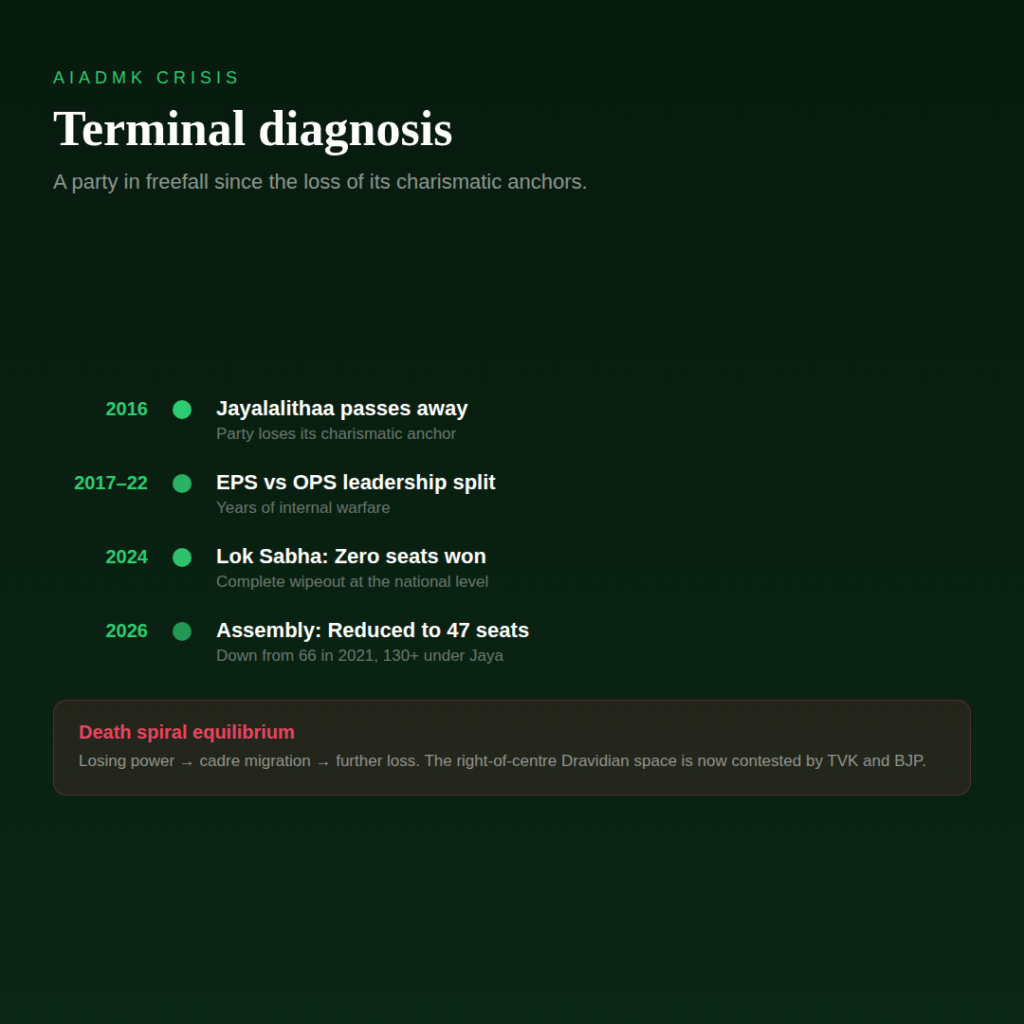
The party was built around charismatic, larger-than-life leaders: MGR’s mass appeal, Jayalalithaa’s iron grip. Since Jayalalithaa’s death in 2016, the AIADMK has been in a state that physicists would call entropy — a system moving irreversibly toward disorder.
The party split between Edappadi K. Palaniswami (EPS) and O. Panneerselvam (OPS). The reunification under EPS was incomplete — OPS eventually left for the DMK. The party’s 2024 Lok Sabha performance was disastrous: zero seats. And now, 47 seats in 2026, down from 66 in 2021, and a far cry from the 130+ seats they won routinely under Jayalalithaa.
In Game Theory, this is a problem of Credible Threat. A player’s power in any negotiation depends on whether other players believe they can actually follow through on their stated strategy. The AIADMK’s threat credibility has collapsed. Its cadres — the foot soldiers who decide elections booth by booth — are rationally asking themselves: Is this a party that can return to power? If the answer is no, they will “hedge” by migrating to whoever can. And in 2026, that is Vijay’s TVK.
The AIADMK’s “right-of-centre Dravidian” space — the voter who wants Tamil identity politics but not the DMK — is precisely the space that TVK is occupying. Every election cycle that the AIADMK fails to win accelerates the migration. This is a self-reinforcing loop: losing power causes cadre loss, which causes further loss of power. Game theorists call this a death spiral equilibrium — stable, yes, but stable in the way a corpse is stable.
For the AIADMK, the 2026 result isn’t a warning. It’s a last call.
The DMK’s Quieter Crisis: The Brand Without a Buyer
The DMK’s situation is less acute but arguably more insidious.
On paper, 59 seats isn’t extinction. The party retains organizational muscle, financial depth, and ideological coherence. Stalin’s concession speech was measured and dignified. The party has survived losses before — it lost power in 2011 and came roaring back in 2021.
But 2026 is different, and the difference is structural.
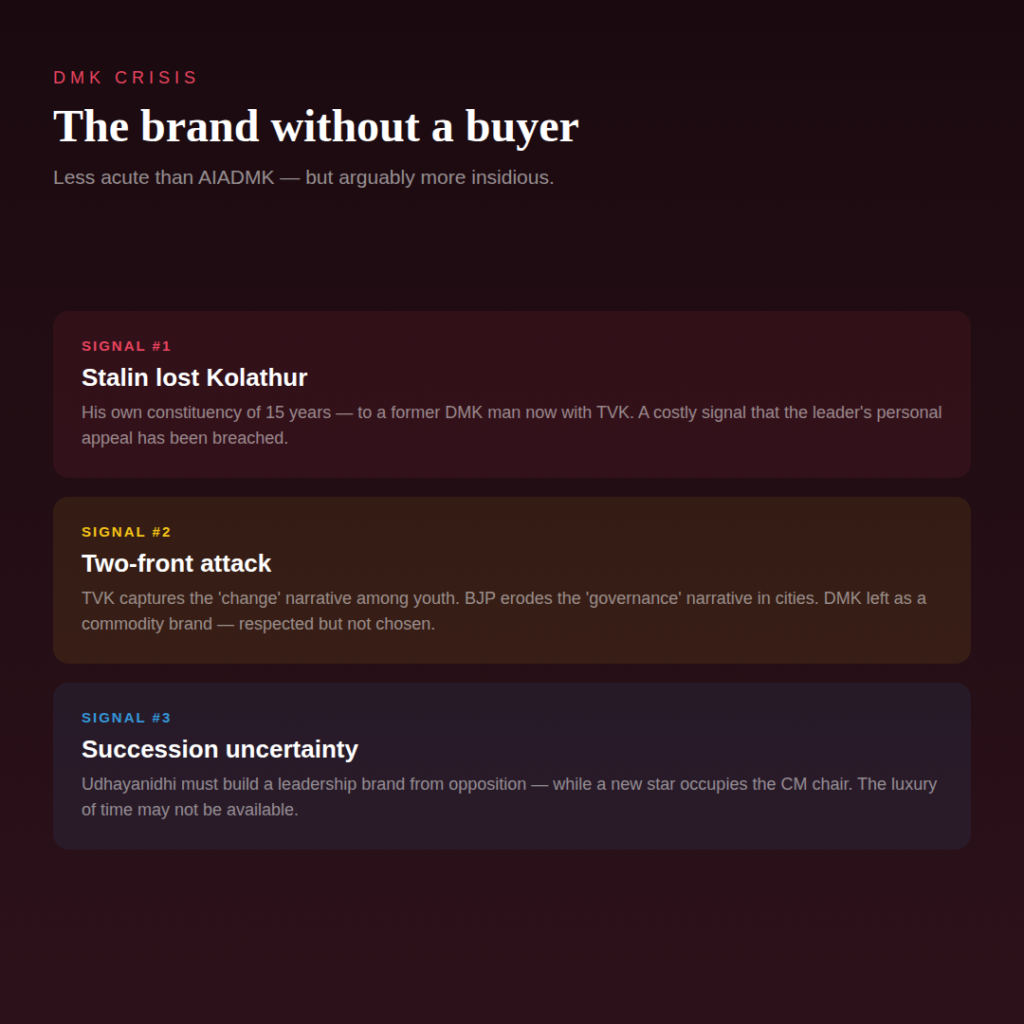
First, Stalin lost Kolathur — his personal constituency of 15 years — to a TVK candidate who was a former DMK functionary. This isn’t just symbolically devastating. In Game Theory terms, it’s a costly signal — an action so expensive that it cannot be faked. When a Chief Minister loses his own seat, the signal to every cadre, ally, and voter is unmistakable: the leader’s personal appeal has been breached. Reports suggest that warnings about Kolathur came six months before the election and were ignored. The party’s local functionaries were described as arrogant and disconnected.
Second, the DMK’s value proposition has been attacked from two sides simultaneously. TVK has captured the “change” narrative among youth and aspirational voters. The BJP, despite winning only 1 seat, continues to build organizational depth in urban pockets, signaling what game theorists call a Future Threat — not dangerous today, but increasingly credible tomorrow.
The DMK has historically positioned itself as two things: the protector of Tamil cultural identity, and the party of efficient administration. If Vijay captures the first (through mass appeal and a Tamil-pride narrative) and the BJP erodes the second (through its “corruption-free governance” pitch), the DMK is left as what marketing strategists would call a commodity brand — respected, but not compelling enough to choose.
Third, and perhaps most critically, the DMK faces a succession signal problem. Udhayanidhi Stalin, who has been positioned as the next generation of DMK leadership, now enters this phase without the advantage of incumbency. Building a leadership brand from the opposition benches, while a new star is in the Chief Minister’s chair, is exponentially harder. The Karunanidhi-to-Stalin succession worked in part because Stalin had decades of organizational work and multiple election cycles to build credibility. Udhayanidhi may not get that luxury of time.
Nash Equilibrium in a Hung Assembly: Who Blinks First?
A Nash Equilibrium is a state where no player can improve their outcome by unilaterally changing their strategy. In the current hung assembly, the state is in what we might call a sub-optimal Nash Equilibrium: nobody is happy, but nobody can improve things alone.
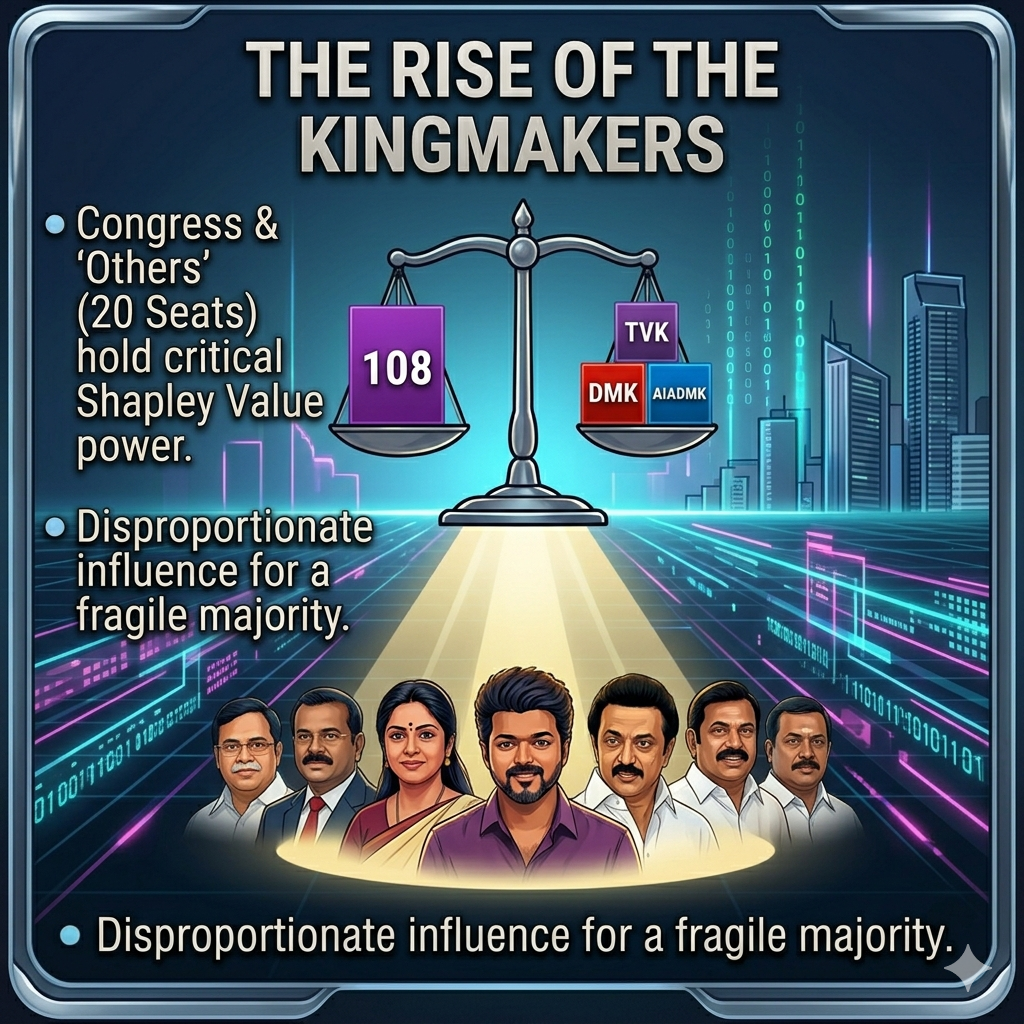
TVK has 108 seats. It needs 10 more. Congress, with 5 seats, has already offered support. That brings the effective count to 113 — still 5 short. But with the VCK (2), CPI (2), and CPI(M) (2) all historically allied with the DMK’s progressive front, TVK has a rich menu of potential partners.
Game Theory predicts that in coalition formation, the dominant player will pursue the Minimum Winning Coalition — the smallest possible alliance that secures a majority. This is Riker’s Size Principle: larger coalitions mean more power-sharing, so rational actors assemble the smallest viable majority. TVK doesn’t need the DMK or AIADMK. It needs 10 seats from a pool of small parties who would be thrilled with two or three cabinet berths.
This is the Dravidian parties’ nightmare. They aren’t being rejected. They’re being bypassed. Their bargaining power is zero in a game where the small parties hold all the pivotal votes.
The only counter-strategy? Make the small parties’ cooperation with TVK costly. A combined DMK-AIADMK opposition of 106 seats could paralyze governance, stall budgets, dominate legislative committees, and make life miserable for any TVK-led minority government. In coalition theory, this is called a blocking coalition — you may not be able to form a government, but you can make sure no one else governs effectively.
Backward Induction: Working From 2056 to Today
Backward Induction is a method where you start with the desired end-state and reason backward to determine what must happen at each stage to reach it.
The goal: Be a relevant political force in 2056.
- 2046–2056: To matter in this decade, the party needs a robust cadre base, a viable leadership pipeline, and organizational depth.
- 2036–2046: To build that base, the party needs to have held power at least once in the preceding decade to refresh its patronage networks, fund its machinery, and demonstrate to voters that it can still govern.
- 2026–2036: This is the critical window. If Vijay governs now and establishes himself as the default — if the 18-year-old first-time voter grows up with TVK as the “natural” ruling party — then by 2036, the DMK and AIADMK will be what the Congress is to Tamil Nadu today: a historical artifact, occasionally useful in alliances, but never again the main act.
The backward induction is devastating in its clarity: everything depends on what happens in the next five years. Not the next election. This one.
The BJP’s Quiet Signaling Game
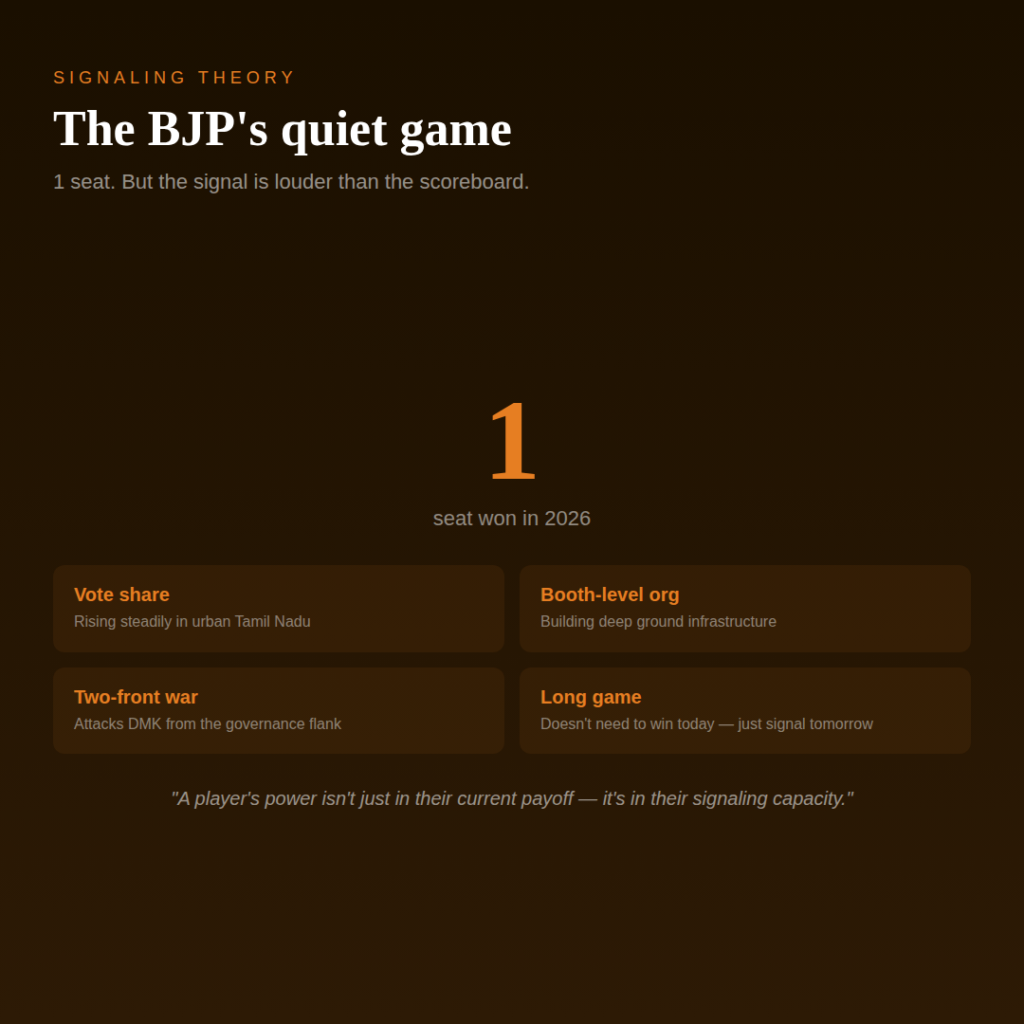
The BJP won just 1 seat. By any conventional measure, that’s irrelevant. But Game Theory teaches us that the value of a player isn’t just in their current payoff — it’s in their signaling capacity.
The BJP’s vote share has been climbing steadily in urban Tamil Nadu. They’ve built booth-level organization. They’re investing in local leaders. They don’t need to win today; they need to signal that they’ll be competitive tomorrow.
For the Dravidian parties, this creates a two-front war. TVK attacks from the populist-charismatic flank. The BJP attacks from the ideological-organizational flank. And a player fighting on two fronts — as any student of military game theory will tell you — almost always loses on at least one.
The BJP’s strategic interest, notably, is served by Dravidian fragmentation. A weak AIADMK allows the BJP to inherit the “right-of-centre opposition” space. A weak DMK allows it to pitch itself as the “serious governance” alternative. The BJP doesn’t need to conquer Tamil Nadu. It just needs the Dravidian parties to remain divided long enough for the opportunity to mature.
The Cartel Solution: Can Rivals Become Allies?
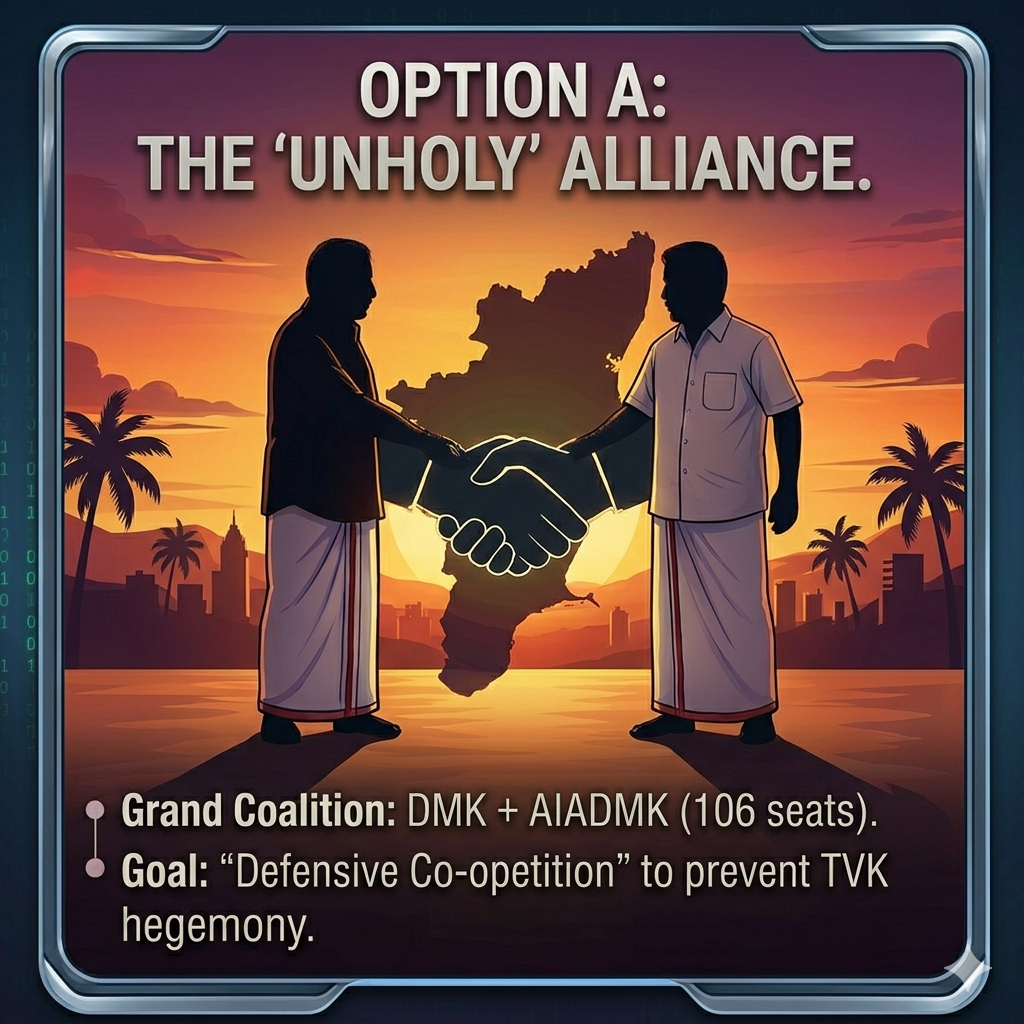
In industrial economics, when a market faces a disruptive new entrant, the established players sometimes form a cartel — an agreement to coordinate rather than compete, in order to protect their collective market share against the outsider.
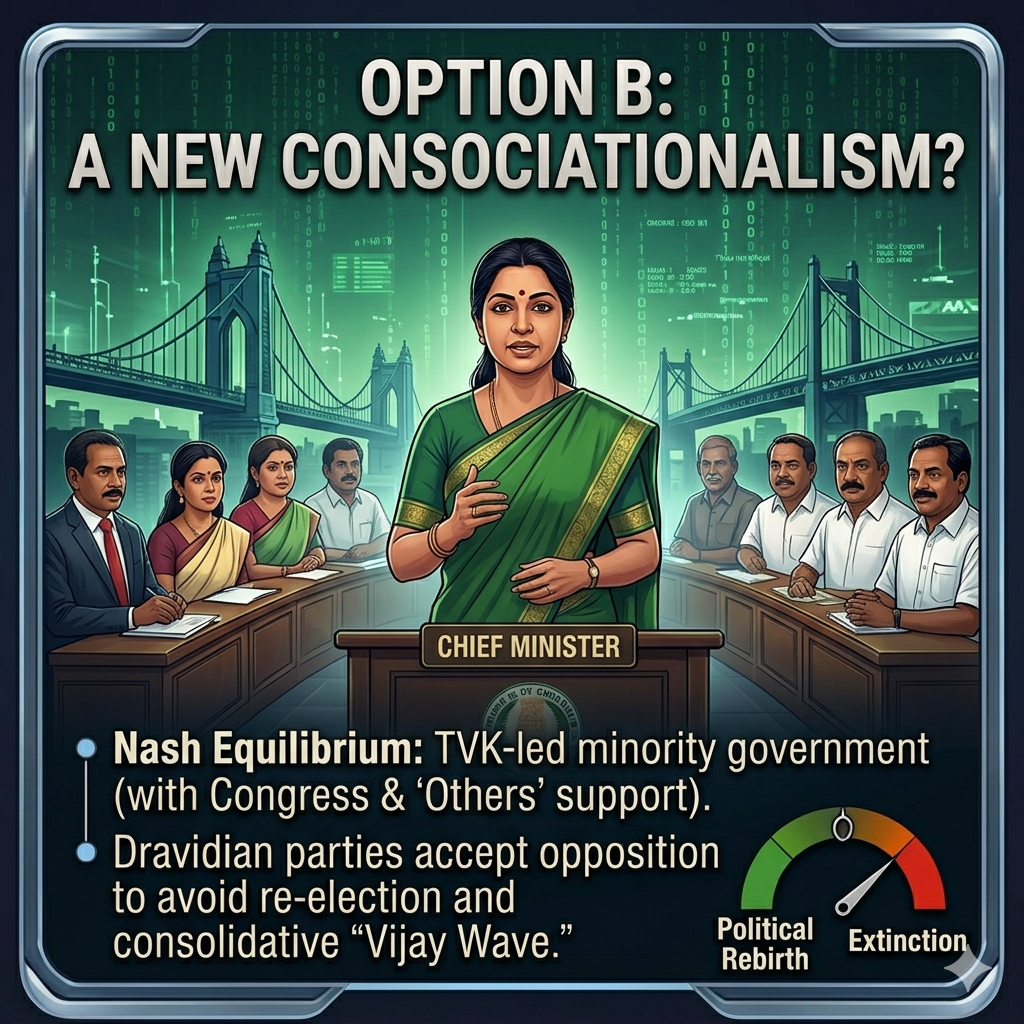
The political equivalent would be what scholars call Consociationalism — a power-sharing arrangement between rival groups who recognize that their mutual survival depends on cooperation against a common threat.
What would this look like in Tamil Nadu?
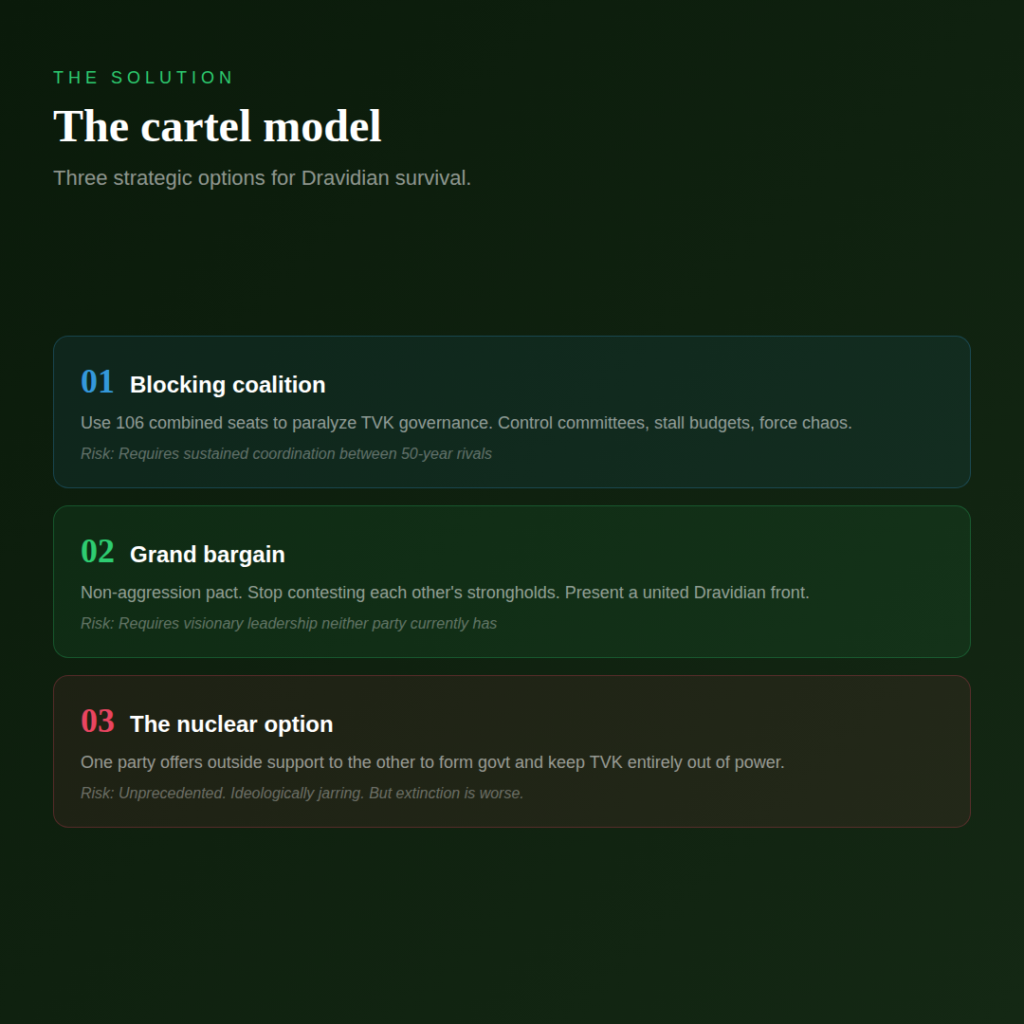
Option 1 — The Blocking Coalition: DMK and AIADMK use their combined 106 seats to deny TVK stable governance. They coordinate on floor strategy, committee assignments, and legislative resistance. The goal isn’t to govern — it’s to make Vijay’s tenure so chaotic that voters reconsider in 2031.
Option 2 — The Grand Bargain: The two parties formally or informally agree to a non-aggression pact. They stop contesting each other’s strongholds. They coordinate alliance partners. They present a “Dravidian United Front” narrative against what they frame as political adventurism.
Option 3 — The Nuclear Option: In the most dramatic scenario, one Dravidian party offers “outside support” to the other to form a government and keep TVK out entirely. A DMK-supported AIADMK government (or vice versa) would be historically unprecedented, ideologically jarring, and politically suicidal in the short term. But in a game where the alternative is extinction, short-term costs may be acceptable.
Each option has trade-offs. The blocking coalition is the most realistic but requires sustained coordination between parties that have spent 50 years trying to destroy each other. The grand bargain requires visionary leadership that neither party currently seems to have. The nuclear option would alienate voters who see the two parties as fundamentally different.
But Game Theory doesn’t ask what’s comfortable. It asks what’s rational. And the math is simple: 106 together might survive. 59 and 47 apart almost certainly won’t.
The Evolutionary Game: Adapt or Die
There’s a branch of Game Theory called Evolutionary Game Theory, originally developed to model biological competition. Its central insight is that in a changing environment, the fittest strategy isn’t the one that was optimal yesterday — it’s the one that adapts fastest to the new conditions.
The Dravidian movement has survived for seven decades because it adapted. It began as a social reform movement, became an electoral force, absorbed cinema culture, and embraced welfare economics. But each adaptation had a driver — usually a leader with the vision to see the shift before it was obvious. Annadurai saw the power of linguistic pride. Karunanidhi saw the power of television. MGR saw the power of cinema-to-politics. Jayalalithaa saw the power of welfare populism.
The question for the Dravidian parties in 2026 is whether they can see the current shift clearly enough to adapt to it. The shift isn’t just electoral. It’s generational. Tamil Nadu’s median voter is younger, more urban, less bound by caste loyalties, more influenced by social media, and more willing to vote for “new” over “known.” Vijay didn’t just win an election — he proved that the rules of the game have changed.
The parties that survive the next decade will be the ones that internalize this, not the ones that spend five years in opposition blaming the EVM or the media or each other.
The Final Calculation
Let’s return to the numbers that matter.
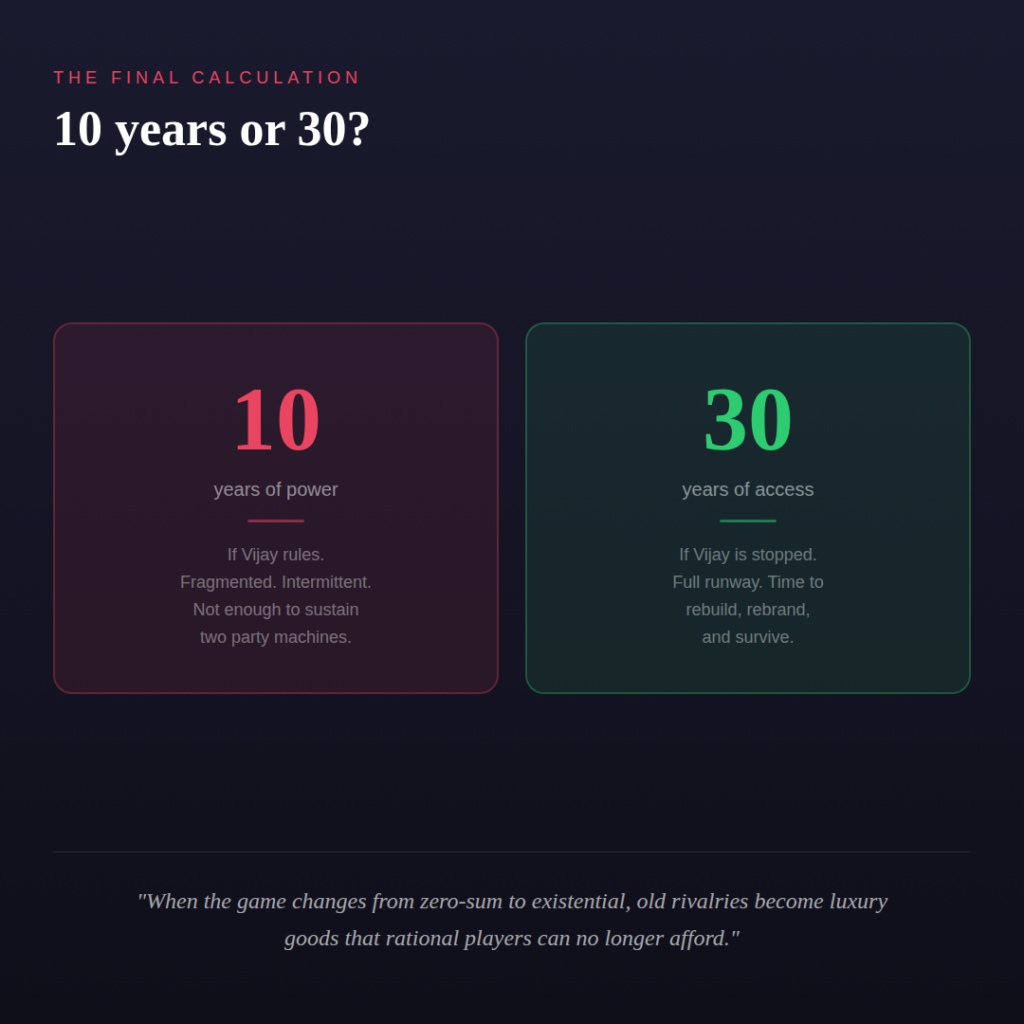
If Vijay governs for the next 30 years’ cycle (directly or through his political lineage), the historical model gives the Dravidian parties roughly 10 years of power, fragmented and intermittent. That’s not enough to sustain two separate party organizations, two separate cadre structures, two separate leadership pipelines. One of them — most likely the AIADMK — will cease to exist as a meaningful political force within a decade.
If Vijay is prevented from consolidating — through legislative obstruction, coalition denial, or a governance crisis that forces early elections — the Dravidian parties retain access to the full 30-year cycle. They have time to rebuild, rebrand, and present an alternative.
The gap between these two outcomes — 10 years versus 30 years — is the gap between life and death for these parties.
Game Theory doesn’t tell you what to feel about this. It tells you what the rational strategy is, given the payoffs. And the rational strategy, for both the DMK and the AIADMK, is cooperation. Not because they like each other. Not because they trust each other. But because the alternative is mutual extinction at the hands of a player who doesn’t need either of them.
In the language of the discipline: when the game changes from zero-sum to existential, old rivalries become luxury goods that rational players can no longer afford.
The only question left is whether the DMK and AIADMK are rational players — or whether fifty years of habit will prove stronger than the mathematics of survival.
The Dravidian movement was born in defiance of a rigged game. Whether it dies because it couldn’t stop playing an outdated one is, perhaps, the cruelest irony Tamil Nadu politics could produce.
The 2026 Deadlock: A 30-Year Survival Guide for Dravidian Giants
In the game of thrones, when a new king rises, the old rivals must become brothers, or they both become history!
Whom this blog is relevant for?
For DMK cadre & leadership: DMK Won 159 Seats in 2021. Now It Has 59. Game Theory Explains What Happens Next — And It’s Not a Comeback Story.
For AIADMK cadre & leadership: The AIADMK Has Lost Every Election Since Jayalalithaa. A Game Theory Model Shows Exactly How Many Cycles It Has Left Before Extinction.
For TVK supporters & Vijay’s camp: Vijay’s TVK Just Replicated MGR’s 1977 Playbook. Here’s Why History Says the Next 30 Years Belong to Him — Unless Two Rivals Do the Unthinkable.
For BJP strategists: BJP Won Just 1 Seat in Tamil Nadu 2026. A Game Theorist Would Tell You That’s Exactly the Plan.
For Congress: Congress Backing Vijay in Tamil Nadu Might Be Its Smartest Move in 60 Years. Here’s the Coalition Math Behind It.
For political analysts & commentators: Tamil Nadu’s First Hung Assembly Is Not an Anomaly — It’s a Phase Transition. A Game Theory Breakdown of the New Three-Player Equilibrium.
For economics & MBA students: Prisoner’s Dilemma, Nash Equilibrium, Backward Induction — All Playing Out Live in Tamil Nadu 2026. This Is the Best Game Theory Case Study You’ll Read This Year.
For media professionals & journalists: Everyone Is Covering Who Will Be CM. The Real Story Is Who Will Exist as a Party by 2036. A 30-Year Survival Analysis of Dravidian Politics.
For researchers & academics: From Duopoly to Three-Player Non-Cooperative Game: How Vijay’s TVK Broke Tamil Nadu’s 50-Year Nash Equilibrium — A Political Game Theory Framework.
For common citizens & first-time voters: You Just Voted in Tamil Nadu’s Most Important Election in 50 Years. Here’s a Simple Framework That Explains What Your Vote Actually Changed — For the Next 30 Years.
For business leaders & industrialists: Tamil Nadu’s Political Stability Was a Business Advantage for Decades. The 2026 Hung Assembly Just Ended That. What Boardrooms Need to Understand About the New Power Math.
For startup founders & investors: Policy Continuity Drives Investment. Tamil Nadu 2026 Killed Continuity. Here’s a Game Theory Map of Every Likely Government Scenario and What It Means for Your Capital.
For the strategy & consulting crowd: McKinsey Would Call It a Cartel Strategy. Political Scientists Call It Consociationalism. Whatever You Call It, It’s the Only Move That Saves the Dravidian Parties. Here’s Why.
For the social media / viral audience: 10 Years or 30? That’s the Only Question Tamil Nadu Politics Comes Down to After 2026. The Math Is Brutal.
For the history & politics nerd: MGR Got 10 Years. Jayalalithaa Got 14. If the Pattern Holds, Vijay Gets 20. A Game Theory Analysis of Why Actor-Politicians Don’t Just Win Elections in Tamil Nadu — They Colonize Decades.