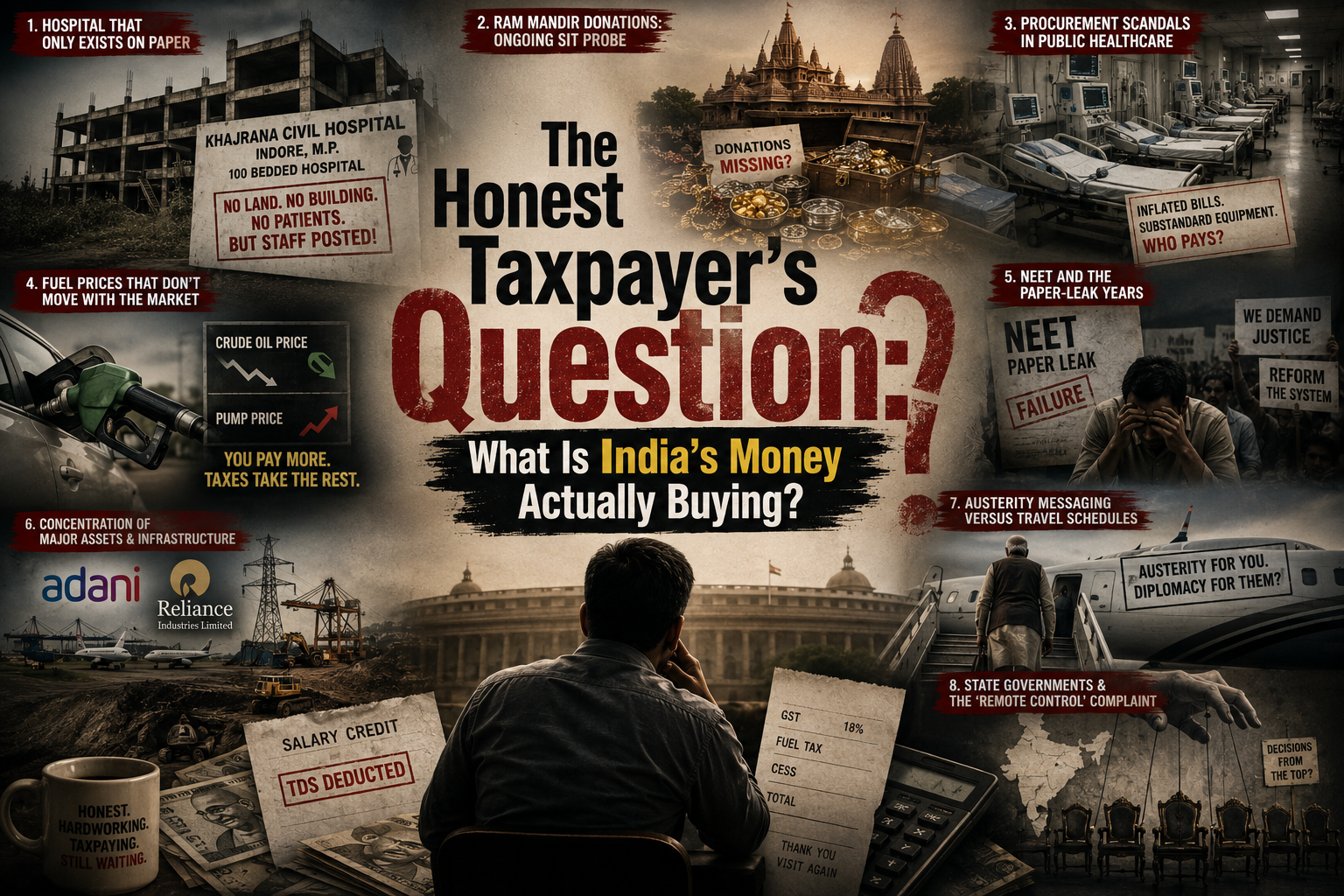
Every month, salaried Indians watch tax deducted at source before they’ve even seen their paycheck. Every fuel-up, every restaurant bill, every online purchase carries GST on top. In return, the social contract implicitly promises competent, accountable government. A string of recent stories suggests that promise is fraying — not because taxes are too high, but because of what appears to be happening to the money and the institutions after it’s collected.
This isn’t a case against any one party or leader. It’s a look at documented failures across states and levels of government, what’s actually been established versus what’s still alleged, and why so many honest, tax-compliant citizens feel like they’re funding a system that doesn’t answer to them.
1. A hospital that only exists on paper
In Indore, Madhya Pradesh, the Khajrana Civil Hospital has been sanctioned since 2020 — a planned 100-bed facility meant to serve over three lakh residents. Six years on, it has no land and no building, and has never treated a single patient. Yet it has had sanctioned staff, official postings, and transfer orders — as recently as June 2026, a lab technician was formally transferred to a hospital that doesn’t physically exist. Congress leaders have called it a scam and demanded a high-level inquiry; the state government has yet to offer a full public accounting. Whatever the final finding, the paper trail itself — postings and transfers to a nonexistent building — is the story, and it raises an obvious question: how many salaries were drawn against a hospital that was never built?
2. Ram Mandir donations: an ongoing SIT probe
In June 2026, allegations emerged that donations at the Ram Janmabhoomi temple in Ayodhya — cash, gold, and silver offered by devotees — had gone missing, with claims running into crores of rupees and suspicion that some of it dates back years. The Uttar Pradesh government formed a Special Investigation Team, several temple staff have been arrested, and police have recovered cash, US dollars, and gold and silver ornaments from the accused. Investigators are now examining whether stolen ornaments were melted down to erase identifying marks. The temple trust denies large-scale irregularities and says it is cooperating; opposition leaders have called for a Supreme Court-monitored probe. This is a live investigation, not a closed case — but the fact that a religious institution built on public devotion and public money is now the subject of a criminal probe over missing valuables is itself damning, regardless of where the final blame lands.
3. Procurement scandals in public healthcare
Delhi has seen its own healthcare procurement controversies, with allegations of inflated pricing and irregularities in equipment purchases for government hospitals — the kind of story that recurs across states with numbing regularity. The pattern is familiar: money sanctioned, equipment ostensibly bought, and then questions about whether what arrived matched what was paid for. Public procurement in healthcare is exactly the area where scrutiny should be tightest, since patients pay the price for missing or substandard equipment.
4. Fuel prices that don’t seem to move with the market
For years, the government defended ethanol blending as a policy that would eventually ease pump prices, alongside promises tied to reduced import dependence. Meanwhile, global crude prices have fallen sharply at various points without a proportionate cut in what consumers pay at the pump — a gap largely explained by excise duty structures that let the exchequer capture the difference rather than pass it through. The government’s counter-argument is that fuel taxes fund welfare spending and infrastructure, and that blending genuinely reduces the import bill over time. Both things can be true — the policy may have long-run merit, and the near-term pass-through to consumers has still been weak, which is what people actually feel at the pump.
5. NEET and the paper-leak years
The 2024 NEET-UG paper leak controversy, and the exam-integrity failures that preceded and followed it, triggered nationwide protests and were linked by families and activists to student suicides amid the stress of India’s exam culture. The Education Minister at the time faced sustained calls to resign over the National Testing Agency’s failures but did not step down, arguing that systemic reform mattered more than a resignation. Critics saw that as an accountability gap; supporters argued that ministerial resignations rarely fix underlying institutional rot. Reasonable people can disagree on the right response — but the underlying failure of exam security, at the cost of student welfare, is not in serious dispute.
6. Concentration of major infrastructure and assets
Ports, airports, power transmission, mining blocks, media assets, and cement — a striking share of large privatised and newly awarded infrastructure projects over the past decade has gone to two conglomerates, Adani Group and Reliance (Ambani). Both groups say their growth reflects competitive bidding, scale, and execution capacity that few Indian firms can match, and both have faced (and in some cases settled or contested) allegations of using political proximity to win terms — allegations they deny. The economic debate is genuine: does concentrated capital build infrastructure faster, or does it crowd out competition and leave the system more fragile if one group stumbles? Both are legitimate readings of the same data.
7. Austerity messaging versus travel schedules
Indian governments — this one included — have periodically urged restraint in official travel and ceremonial excess as a cost-consciousness signal to the bureaucracy. Critics have pointed out that this messaging sits awkwardly next to a genuinely heavy international travel schedule at the top, including multiple foreign visits in the months after austerity was invoked. The government’s response is that head-of-state diplomacy is not discretionary spending in the way departmental junkets are, and that foreign engagement serves trade and strategic interests. That’s a fair distinction — but it’s also fair for citizens to notice the optics gap between “cut back” messaging aimed downward and business-as-usual at the top.
8. State governments and the “remote control” complaint
Several BJP-ruled states have seen chief ministers replaced or reshuffled with limited public explanation, and state units have at times appeared to defer heavily to the central leadership on personnel and policy calls — Bihar’s rapid CM transition in 2026 being one recent example. Regional leaders in most large Indian parties, not just the BJP, have long complained about high-command culture overriding local mandates; it is a feature of Indian party politics more broadly, not unique to one organisation, though its intensity varies.