Gold, Grievance, and Gambles: Is Washington Gambling Away the Dollar’s Advantage?
A critical look at the numbers behind the “de-dollarization” narrative — and at the political overreach that is feeding it.
The thesis, stated plainly
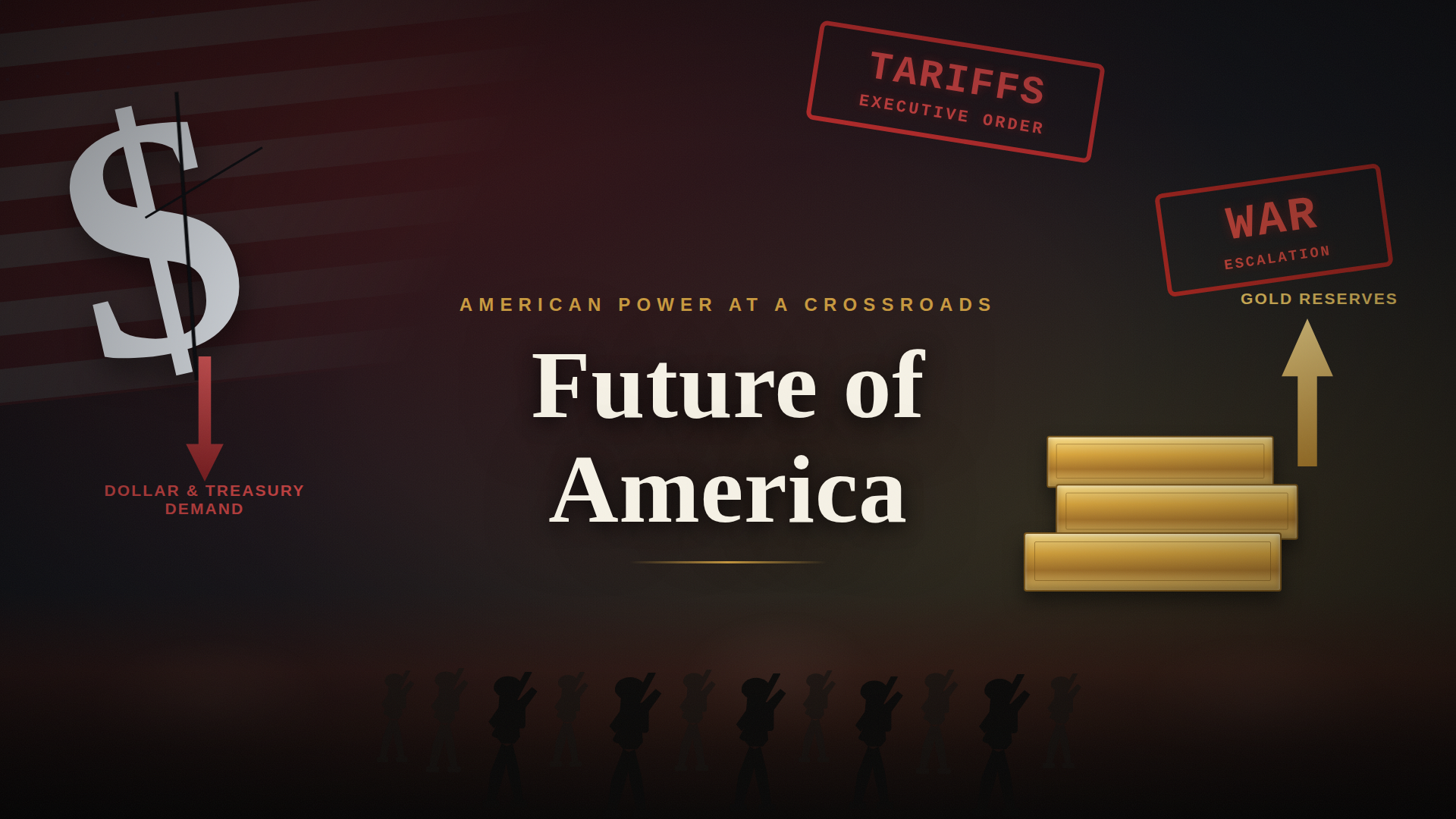
There is a real story underneath the viral social-media version of “China is dumping treasuries and buying gold.” It is less cinematic than the version that circulates in trading-app group chats, but it is genuinely unflattering to Washington: a decade-long, accelerating retreat by foreign central banks from U.S. government debt, a synchronized global move into gold, and — layered on top of it in 2025–26 — a set of self-inflicted American wounds (a trade war fought on tariffs, a military intervention in Venezuela, a war with Iran, and a president whose approval ratings are cratering at home and abroad) that make the structural trend look worse than it might otherwise. None of that means the dollar is about to collapse. But the complacent assumption that American financial dominance is permanent and cost-free is no longer obviously true, and the last twelve months have given the skeptics real ammunition.
What actually checks out
Start with the parts of the popular narrative that hold up under scrutiny.
China has been quietly exiting U.S. debt for over a decade, and the retreat has accelerated. China’s Treasury holdings have nearly halved since their 2013 peak, falling to roughly $683 billion by late 2025 — the lowest level in close to two decades. Reporting through 2026 shows the slide continuing for a third straight month as of May, with central banks broadly, not just China’s, pulling back from Treasuries following the fallout of the U.S.–Iran war and renewed currency anxiety (Bloomberg; CNBC; Global Times).
China’s gold reserves have hit a genuine record, and the buying has been sustained. The People’s Bank of China’s reserves surpassed $306 billion in value by August 2026, with industry trackers documenting close to two years of consecutive monthly additions (19 straight months as of May, extending further into the summer) (goldsilver.com; Kitco; Zambian Observer).
Hong Kong really did launch a gold-clearing system linked to Shanghai, and it really did begin trial operations in July 2026. This is one of the more concrete, underreported developments in the whole story. Hong Kong’s government confirmed the trial launch of a central gold clearing and settlement system on July 7, 2026, explicitly designed to connect with the Shanghai Gold Exchange and position Hong Kong as a bullion-trading hub to rival London (Hong Kong government press release; Bloomberg; South China Morning Post). Whatever one thinks of the endgame, this is real financial infrastructure, not a rumor.
South Korea genuinely resumed gold buying after a 13-year pause. The Bank of Korea made its first gold-linked purchase since 2013 in August 2026, a decision multiple outlets tied explicitly to reserve diversification away from a dollar-and-Treasury-heavy portfolio (Bloomberg; Korea JoongAng Daily). South Korea is not a BRICS country, not a Chinese client state, and not remotely hostile to Washington — which is precisely why this one matters more than another China gold purchase would. When a treaty ally with tens of billions parked in dollar assets quietly starts buying bullion again for the first time in over a decade, that is a signal about the asset, not about geopolitics.
Gold has, by at least one significant measure, overtaken Treasuries as the world’s most important reserve asset. The European Central Bank’s own reporting in mid-2026 found gold pulling ahead of U.S. government debt in central bank reserve composition — a genuinely historic inflection point that gold bulls have predicted for years and that, this time, actually arrived (Yahoo Finance / ECB; Mining.com; Sprott).
So far, the viral narrative is not wrong. It is describing something real: a slow, then accelerating, diversification away from the instrument that has anchored the postwar dollar system — Treasury debt — and toward the instrument that anchored the pre-1971 one: gold.
Where the popular version overreaches — and gets one big thing backwards
The Venezuela detail is where the narrative needs the most correction, and it’s worth dwelling on because it illustrates how a real, embarrassing-to-Washington story (the Treasury retreat) gets fused with an unrelated, more complicated story to produce a cleaner but false picture.
Venezuela is not “moving its reserves” as an act of monetary sovereignty. In January 2026, U.S. forces captured Nicolás Maduro in a military intervention that is still being litigated as a matter of international law — Al Jazeera reported legal experts calling the operation’s legality into serious question even as the U.S. filed charges against him (Al Jazeera; Wikipedia summary of the intervention; USNI News). In the aftermath, reporting indicates Venezuela’s roughly $4 billion, 31-tonne gold holding — long frozen at the Bank of England — is being discussed for transfer not to Caracas, but to a U.S. Treasury account, ostensibly to help fund earthquake recovery, with the transfer itself unconfirmed as a physical movement of bullion (cryptobriefing.com; Fox News on the UK freeze).
That is close to the opposite of “Venezuela is de-dollarizing.” It is a case where U.S. hard power, not Venezuelan monetary strategy, may end up routing gold toward American control rather than away from it. Folding this into a story about sovereign nations fleeing the dollar system flattens a genuinely troubling story about the use of force into a tidier narrative about currency competition. The honest version is messier and, in its own way, more damning: it suggests Washington is currently using military force in its own hemisphere at the same moment its debt is being quietly abandoned by allies — two separate crises of legitimacy, not one coherent trend.
The part that is genuinely new: America doing this to itself
Here the popular narrative undersells its own case, because it treats “China’s strategy” as the whole story when the more proximate driver in 2025–26 has been Washington’s own choices.
Trump’s tariff regime has been broadly unpopular and is showing up as a political liability rather than a strength heading into the midterms. The Washington Times, CNBC, and The Hill have all reported on tariffs and affordability becoming a “warning bell” for the White House and congressional Republicans, with grocery and consumer price increases tied directly to tariff exemptions and expirations ahead of the vote (Washington Times; CNBC; The Hill). Trump’s approval rating has fallen to a second-term low, driven substantially by trade and energy costs, according to multiple 2026 trackers (Reason; Tampa Free Press).
Internationally, Pew Research’s mid-2026 global survey found Trump receiving negative reviews abroad and fewer respondents describing the U.S. as a reliable partner — precisely the reputational cost that erodes the “safe haven” premium that has historically kept foreign money in Treasuries regardless of price (Pew Research).
And the wars matter economically, not just politically. UCLA Anderson’s forecasting group flagged an oil-price shock — flowing from the Iran war and the Venezuela intervention — as having replaced tariffs as the leading risk to the U.S. economy heading into 2026, and the Dallas Fed published research specifically modeling how the Iran war fed through into U.S. inflation (UCLA Anderson; Dallas Fed). That is the mechanism by which wars and tariffs that are supposed to be helping the economy in the short run can flip into a drag: energy volatility from the same conflicts that are supposed to be delivering supply is also what shows up in headline inflation.
Put together, this is a coherent — if damning — picture: an administration running a trade war and two overlapping military interventions simultaneously, while its bond market’s traditional foreign buyers quietly walk away and its own approval ratings sink at home and abroad. Whether or not any single foreign government is executing a deliberate “kill the dollar” strategy, Washington’s own conduct over the past eighteen months has made the dollar and Treasury system more discretionary to hold and easier to distrust than at any point in a generation. If the midterms go badly for the White House, and if a wounded, more desperate administration escalates rather than retrenches on tariffs or Venezuela, the pattern the numbers already show — slow retreat from Treasuries, faster accumulation of gold, new settlement infrastructure being built in parallel — has every reason to keep extending rather than reverse.
So — free fall?
No, not on the evidence gathered here, and it is worth being precise about why, because overclaiming is exactly how the accurate parts of this story get discredited.
The dollar still holds roughly 57% of global foreign exchange reserves — down meaningfully from 64% a decade ago, but still more than three times the euro’s share and nowhere near a level associated with a currency in crisis. The gains against the dollar have gone mostly to “nontraditional” reserve currencies (the Australian and Canadian dollars, the renminbi) rather than to gold displacing currency reserves wholesale, according to the same COFER data that the gold-triumphalist headlines draw on. China’s $306 billion in gold, however record-setting, is still a rounding error against the roughly $29 trillion U.S. Treasury market outstanding — gold “overtaking” Treasuries in one ECB reserve-composition metric is a genuine milestone, but it describes a shift in central-bank portfolio weighting, not the disappearance of Treasury demand, which remains the deepest and most liquid government bond market on Earth by a wide margin.
It is also worth remembering that China has its own reasons to be cautious about crowing over American decline. Beijing enters this period with its own serious vulnerabilities: a multi-year property crisis, persistent deflationary pressure, and a 2026 growth target set at its lowest level in decades, all of which constrain how aggressively China can actually press its advantage even as it builds gold reserves and clearing infrastructure (CNN; East Asia Forum; HL / China growth forecast). A country managing a property bust and deflation is not obviously in a position to dictate the terms of a new global financial order, whatever its gold vault says.
BRICS Pay and blockchain-based settlement alternatives, similarly, remain more aspiration than functioning system as of 2026 — announced, piloted, and genuinely under construction, but not yet processing anything close to the volume needed to threaten SWIFT or dollar clearing at scale.
The honest bottom line
The specific, checkable facts in the “China is preparing for collapse” narrative mostly hold up: the Treasury retreat is real and long-running, the gold accumulation is real and record-setting, the Hong Kong clearing system is real infrastructure, and South Korea’s return to gold buying after 13 years is a genuinely notable signal from a U.S. ally, not an adversary. Where the narrative goes wrong is in stitching those facts to a Venezuela story that actually points the other way (gold moving toward U.S. control after a U.S. military intervention, not away from it), and in skipping past the extent to which the acceleration of the last eighteen months is self-inflicted — a tariff war and two wars pursued simultaneously by an administration whose approval is falling at home and whose reliability is being downgraded abroad, arriving right as the structural, decade-long drift away from Treasuries was already underway.
That is not evidence of an imminent dollar collapse. The dollar’s scale advantages — reserve share, market depth, network effects in trade invoicing — are real and will not vanish in a news cycle, and China’s own economic troubles limit how fast it can capitalize even if it wanted to. But “not a free fall” and “cost-free” are different claims. The more defensible conclusion is the least dramatic one: Washington is spending down a decades-old advantage through policy choices — tariffs, wars, and an increasingly transactional relationship with allies and adversaries alike — faster than at any point in recent memory, and the gold and clearing-system numbers are the paper trail of other governments quietly hedging against the possibility that the discount window on American reliability has narrowed for good. Whether that trend snowballs after the midterms, as the pressure-and-desperation theory predicts, or stabilizes as it has after past dollar-doom cycles, is a genuinely open question — not a foregone conclusion in either direction.
Counterpoints worth weighing seriously
A fair reading of this evidence should also hold onto the strongest objections to the “US is in free fall” framing:
- The dollar has been declared dying many times before. Predictions of imminent dollar collapse date back to the 1970s oil shocks, the 1980s Japan panic, the 2008 financial crisis, and the 2011 U.S. credit downgrade — none of which ended dollar primacy. Base rates favor skepticism of any single cycle’s doom narrative.
- 57% of reserves in one currency, with the next-largest around 20%, is not a system near collapse. A gradual multi-decade decline from a very high base is consistent with normal diversification, not imminent abandonment.
- China’s own economic fragility limits its ability to capitalize on U.S. missteps. A country fighting deflation and a property crisis is not obviously positioned to become the anchor of a new global financial order.
- Gold “overtaking” Treasuries in one reserve-composition metric is a milestone, not a replacement. The Treasury market’s depth and liquidity have no current substitute at anywhere near its scale.
- Elections are a self-correcting mechanism the narrative discounts. If the tariff and foreign-policy backlash showing up in Trump’s approval numbers translates into a changed Congress or administration after the midterms, the policy drivers of the acceleration described above could reverse rather than compound.
The strongest version of this article’s argument is not “the dollar is collapsing” — it’s that policy choices, not inevitability, are doing the damage, which also means policy choices could undo it.