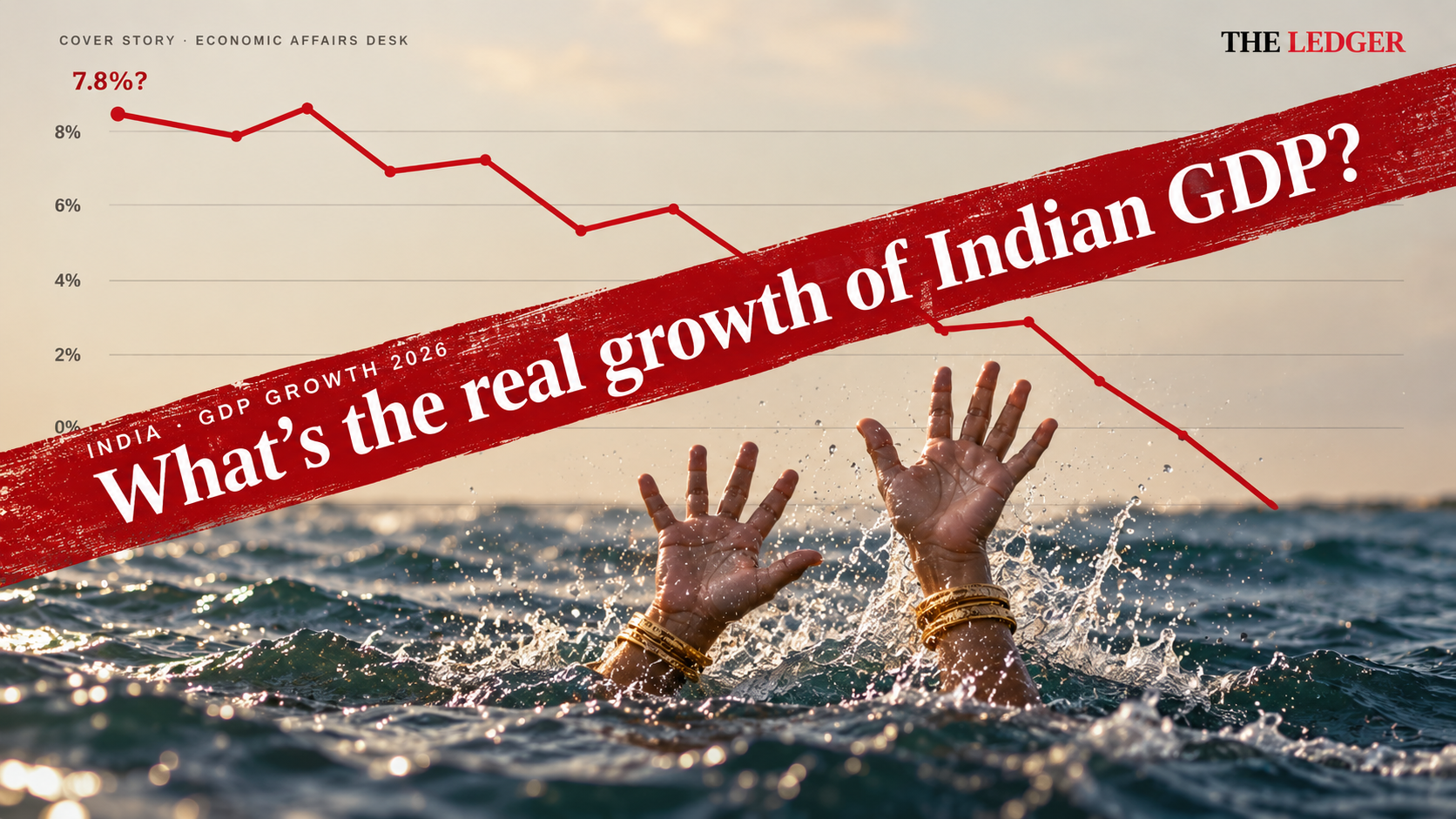
Three Numbers, One Economy: What India’s 7.8% GDP Growth Is Actually Hiding
Pick a growth rate, and you can tell three completely different stories about the Indian economy in 2026. The trouble is, all three come from the same set of books — which is precisely the problem.
On August 29, the Ministry of Statistics and Programme Implementation (MoSPI) announced that India’s real GDP grew 7.8% in the April–June quarter of FY27, making India, once again, the “fastest-growing major economy in the world.” The press releases wrote themselves. Then Subhash Chandra Garg — a former Union Finance Secretary, not a stray critic but a man who has sat inside the machine that produces these numbers — said the real figure was closer to 2.6%. And if you strip out what inflation actually did to ordinary households rather than what the GDP deflator says it did, the growth that Indians felt in their wallets this year rounds down to somewhere near nothing at all.
This is not a fringe conspiracy theory. It is a live, documented dispute among India’s own statisticians, a former finance secretary, the opposition, and — quietly — the IMF. It deserves to be treated as one.
The number the government wants you to see
MoSPI’s headline claim rests on comparing this quarter’s output to the same quarter last year, valued at constant prices. Sounds unimpeachable. Except last year’s base wasn’t left alone. When India shifted its GDP base year from 2011-12 to 2022-23 earlier this year, the nominal GDP figure for April–June 2025 — the denominator against which “growth” is measured — was revised down from roughly INR 86 lakh crore to about INR 80 lakh crore. Shrink the base, and the same absolute output automatically produces a bigger growth percentage. That is not economic dynamism. That is arithmetic.
Shrink the base, and the same absolute output automatically produces a bigger growth percentage. That is not economic dynamism. That is arithmetic.
MoSPI Secretary Saurabh Garg has defended the revision as routine, the kind of five-to-seven-year methodological refresh every statistical agency does, fully disclosed back in February. He points to double-digit growth in cement, steel and automobile production as independent proof the economy really is moving. Those are fair points, and they deserve to be on the record. But “the base revision was disclosed” and “the base revision conveniently flattered this quarter’s headline number” are not mutually exclusive facts. Both are true. The government would like you to notice only the first.
The deflator that inflation forgot
Here is the part that should worry anyone who actually reads national accounts rather than press summaries. Real GDP growth is nominal growth minus the GDP deflator — the government’s own measure of economy-wide inflation. For this quarter, MoSPI put that deflator at roughly 2.3–2.5%. Meanwhile, wholesale prices (WPI) were running at about 9.3% year-on-year, and even the more moderate consumer price index (CPI) was at 3.9%. Fuel and power inflation alone hit 27%.
A deflator that runs at half the pace of the low inflation number and a quarter the pace of wholesale inflation is not a footnote — it’s the entire ballgame, because a lower deflator is mathematically identical to higher “real” growth. Independent economic analysis of the release has pointed to the culprit: a “double-deflation” methodology in manufacturing that deflates output prices and input prices separately. When crude oil and other input costs spiked far faster than what factories could charge for their output, this method spat out a negative deflator for manufacturing — officially implying prices fell — even though everyone actually paying those input bills watched their margins get crushed. Feed a negative deflator into a growth calculation and you don’t get a more accurate picture of the economy; you get margin compression laundered into phantom volume growth.
Recalculated using Real Gross Domestic Income — which accounts for the roughly INR 1.8 lakh crore “trading loss” India suffered as import costs (crude, above all) outran export earnings — independent estimates put real income growth for the quarter at 3.2% to 3.6%. That is not 7.8%. It is barely half of it, and it sits uncomfortably close to the 2.6% figure Garg was mocked for suggesting.
What “0%” actually means
The opposition’s harder-edged claim — that real growth is closer to zero — doesn’t survive as a literal GDP statistic; even the harshest independent recalculations land in the 3% range, not zero. But the “0%” framing captures something the GDP print genuinely obscures: growth that ordinary Indians cannot feel. Real wage growth in 2025 hovered around 0–0.5%. Nearly one in five workers reportedly received no wage increase at all. Household debt has climbed to 41% of GDP as families borrowed or sold gold to cover ordinary expenses, even as headline inflation looked tame — tame, critics argue, precisely because weak consumer demand was suppressing prices, which is a symptom of a sick economy, not a healthy one. Over 80 crore Indians remain on free food rations nearly six years after the pandemic that supposedly justified the scheme. That is not the profile of a country growing at 7.8%. It is the profile of a country where the aggregate number and the lived number have come apart.
The Congress party’s broader indictment — that manufacturing GVA claimed 8.4% growth while the Index of Eight Core Industries showed only 2.9%, and that the IMF’s own evaluation of India’s national accounts data reportedly gave it a “C” grade — adds to a pattern rather than settling the argument on its own. Individually, each discrepancy has a technical explanation on offer from MoSPI. Collectively, the pattern is that nearly every discrepancy, revision and methodological choice over the past year has pointed in the same convenient direction: up.
The defense deserves a hearing — and it isn’t enough
To be fair to MoSPI: comparing GDP deflators to CPI or WPI directly is methodologically sloppy, since the deflator covers a completely different and much broader basket of goods and services than either consumer or wholesale indices. Base-year revisions are standard international practice, and India was arguably overdue for one. Physical output indicators — cars sold, steel poured, cement mixed — are real, and they are not the kind of thing a statistician can fake in a spreadsheet.
But transparency is not the same as trustworthiness, and “our methodology has technical justifications” is not an adequate answer to “your methodology has, four times in a row, revised growth upward, never down, and always in a direction that flatters the ruling government going into election cycles.” A statistical agency’s credibility rests on being boring and consistent, not on repeatedly producing numbers so good they need a press conference and a fact-check thread to defend.
The verdict
India’s economy may well be growing. Auto sales and cement output suggest it is. But “growing” and “growing at 7.8%, the fastest of any major economy on earth” are two very different claims, and the government has an obvious interest in insisting on the second when the honest number is closer to the first. When the people who built these statistical systems — not activists, not opposition politicians, but former finance secretaries — are the ones raising the alarm, dismissing the concern as partisan noise is itself a form of data management.