Shall We Deploy AI Doctors? Rethinking Rural Healthcare in India
Yes, India should deploy AI doctors, but as doctor-assistants that screen, record and refer, never as a replacement for a licensed physician. That one design choice keeps most of the benefit and avoids most of the ethical and legal risk.
The impossible arithmetic of rural care
India is home to roughly 1.4 to 1.5 billion people, about 150 crore. Around two-thirds of them live in more than six lakh villages, many hours from a hospital and far from a specialist.
No amount of hiring closes that gap on its own. A rural doctor who sees 80 to 100 patients a day has a few minutes for each one. Most of those minutes go to fever, cough, diarrhoea and other common, treatable complaints, which leaves little time for the one patient whose quiet symptom is the first sign of cancer, a failing kidney or a stroke waiting to happen.
So the honest question is not whether AI is as good as a doctor. It is whether a patient in a remote village is better off with an AI-assisted first check than with no timely check at all.
Why people die early: awareness, detection and money
Most premature deaths in rural India come from three gaps, and all three are gaps in time. The patient does not know a symptom matters, nobody catches the disease early, and by the time they reach a hospital the treatment is expensive.
- Lack of awareness. A lump, a cough that lasts a month or a wound that does not heal is easy to ignore when daily wages are at stake.
- Late detection. The Health Dynamics of India 2022-23 report found that rural Community Health Centres had only 4,413 of the 21,964 specialists they need, a shortfall of about 80%. In Madhya Pradesh the gap was 94%.
- Lack of money. Families still pay about 39% of India’s total health spending out of their own pockets, down from 64% in 2013-14 (National Health Accounts). A cancer caught at stage 1 is cheaper to treat and far more survivable than one caught at stage 4.
Early detection fixes all three at once. It turns a crisis into a manageable case, and a ruinous bill into an affordable one.
What AI is already doing in healthcare
AI is no longer a promise in medicine; it is already catching disease earlier and cutting research time from years to months.
- Faster research. Work that once took five years to decades, such as working out the shape of a protein or screening millions of drug candidates, can now be done in weeks. AI reads data sets far larger than any human team could, which speeds the search for cures to deadly diseases.
- Earlier cancer detection. In Sweden’s MASAI trial of more than 105,000 women, AI-supported mammography screening found 29% more breast cancers than standard double reading, with no rise in false alarms. It also cut radiologists’ reading workload by 44%.
- Screening at scale. AI tools already read chest X-rays for tuberculosis, check retina photos for diabetic eye disease and flag abnormal ECGs, often in places where no specialist is present.
The pattern matters for India. In each case AI does the repetitive first look, and a human expert spends time only where the AI raises a flag.
The model: an AI doctor-assistant in every village
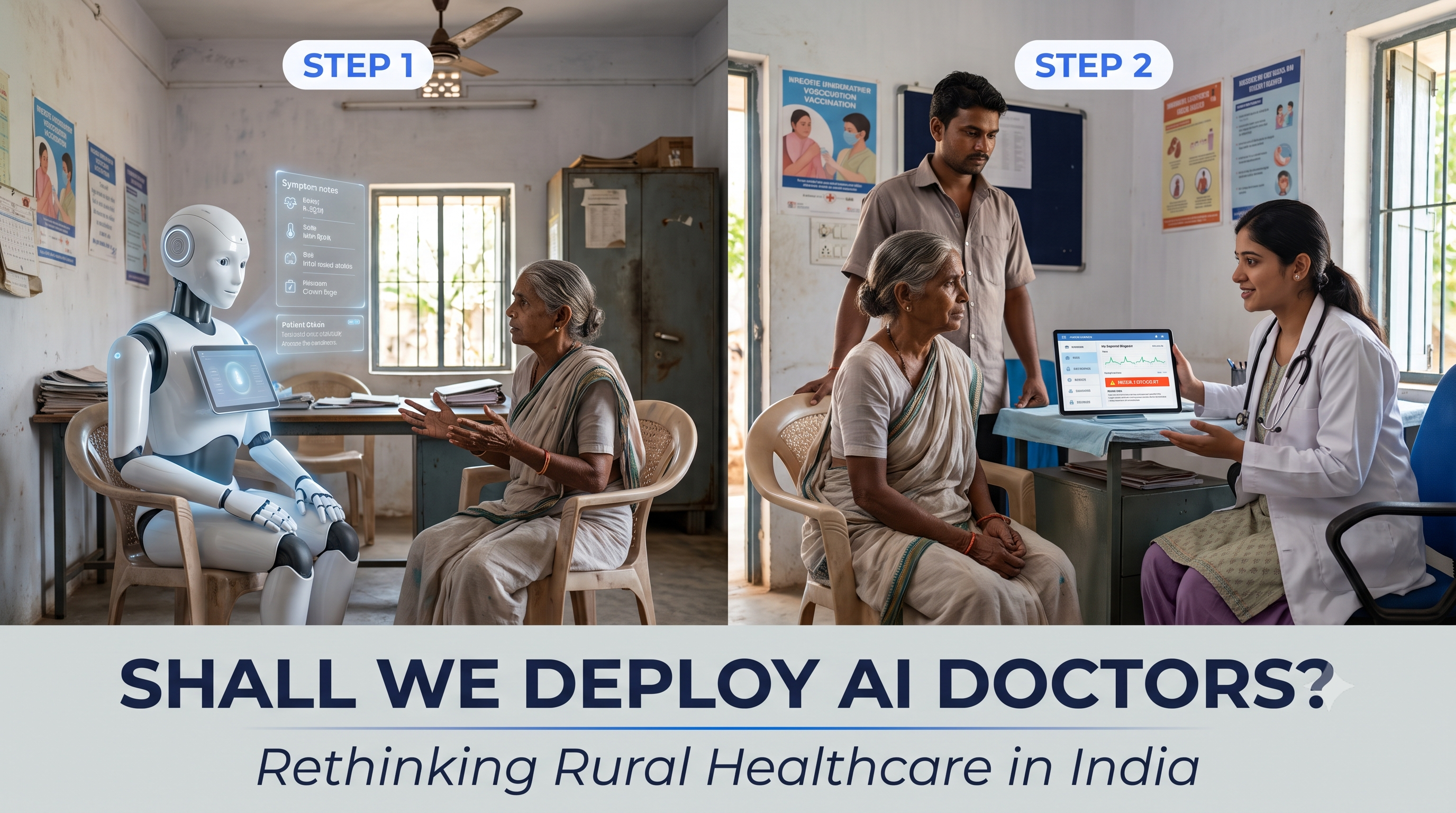
The proposal is an AI assistant, on a tablet, kiosk or simple robot at the village health post, that does the first conversation so the doctor can spend time where it matters most.
How it would work, step by step:
- Listen and record. The AI talks to the patient in their own language, such as Odia, Hindi or Bengali, and records symptoms, history, temperature, blood pressure, oxygen and, where available, photos or simple scans.
- Sort by urgency. Most village cases are waterborne or airborne infections, fever and cold. The AI separates these from cases that need a closer look.
- Flag the dangerous few. If the pattern suggests a tumour, cancer, heart trouble or another life-threatening disease, the AI immediately refers the patient for tests at the nearest Community Health Centre or district hospital.
- Hand over to the doctor. Every case reaches a licensed doctor, in person or by teleconsultation, with a ready summary. The doctor no longer starts from zero, so one doctor can safely see far more patients.
The AI never prescribes or diagnoses on its own. It is a tireless assistant that never skips a question, and the doctor remains the decision-maker.
How big could the impact be?
The impact scales with India’s size: even a small gain per patient, multiplied across hundreds of millions of rural visits a year, means lakhs of earlier diagnoses. India also does not need to build from scratch. It already has Ayushman Arogya Mandirs (health and wellness centres) at the village level and the eSanjeevani teleconsultation network to plug an AI assistant into.
What changes at a village health post (an illustration, not measured results):
| What changes | Without AI assistant | With AI assistant |
|---|---|---|
| Doctor’s time per routine case | History, vitals and notes taken from scratch | Reviews a ready summary and confirms |
| Patients one doctor can safely see | Limited by minutes per patient | Noticeably more, because intake is done |
| A suspicious lump or chronic cough | Often missed or delayed for months | Flagged on the first visit and sent for tests |
| Health worker skills | Depend on individual training | Every visit follows the same full checklist |
| Data for planning | Paper registers, slow reporting | Real-time signals of outbreaks, such as a cluster of diarrhoea cases |
The biggest gains are in three areas:
- Cancers that are curable when caught early, such as breast, oral and cervical cancer.
- Silent chronic diseases, such as diabetes, high blood pressure and kidney disease, which cause strokes and organ failure when left untreated.
- Infectious diseases, such as tuberculosis, where early detection also stops spread to the whole village.
Every early diagnosis also protects a family from the debt that late-stage treatment brings.
The ethical questions we must answer first
The ethical risks are real, but each one has a known safeguard, and none is a reason to leave villages with no first check at all.
- Accuracy and bias. An AI trained mostly on urban or foreign patients may misread rural Indian bodies, skin tones and disease patterns. Models must be trained and tested on Indian data, across states, ages and genders.
- Missed cases. A false “all clear” is the most dangerous error. The system should be tuned to over-refer rather than under-refer, and every case should still reach a doctor.
- Consent and dignity. Many patients have little formal education. Consent must be explained in their own language, and they must always be able to ask for a human.
- Privacy. Health data is deeply personal. It must be stored securely, used only for care and never sold to insurers or advertisers.
- Trust and over-reliance. Doctors may start accepting AI suggestions without thinking. Training and regular audits keep the doctor’s judgment in charge.
- A two-tier system. AI must not become the excuse for “robots for the poor, doctors for the rich”. It should add to rural care, not replace the hiring of doctors.
The ICMR’s 2023 ethical guidelines for AI in healthcare already set out these principles, including human oversight, accountability, data privacy, fairness and patient autonomy.
What Indian law allows today
Under current Indian rules, an AI cannot legally be “the doctor”, but it can be the doctor’s assistant. That is exactly the model proposed here.
| Law or rule | What it means for an AI doctor-assistant |
|---|---|
| National Medical Commission Act, 2019 | Only a registered medical practitioner may practise medicine, so diagnosis and prescription stay with a human doctor. |
| Telemedicine Practice Guidelines, 2020 | AI tools may support a doctor, but may not counsel patients or prescribe medicines on their own. |
| Medical Devices Rules, 2017 (CDSCO) | Software used for diagnosis or screening counts as a medical device and needs approval and quality checks. |
| Digital Personal Data Protection Act, 2023 | Patient data needs clear consent, secure storage and limits on how it is used and shared. |
| Consumer Protection Act, 2019 | Patients can claim compensation for negligent medical service, so liability must be clearly assigned. |
The biggest open question is liability. If the AI misses a cancer, who is responsible: the doctor, the hospital, the government programme or the software company? India needs clear rules that share responsibility, require insurance and keep a full record of every AI suggestion so mistakes can be traced and fixed.
This section is a general overview, not legal advice.
Weighing the risk against lives saved
The fair comparison is not AI versus a perfect doctor; it is AI-assisted care versus the delayed or missing care most villages get today. Seen that way, the risk of an imperfect AI is smaller than the risk of doing nothing.
To keep that balance, any rollout should follow a few non-negotiable safeguards:
- Doctor in the loop, always. The AI screens, records and refers; a licensed doctor confirms every diagnosis and prescription.
- Over-refer by design. When in doubt, the AI sends the patient for tests. A wasted test is cheaper than a missed cancer.
- Pilot before scale. Start in a few districts, measure early-detection rates and errors, publish the results, then expand.
- Indian data, independent audits. Test the AI on Indian patients from every region, and have outside experts audit it every year.
- Local language and a human option. Patients speak in their own language and can always ask for a human.
- Clear liability and data rules. Decide in advance who is responsible for errors, and keep patient data private and on Indian servers.
- Invest in people too. Use AI to support ASHA workers, nurses and doctors, alongside continued hiring of specialists, not instead of it.
So, shall we deploy AI doctors?
Yes, as AI doctor-assistants, starting now with careful pilots. With about 80% of specialist posts empty at rural health centres, waiting for enough human doctors means accepting years more of late diagnoses and avoidable deaths.
An AI that listens to every patient, misses no question, flags the dangerous few and hands a clean summary to a human doctor does not replace medicine. It stretches our scarce doctors across lakhs of villages. The ethical and legal concerns are serious, but they are reasons to deploy AI carefully, not reasons to leave rural India waiting.