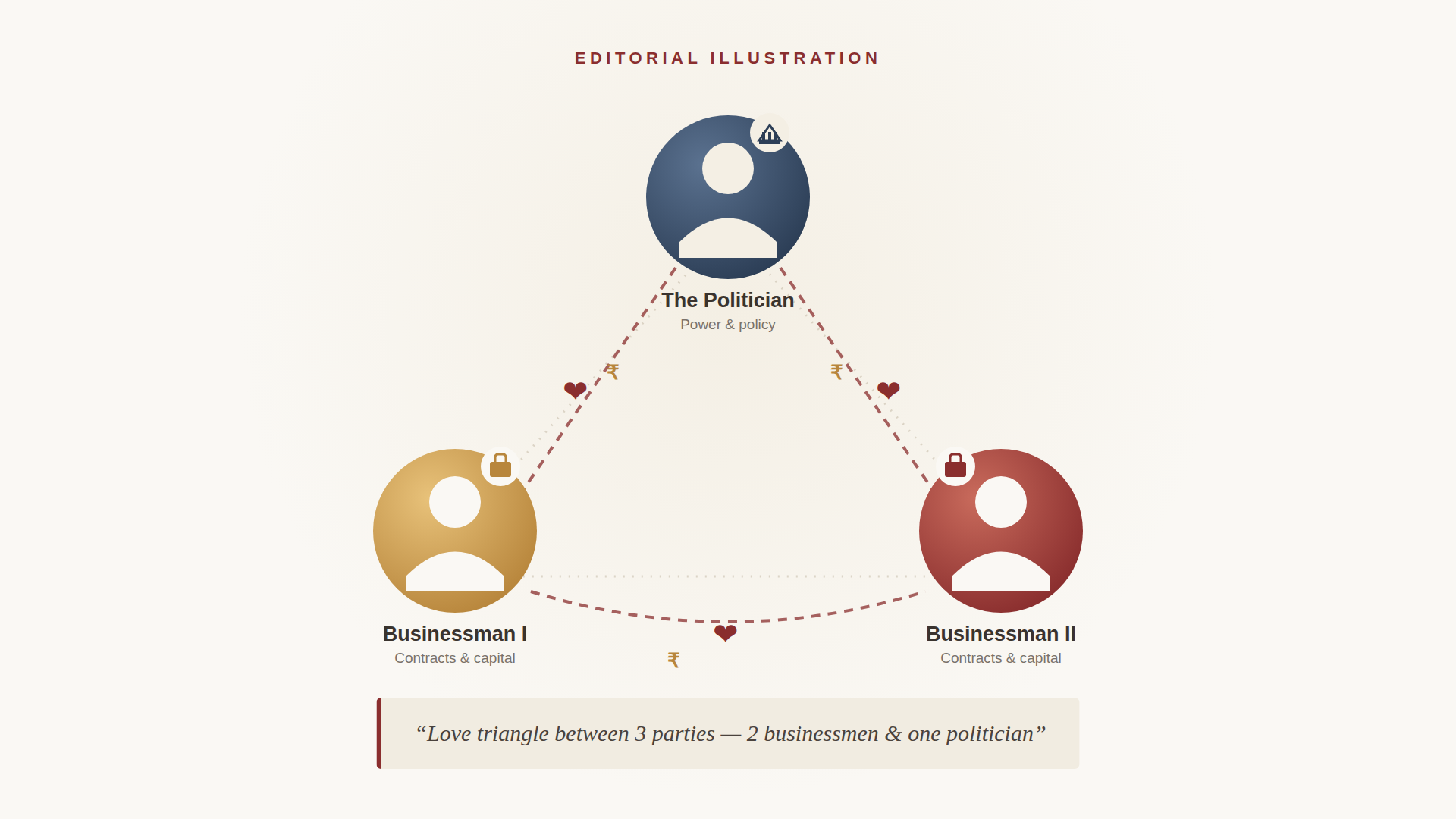
The Silent Merger: How Two Conglomerates and One Government Became Indistinguishable
No individuals, companies, or parties are named here. The pattern in the public record speaks for itself.
There is a story India’s institutions tell about themselves: an independent judiciary, an autonomous central bank, a competition watchdog that polices monopoly, and a Parliament that holds the executive to account. And there is a second story, told increasingly by economists, opposition leaders, and India’s own regulatory filings — of a country where two business conglomerates have grown so large, and so entangled with the ruling establishment, that the line between public policy and private favor has become difficult to find.
This piece names no one. It doesn’t need to. Anyone who has watched an airport, a port, a coal block, a grain-storage contract, a spectrum auction, or a media acquisition change hands in India over the last decade already knows which two business houses keep appearing on the winning side.
When “the market” only has one bidder
Over the past several years, a pattern has repeated across sector after sector: airports, seaports, power transmission, cement, edible oil, media, and financial services have all seen extraordinary concentration in the hands of a small number of conglomerates. Independent competition scholars have questioned whether India’s antitrust regulator, the Competition Commission of India (CCI), has kept pace. Opposition politicians have gone further, accusing the CCI of “remaining passive” while dominant positions were built in sector after sector.
The CCI’s own record supplies ammunition to both sides of that argument. In cases involving one of the two conglomerates’ dominance in power generation, and in a solar-tender bid-rigging complaint referred to it, the CCI closed its investigations and issued clean chits, finding no evidence of anti-competitive conduct. Critics call this regulatory capture; the regulator calls it due process. What is harder to dispute is the underlying trend: as recently as this year, reporting has documented that an anti-monopoly clause was quietly dropped from a major government grain-storage tender — clearing the way for one conglomerate’s footprint to expand further into a state-run food security program worth thousands of crores. Whether that is coincidence, competence, or capture is exactly the question India’s watchdogs are supposed to settle in public, and mostly haven’t.
Loans that vanish, borrowers who don’t
Government data placed before Parliament shows that Indian banks — most of them public-sector, meaning taxpayer-backed — have written off roughly INR 10.6 lakh crore in loans over a recent five-year period, and closer to INR 19 lakh crore over eleven years, with officials confirming that a large share of the corporate portion is linked to large corporates rather than small borrowers. Separately, RBI disclosures show thousands of “wilful defaulters” — borrowers found to have the capacity to repay but chose not to — collectively owing well over INR 1.7 lakh crore to public banks. The RBI has at various points resisted disclosing the identities behind the largest write-offs even to Parliament, citing confidentiality provisions, which is precisely what allows the pattern to persist without individual accountability. A “write-off” is not automatically a “forgiveness” — banks can and do pursue write-off accounts — but campaigners note that recovery rates on these accounts have historically been a small fraction of the amount owed, and that the largest, most politically connected defaulters are the least likely to face the asset seizures or personal liability that smaller borrowers routinely face.
The funding that flowed one way
For six years, India ran a political financing instrument — electoral bonds — that let individuals and companies donate to political parties anonymously, with only the State Bank of India able to identify buyers. When India’s Supreme Court finally forced disclosure in early 2024, ruling the scheme unconstitutional precisely because its opacity was “unguided” and violated citizens’ right to information, the released data showed the ruling party at the centre had received by far the largest share of the roughly INR 16,000+ crore in bonds encashed since 2018 — reportedly closer to half of the total, dwarfing every opposition party combined. Several donors had business before the very ministries and agencies that regulate them, including companies that had faced raids or investigations shortly before donating and saw those investigations quietly recede afterward — a pattern investigative journalists labelled “extortion-to-donation” or “donation-for-relief,” even as the government and donor companies denied any quid pro quo.
Why this adds up to more than bad optics
No single data point above proves criminal intent by any individual or company — and it would be irresponsible to claim otherwise without naming names and presenting evidence a court could test, which is not the purpose of this piece. But taken together — a competition regulator that repeatedly clears the same handful of dominant players; a banking system that writes off enormous sums linked to large corporates while shielding their identities from Parliament; and a political financing system that funnelled the largest, least transparent share of money to the party in power from firms with regulatory business pending — the pattern is no longer subtle. It describes an economy where the state’s discretionary powers (contracts, licenses, loan recovery, investigative attention) have become a resource that flows disproportionately toward a small number of politically proximate firms, and where political power is, in turn, substantially bankrolled by that same small number of firms.
That two individuals connected to these conglomerates now regularly appear among the handful of richest people on earth on the Forbes billionaires list is not, by itself, evidence of wrongdoing — plenty of legitimate entrepreneurship has made fortunes at that scale. But it does mean the stakes of getting the accountability question right are no longer a niche economic-policy concern. When wealth concentration of that magnitude coincides with regulatory bodies clearing the same names again and again, with write-offs the public can’t trace, and with campaign finance flowing one direction, “crony capitalism” stops being a slogan and starts being a description of how the economy actually allocates its resources.
The other side of the argument
In fairness, the government and the companies involved have consistently denied any preferential treatment, and each has a rebuttal available: the CCI’s clearances were reasoned, published decisions, not favors; large-scale infrastructure inevitably favors large, well-capitalised firms capable of executing it; loan write-offs are an accounting mechanism, not forgiveness, and banks continue pursuing recoveries; and electoral bonds, whatever their flaws, replaced an even more opaque cash-donation system that every party used previously. Supporters of the current approach argue these conglomerates have built ports, power grids, telecom networks, and retail infrastructure at a scale India badly needed, and that vilifying scale itself risks discouraging the investment the country needs to grow. Reasonable people, including serious economists, disagree about how much of this is normal industrial policy in a developing economy and how much is capture. What almost no one disputes is that the underlying data — on write-offs, on regulatory outcomes, and on political financing — should be fully public and independently auditable, so that citizens rather than the institutions being questioned get to decide which story is true.