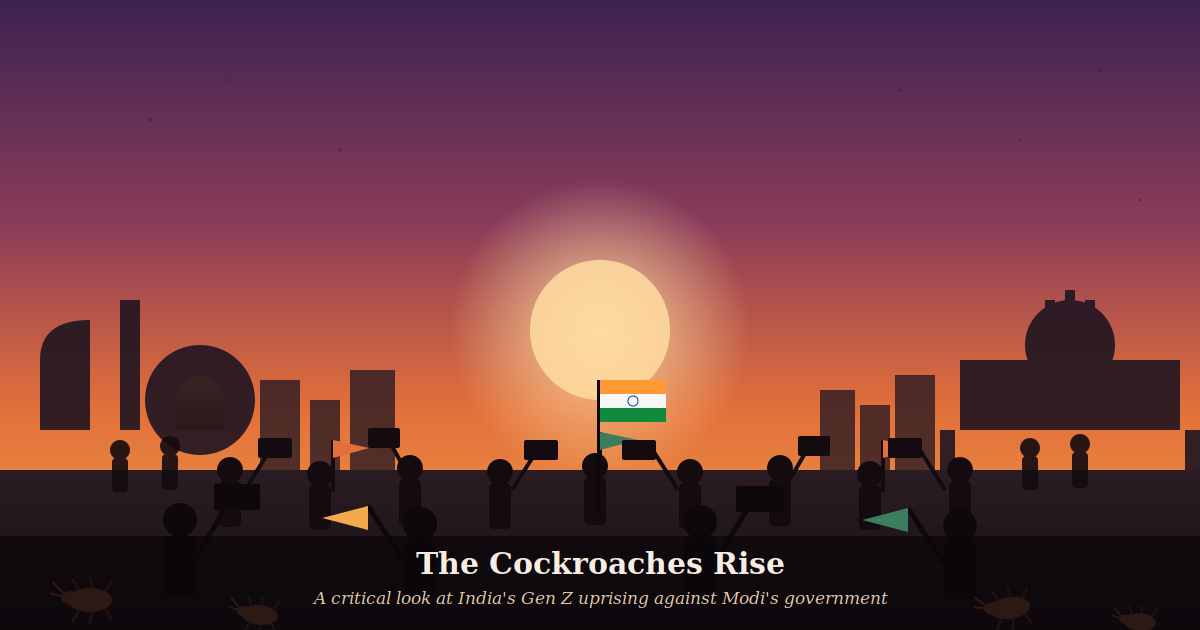
The Cockroaches Rise: A Critical Look at India’s Gen Z Uprising Against Modi’s Government
How a Supreme Court insult turned into the biggest street challenge to Narendra Modi in twelve years
Introduction
In the summer of 2026, a strange word began appearing on placards, hashtags, Instagram reels, and finally on the streets of New Delhi: cockroach. What started as a bitter joke aimed at India’s unemployed youth turned, within weeks, into a nationwide protest movement — the Cockroach Janta Party (CJP) — that forced the resignation of a sitting Union minister, triggered accusations of police brutality including the use of pellet guns on unarmed students, and became, by most independent assessments, the most serious political challenge Prime Minister Narendra Modi has faced since he came to power in 2014.
This article attempts to lay out, critically and in detail, how the movement got its unusual name, what it actually demanded, who built and led it, why India’s Gen Z became its backbone, how the government’s response evolved from contempt to negotiation, which minister was forced out, how BJP leaders sought to delegitimise the protest by branding it “anti-national,” what role the police and paramilitary forces played, and why — regardless of one’s politics — this moment deserves to be understood as a significant one in India’s democratic history.
Where Did the Name Come From? The Insult That Became an Identity
The origins of the Cockroach Janta Party lie not in a political manifesto but in a single, dismissive remark. In May 2026, India’s Chief Justice, Surya Kant, was presiding over an unrelated court hearing when he made a comparison that likened some unemployed young people to “cockroaches” and “parasites.” The comment, seemingly an offhand aside, was clipped, shared, and amplified across social media within hours — arriving at a moment when India’s youth were already simmering with frustration over joblessness, the rising cost of living, and a string of scandals in the country’s high-stakes competitive examination system.
Rather than simply expressing outrage, a 30-year-old Indian graduate student in the United States, Abhijeet Dipke — who holds a master’s degree in public relations from Boston University — turned the insult on its head. He posted a short, almost throwaway question on X: “What if all cockroaches came together?” The post detonated. Within days, Dipke had built a website and social media accounts for what he called the “Cockroach Janta Party,” a name that does double duty: it reclaims the Chief Justice’s slur as a badge of resilience (cockroaches, after all, are famous for being nearly indestructible and impossible to eradicate), while simultaneously mocking the name of India’s ruling party, the Bharatiya Janata Party (BJP) — “Janata” meaning “people’s,” so “Cockroach Janta Party” reads as a deliberate, satirical mirror of “Bharatiya Janata Party.”
The symbolism was not subtle, and it was not meant to be. It suggested that India’s unemployed and aggrieved youth — dismissed as an irritant by the establishment — were, like cockroaches, both looked down upon and impossible to stamp out. When the government later moved to suspend the party’s social media accounts, citing national security concerns, Dipke simply opened a new account under the message: “Cockroaches don’t die.”
Within days of its founding, the movement had signed up over 350,000 members and amassed more than 20 million followers on Instagram — a following that within weeks would grow past 25 million, reportedly larger than the BJP’s own official social media presence. Offline, the “cockroach” branding spilled into the streets: volunteers appeared at protests and clean-up drives dressed in cockroach costumes, an image that was equal parts absurdist comedy and pointed political theatre.
From Satire to a Serious National Movement: What Actually Happened
What transformed an ironic social media joke into a mass movement was a real and painful scandal: the leak of the National Eligibility cum Entrance Test (NEET), India’s fiercely competitive medical college entrance examination. More than two million students sat for NEET in early May 2026, competing for fewer than 130,000 seats. Investigations found evidence that some parents had paid enormous sums — reportedly amounting to roughly a million rupees in some cases — to secure advance access to papers for their children. The exam was ultimately cancelled and a retake ordered, but the damage to public trust, and to the students who had spent years and family savings preparing, was already done.
According to the CJP, at least a dozen — by some accounts as many as 21 — students died by suicide in the aftermath, unable to cope with the prospect of resitting an exam whose integrity had already been compromised, or with the financial and emotional toll the ordeal had taken on their families. Whatever the precise figure, the deaths became the emotional core of the protest, transforming what might have remained an abstract complaint about “systemic corruption” into a movement with named victims and grieving families.
This was not, in truth, a new scandal. Opposition parties, including the Congress, had been raising the alarm over examination irregularities for years, alleging more than 150 paper leaks across various government-run competitive exams since 2014. Union Education Minister Dharmendra Pradhan had repeatedly denied systemic failure, insisting in Parliament that anomalies were confined to isolated incidents — a single Patna examination centre, in his telling — and that no credible evidence of a wider paper leak existed in the preceding seven years. It was precisely this repeated, technocratic denial in the face of visible, painful evidence that gave the CJP its central grievance and its central demand: the resignation of the education minister.
Timeline of the Protest
- May 2026: Chief Justice Surya Kant’s “cockroach” remark; Dipke’s viral post; the Cockroach Janta Party is founded as a satirical online campaign.
- June 6, 2026: Protesters, led by CJP organizers, begin an open-ended sit-in at Jantar Mantar in New Delhi, one of the few sites in the capital where the government permits mass demonstrations.
- June 20: A second, larger Delhi protest, now drawing support from left-leaning student organizations and, later, farmer unions — signalling the movement’s spread beyond its original social-media base.
- June 28: Educationist and climate activist Sonam Wangchuk announces an indefinite hunger strike from the CJP stage, dramatically raising the stakes and the movement’s visibility.
- Mid-July: Wangchuk’s health visibly deteriorates; by some accounts he loses over 18 pounds (more than nine kilograms) across roughly three weeks without food. Protesters report internet shutdowns around the protest site.
- July 18–19: Dipke himself begins a hunger strike. Plain-clothes police reportedly enter the protest site, forcibly remove Wangchuk (citing his declining health), and dismantle the CJP’s stage and tents.
- July 20 (“Sansad Chalo,” or “March to Parliament”): Tens of thousands of protesters attempt to march on India’s Parliament. Authorities cut mobile internet, erect barricades, shut down metro stations, and deploy riot police. Violent clashes leave dozens injured, and — as later confirmed by a police station’s own general diary entry — the Rapid Action Force (RAF) fires rounds of “non-lethal” munitions, including plastic pellets, into the crowd.
- Following days: The protest movement, far from being suppressed, explodes into more than a dozen cities nationwide. Opposition leaders, including Congress’s Rahul Gandhi and Priyanka Gandhi Vadra, visit injured protesters in hospital and stage solidarity demonstrations outside the Prime Minister’s residence.
- July 24: CJP leaders hold direct talks with senior government ministers, even as protests continue.
- July 25: Education Minister Dharmendra Pradhan announces his resignation, framing it as a decision to prevent students’ anger from being “exploited by anti-national forces” — a resignation letter that notably contained no apology for the paper leaks themselves.
Even after Pradhan’s resignation, CJP leadership signalled the movement was not over, citing unmet demands: a guarantee that no criminal cases would be pursued against protesters, and compensation of INR 1 Crore for the families of students who died by suicide because of the exam scandal.
Who Was Behind It? The Organizers
Unlike traditional Indian political movements, which typically emerge from established parties, unions, or civil-society networks with formal hierarchies, the CJP was — by its founder’s own account — deliberately unstructured. Abhijeet Dipke, who conceived and launched the movement while still a graduate student abroad, remained its most visible face and de facto spokesperson, but he consistently described the CJP as leaderless and organic, a claim that served both an ideological purpose (positioning it as a genuine grassroots youth uprising rather than a top-down political project) and a practical one (making it harder for authorities to decapitate the movement by targeting a single leader).
Alongside Dipke, several figures gave the protest institutional weight and moral authority:
- Sonam Wangchuk, the 59-year-old Ladakhi educationist, engineer, and climate activist — a Ramon Magsaysay Award recipient best known for inspiring the “3 Idiots” film character and for his climate activism in the Himalayas — lent the movement gravity well beyond its Gen Z base. By joining the protest and calling himself an “honorary cockroach,” and then undertaking a three-week hunger strike, Wangchuk connected the CJP to a much older Indian tradition of hunger strikes as a form of moral, nonviolent political pressure — the same tactic used by Mahatma Gandhi and, more recently, by anti-corruption crusader Anna Hazare in 2011.
- The Cockroach Students’ Union of India (CSUI), a formally organized offshoot that campaigned specifically around student participation in politics, affordable education, transparency in recruitment and entrance examinations, and youth representation in governance — giving the otherwise diffuse online movement a policy-oriented, campus-based arm.
- Left-leaning student organizations and, later, farmer unions, which joined the protest from its second major Delhi demonstration onward, broadening its base beyond aspirational, exam-focused middle-class youth toward a wider coalition of Indians with grievances against the Modi government.
- Opposition political parties, particularly the Congress, which had raised the paper-leak issue in Parliament for years but had largely stayed on the sidelines of the CJP-led street agitation until the July 20 violence, after which senior Congress leaders visited injured protesters and staged their own solidarity actions — a calculated move to align with, without appearing to co-opt, an ostensibly non-partisan youth movement.
For communication and coordination — especially once the government began restricting mobile internet around protest sites — organizers turned to encrypted and offline tools: the Signal messaging app for planning, and Bitchat, a peer-to-peer Bluetooth messaging app (co-founded by former Twitter chief Jack Dorsey) that allows communication without an internet connection. The Indian government reportedly ordered Bitchat’s takedown under information-technology laws that critics say are routinely used to suppress online dissent — itself a small but telling episode in the broader story of how the state responded to the protest’s digital infrastructure.
Why Gen Z? The Generational Character of the Movement
It would be a mistake to read the CJP simply as “yet another student protest.” Analysts who have studied the movement closely argue that its generational character is what made it distinct — and dangerous, from the government’s point of view.
First, the movement’s language and aesthetic were unmistakably native to Gen Z internet culture: memes, self-deprecating irony, absurdist costumes, rap and poetry mocking the Prime Minister directly, and a satirical name that functioned simultaneously as a joke and a serious political statement. This was not protest imagery borrowed from an older generation’s playbook; it was built from the idioms — visual, verbal, and comedic — that young Indians already used to talk to each other online, which is precisely why it spread so fast and so far.
Second, the grievances at the heart of the protest were generationally specific. India’s youth unemployment has remained stubbornly high despite years of headline GDP growth, and the country’s competitive examination system — for medical colleges, engineering institutes, and government jobs alike — has become a pressure cooker in which families mortgage their futures for a shot at a handful of secure positions. When that system was shown to be riggable by those with money and connections, it confirmed a suspicion many young Indians already held: that the system, as one protester put it, dances at the fingertips of the rich while leaving the poor to fend for themselves. For a generation raised on promises of a “New India” and a “Vishwaguru” (world-teacher) status, the exam scandal was not a minor bureaucratic failure — it was a betrayal of the meritocratic bargain they had been told to believe in.
Third, and perhaps most significantly, analysts note that this movement broke a taboo that had constrained earlier protests: it explicitly and directly targeted Prime Minister Modi’s personal accountability, rather than confining its criticism to a minister, a policy, or an agency. Slogans linking Modi and Home Minister Amit Shah by name, chants demanding “it’s your turn now,” and placards mocking the Prime Minister directly signalled a generational shift in how young Indians are willing to address power — a shift that commentators have described as qualitatively different from the more institutionally cautious protests of the past.
Finally, many participants told journalists this was the first public demonstration they had ever attended in their lives — a striking data point given India’s rich twentieth-century history of student and labour agitation. For a cohort often stereotyped as apolitical, atomised, and absorbed in social media, the CJP protests represented a rapid, largely self-organized politicisation, catalysed by a single insult and sustained by a genuine sense of betrayal over jobs, education, and a government they felt had stopped listening.
Government Response: From Silence and Contempt to Grudging Negotiation
The Modi government’s handling of the CJP protest went through several distinct phases, and the contrast between them is itself one of the more damning aspects of this episode.
Initial dismissal and hostility. In the movement’s early weeks, the government’s posture was largely one of silence punctuated by contempt. BJP president Nitin Nabhi (referred to in some reports simply as the “BJP chief”) characterized the demonstrators in a public speech as people who wanted to “make the country hollow” — an accusation that framed the protesters not as citizens with legitimate grievances but as a threat to the nation itself. Education Minister Dharmendra Pradhan, for his part, repeatedly and flatly denied that a systemic paper-leak problem existed at all, insisting the NEET issue was confined to a single examination centre and that no credible evidence of a broader leak had emerged in seven years — a position he held even as public anger, and the body count of student suicides, continued to grow. The government’s first concrete action against the movement, notably, was not engagement but suppression: banning the CJP’s original X (formerly Twitter) account on national-security grounds.
Escalating repression. As the protest grew and organizers escalated with an indefinite hunger strike, the state’s response hardened rather than softened. Reports describe plain-clothes police entering the Jantar Mantar protest site, forcibly removing an ailing Sonam Wangchuk after three weeks without food, and dismantling the movement’s stage and tents. Ahead of the July 20 march on Parliament, authorities moved to choke off the protest’s logistical and communicative capacity altogether: mobile internet was cut in large parts of the capital, metro stations near the protest site were shut down, barricades went up across central Delhi, and — most consequentially — the Bitchat offline-messaging app that protesters had turned to as a workaround was ordered taken down under information-technology law.
The turning point. The violence of July 20, and the images and reports of pellet injuries that followed, appear to have been the moment the political calculus shifted. Rather than containing the movement, the crackdown supercharged it: protests spread from Delhi to more than a dozen cities within days, and opposition leaders who had previously kept a cautious distance moved to visibly align themselves with the injured and the aggrieved. Facing a protest that had outgrown any single city or news cycle, senior government ministers — described in reporting only as two senior figures — met directly with CJP leaders on July 24. A government representative said, pointedly, that the administration was willing to talk “for however long it would take” and would not “stand on prestige” — language that, whatever its sincerity, marked a striking reversal from the earlier rhetoric of “hollowing out the country.”
Capitulation on the headline demand — but not the underlying ones. On July 25, Dharmendra Pradhan resigned. Critically, his resignation letter did not apologize for the paper leaks that had triggered the crisis in the first place; instead, he framed his departure as an act of self-sacrifice intended to prevent the students’ legitimate anger from being “exploited by anti-national forces” — a formulation that, even in the moment of concession, kept alive the government’s earlier insinuation that the protest was not entirely organic. CJP organizers, for their part, made clear that the resignation addressed only one of their three core demands; assurances against criminal prosecution of protesters and compensation for the families of students who died by suicide remained unresolved, meaning the underlying confrontation between the movement and the government was far from concluded even as the crisis appeared to de-escalate.
Taken as a whole, the arc of the government’s response — from open contempt, to account suspensions and app bans, to internet shutdowns and forcible removal of a hunger-striking activist, to the eventual use of pellets against demonstrators, and only then to negotiation and a resignation — raises an uncomfortable but unavoidable question: how much of this crisis, and the violence that accompanied it, might have been avoided had the government engaged honestly and early with a scandal that, by its own admission through the resignation, it eventually recognized as serious enough to cost a minister his job?
The Minister in the Crosshairs: Dharmendra Pradhan
Union Education Minister Dharmendra Pradhan became the singular focus of the CJP’s core demand almost from the outset. As the minister responsible for the National Testing Agency and the broader examination apparatus in which the NEET leak occurred, Pradhan was the figure protesters held directly accountable — not merely for the leak itself, but for what they characterized as a pattern of denial and deflection in its aftermath. His repeated insistence in Parliament that no systemic failure existed, his attribution of the scandal to a single Bihar examination centre, and his refusal for weeks to countenance resignation even as the death toll from student suicides mounted, made him — fairly or not — the personification of a government perceived as more concerned with managing the narrative than addressing the underlying rot.
His eventual resignation was, by any measure, the CJP’s single largest concrete victory, and one of the few times in Modi’s twelve years in power that sustained street pressure has directly forced out a sitting Union minister. Yet the manner of his departure — framed around “anti-national forces” exploiting the protest rather than any acknowledgment of ministerial failure — meant that even in defeat, the government sought to preserve its preferred narrative about the movement’s legitimacy.
“Anti-National”: The Government’s Rhetorical Strategy
One of the more troubling threads running through the government and BJP’s public response to the CJP was the recurring effort to cast the protest not as a legitimate expression of youth discontent but as something illegitimate, foreign-influenced, or actively hostile to the nation.
This began early, with BJP president Nitin Nabhi’s characterization of protesters as people seeking to “make the country hollow.” It continued through the government’s decision to suspend the CJP’s social media accounts on stated national-security grounds — treating an ironic, youth-led online campaign as a security threat rather than a political nuisance. It persisted in the framing embedded in Pradhan’s own resignation letter, which spoke of preventing students’ anger from being “exploited by anti-national forces,” without ever specifying who these forces were, but in a context widely understood as gesturing toward insinuations that the protest had been infiltrated, manipulated, or directed by enemies of India.
This rhetorical pattern is a familiar one in Indian politics, and not unique to the current government: labelling dissent as “anti-national” has a long and contested history in India, used at various times against student activists, journalists, and civil society organizations, and criticized by rights groups as a tool for delegitimizing legitimate opposition without engaging its substance. What makes its application to the CJP notable is the target: a movement whose demands — accountability for a proven examination scandal, compensation for grieving families, protection from retaliatory prosecution — were narrow, concrete, and, on their face, difficult to characterize as a threat to national sovereignty by any ordinary reading. Critics of the government argue that the “anti-national” framing functioned less as an accurate description of the protest’s character and more as a rhetorical device to avoid confronting its substance: rather than answering the question of why papers kept leaking and why students kept dying, the government’s early messaging sought to shift the conversation toward the protesters’ alleged motives and loyalties.
It is worth noting, in fairness, that Indian governments across the political spectrum have long expressed genuine concern about the potential for foreign actors or domestic extremist elements to infiltrate and exploit large, loosely organized protest movements — a concern not without precedent in India’s recent history. But the absence, in public reporting, of any substantiated evidence connecting the CJP’s leadership or core organizing structure to such actors makes the repeated invocation of “anti-national forces” read, to many observers, as an unsubstantiated deflection rather than a serious security assessment.
The Role of the Police: Barricades, Batons, and Pellets
The policing of the CJP protests — and particularly the events of July 20 — has become one of the most contested and consequential aspects of the entire episode.
In the run-up to the planned “Sansad Chalo” march on Parliament, Delhi authorities deployed a now-familiar toolkit of protest containment: mobile internet was cut in the vicinity of Jantar Mantar and surrounding areas, metro stations were shut, and barricades were erected across central Delhi to prevent protesters from reaching Parliament. When the march proceeded regardless, riot police used long sticks (lathis) to disperse crowds attempting to push through the barricades.
The most serious and disputed allegation, however, concerns the use of pellet guns — weapons more commonly associated with India’s decades-long crackdown on unrest in Jammu and Kashmir, where their use has caused thousands of injuries, including well over a thousand eye injuries, and has been condemned by human rights organizations as “inherently inaccurate and indiscriminate.” Their appearance, or alleged appearance, on the streets of the national capital against students protesting an exam scandal marked a significant and alarming escalation, both practically and symbolically — extending a weapon associated with a militarized frontier conflict into the heart of mainstream domestic political protest.
Delhi Police initially and categorically denied that pellets had been used against what it described as “peaceful protesters,” dismissing such claims as “false and misleading.” The CJP, several student organizations, and opposition parties maintained the opposite, demanding that the Union Home Minister issue a public statement on the matter. The dispute was ultimately resolved, at least partially, by the police’s own paper trail: a general diary entry at the Parliament Street police station later confirmed that the Rapid Action Force had fired multiple rounds of “non-lethal” munitions — including two rounds of plastic pellets — while attempting to control the crowd near Jantar Mantar during the march. Even after this admission, the paramilitary forces involved, the CRPF and RAF, largely declined to comment in detail, with the CRPF’s Director General stating only that a “professional post-event assessment” would be conducted once the agitation had been called off — a bureaucratic formulation that stood in some tension with the scale of the injuries protesters said they had suffered.
Independent reporting from the demonstrations described law enforcement using tear gas, batons, and reportedly pellet guns against what witnesses characterized as unarmed students — a description at odds with the government’s initial framing of a security operation against an unruly, potentially dangerous mob. Dozens of people were injured in the clashes; opposition leaders, including Rahul Gandhi and Priyanka Gandhi Vadra, visited injured protesters at a New Delhi hospital in the aftermath.
The broader pattern of policing throughout the protest — the internet shutdowns, the takedown of the offline messaging app Bitchat, the forcible removal of a hunger-striking 59-year-old activist, the dismantling of protest infrastructure, and ultimately the use of crowd-control pellets against a demonstration organized around grief for dead students — collectively paints a picture, in the assessment of critics, of a security apparatus oriented first toward suppression and containment, and only belatedly, after visible public backlash, toward de-escalation and dialogue.
Why This Protest Matters for India
Whatever one’s assessment of the CJP’s politics, tactics, or eventual staying power, several features of this episode make it a genuinely significant moment in India’s recent democratic history, deserving of serious attention rather than dismissal as a passing social-media phenomenon.
It represents a rare, sustained challenge to a dominant political order. Since 2014, Modi’s BJP has governed with a degree of political dominance and organizational discipline that has made sustained, large-scale street opposition unusual; critics have long argued that this period has coincided with a broader tightening around civil society, press freedom, and the space available for dissent, including the jailing of political opponents and activists. A protest movement that grew from an internet joke into a nationwide, multi-week mobilization — one serious enough to cost a Union minister his job — stands out sharply against that backdrop, regardless of whether it ultimately produces lasting political change.
It exposed a real governance failure with human costs. This was not a manufactured grievance. The NEET paper leak was real, investigated, and confirmed; students genuinely died in its aftermath; and the government’s own initial response — persistent denial rather than accountability — arguably made the crisis worse rather than better. The protest forced a public reckoning with an examination system that millions of Indian families depend on, and that many had long suspected, correctly, could be gamed by those with money and connections.
It tested, and to a significant degree exposed the limits of, the state’s tools of digital and physical control. Internet shutdowns, social media account bans, and the takedown of encrypted and offline communication apps are increasingly standard instruments in the government’s response to large protests in India and elsewhere. That organizers were able to route around these restrictions — via Signal, via Bluetooth-based offline messaging, via sheer numbers on the street — and that the protest continued to grow even as these tools were deployed against it, suggests that such measures may be reaching diminishing returns as a strategy for controlling a genuinely mobilized and digitally fluent generation.
It marked a new generational relationship to political authority. As noted above, analysts have pointed to the CJP protests’ willingness to hold Modi personally, directly, and publicly accountable — rather than confining criticism to ministers, agencies, or policies — as a meaningful departure from the more institutionally cautious protest culture of recent years. Whether or not this generational shift proves durable, it signals that a cohort of Indians now coming of age politically may be less inclined to treat the Prime Minister’s office as beyond the reach of direct, personal, public criticism.
It raised, starkly, the question of proportionate policing. The reported and subsequently confirmed use of pellet munitions against protesters in the national capital — a tactic drawn from India’s most militarized internal conflict zone — against a protest fundamentally about examination fraud and student suicides, should trouble anyone concerned with the proportionality of state force in a democracy. That the police force’s first instinct was public denial, only reversed by its own internal paperwork, adds a further layer of concern about transparency and institutional accountability in how such incidents are reported to the public.
It offered a case study in how satire can become serious politics. The CJP’s origin as a joke — a mocking, self-deprecating reclamation of an insult — and its subsequent evolution into a movement capable of extracting a ministerial resignation from a historically dominant government, is itself a striking illustration of how quickly online political culture can translate into offline consequence in a country of India’s scale and youth demographics. It is a template that other movements, on various points of the political spectrum, are likely to study closely.
Conclusion: An Unfinished Story
As of late July 2026, the Cockroach Janta Party’s confrontation with the Indian state remains, in important respects, unresolved. Its headline demand — the resignation of Dharmendra Pradhan — has been met, but its other core demands, protection from prosecution for protesters and compensation for the families of students who died by suicide, had not been. Sonam Wangchuk’s health and whereabouts following his forcible removal, the full scope and accountability for the pellet-gun use on July 20, and the long-term fate of a movement built explicitly around having “no formal structure” and no single leader, all remain open questions.
What is already clear, however, is that the government’s initial strategy — dismissal, account suspensions, denial, and eventually force — did not contain the movement; if anything, each escalation appears to have widened it, from a few hundred people at Jantar Mantar to tens of thousands marching in more than a dozen cities. That trajectory, more than any single resignation, may be the most important and most critically instructive lesson of the entire episode: that a government’s attempt to delegitimize a young, aggrieved, digitally organized generation as “anti-national” rather than engage honestly with its underlying grievances is, at best, a temporary strategy — and one that carries real human costs, measured in injuries, in a hunger-striking activist’s declining health, and in the grief of families who lost children to a system that failed them.