Introduction
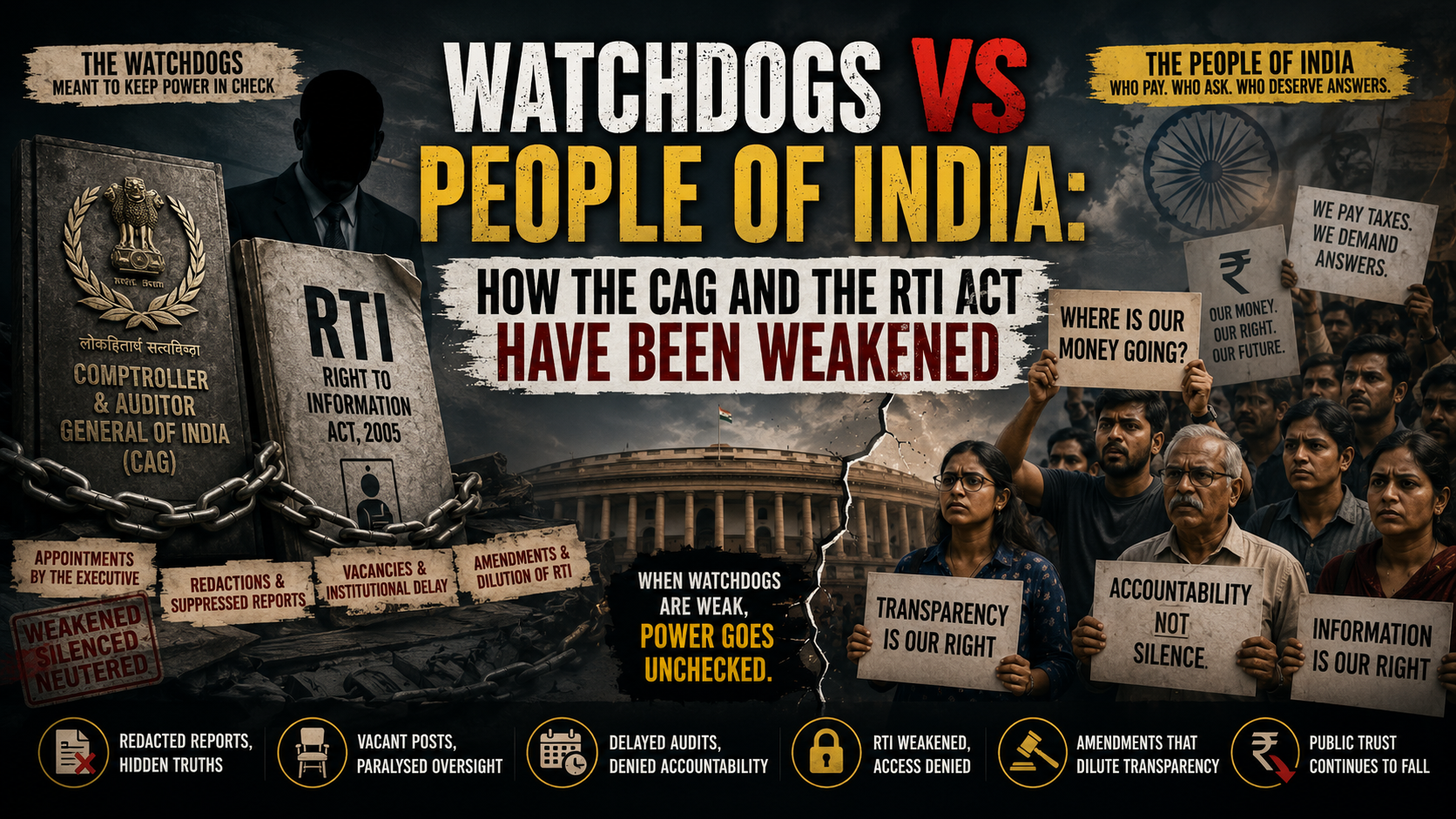
Every functioning democracy needs eyes that the state cannot close and a mouth the state cannot gag. In India’s constitutional design, two institutions were meant to play precisely that role. The Comptroller and Auditor General of India (CAG), a constitutional authority under Article 148, was built to be the nation’s chief auditor — the body that follows every rupee of public money and tells Parliament, and through it the citizen, whether that money was spent honestly and wisely. The Right to Information Act, 2005 (RTI), meanwhile, is not a constitutional body but a statute that did something constitutional bodies rarely manage: it handed an ordinary citizen a legally enforceable weapon to prise open the files of the state.
Both institutions have genuine achievements to their name. The CAG’s 2G spectrum and coal-block allocation reports of 2010–12 reshaped Indian politics and sent ministers to jail. The RTI Act, in its first decade, was used to expose the Adarsh Housing Society scam, irregularities in the Commonwealth Games, leakages in the public distribution system, and fake muster rolls under MGNREGA. Over 25 million RTI applications have been filed since 2005, an extraordinary record of citizen engagement.
Yet a close look at the record since 2014 suggests both institutions have been steadily hollowed out — not necessarily by any single dramatic act, but by a accumulation of appointments, amendments, vacancies, redactions, and evasions that critics say have blunted their teeth precisely when they were most needed: during demonetisation, the GST rollout, the COVID-19 pandemic, the electoral bonds scheme, and a string of big-ticket defence and infrastructure deals. This article lays out that critique in detail, with documented examples, while also noting the government’s own defence of its record — because a fair reckoning requires both sides of the ledger.
PART I: THE COMPTROLLER AND AUDITOR GENERAL — A WATCHDOG THAT LEARNED TO STAY QUIET
1. The structural problem: the auditor is appointed by the audited
The CAG is meant to audit the executive on behalf of Parliament. But the CAG is appointed by the President on the advice of the very executive it audits, with no defined selection criteria, no public shortlist, and no consultation with the opposition or with state governments whose accounts the CAG also examines. Critics have long pointed out that this creates an inherent conflict of interest, especially when former bureaucrats who worked closely with a government are later appointed as its auditor.
This was not merely a theoretical worry after 2017, when Rajiv Mehrishi, a former Union Home Secretary who had earlier served as Chief Secretary of Rajasthan under a BJP government, was appointed CAG. It became sharper still with the appointment of Girish Chandra Murmu in 2020 — a former Gujarat-cadre IAS officer who had served as Principal Secretary to then Chief Minister Narendra Modi and later as Union Home Secretary and the first Lieutenant Governor of Jammu and Kashmir after the abrogation of Article 370. Commentators across the political spectrum, and even sections of retired audit officials, argued that appointing someone with such a direct personal and institutional history with the ruling establishment to head the constitutional audit body undermines the perception, if not always the fact, of independence.
2. The Rafale audit: redacted at the government’s request
Perhaps the most telling episode of the post-2014 period is the CAG’s 2019 report on the Rafale fighter jet deal and ten other defence acquisitions. The government had told the Supreme Court, in a sealed-cover note in 2018, that pricing details of the Rafale deal had already been shared with the CAG and that only a redacted version of the report would be placed before Parliament. The CAG itself formally objected to this in a letter to the Ministry of Defence dated 5 February 2019, warning that redacting commercial figures would make the report incomprehensible and had no precedent in Indian audit history. The CAG ultimately relented and agreed to redact only the Rafale pricing details — while leaving the figures for the other ten defence deals in the same report untouched.
The effect was that Parliament and the public received a report in which crucial tables were reduced to letters of the alphabet standing in for actual prices, even as the report’s own preface, apparently by oversight, disclosed the aggregate cost of all eleven acquisitions — allowing analysts to reverse-engineer the Rafale figure within minutes. Opposition leaders, including then PAC chairman Mallikarjun Kharge, subsequently disputed in Parliament and before the Supreme Court whether any CAG report on Rafale had even reached the Public Accounts Committee at the time the government claimed it had. The episode raises an uncomfortable question that goes to the heart of the CAG’s constitutional purpose: if the nation’s independent auditor can be persuaded to redact the one figure — price — that determines whether a defence deal was value for money, what is left of independent audit scrutiny on matters the executive deems politically sensitive?
3. Slower, thinner, and delayed: the declining output of audit
Economists and former statisticians who track India’s data institutions have pointed out that the number of CAG audit reports has declined and their release has been increasingly delayed in the years after 2014, at exactly the moment when independent cross-checks on administrative data — GDP growth, GST collections, disinvestment proceeds, bank recapitalisation — were most needed. When a government is simultaneously accused of manipulating growth statistics, delaying crime data, and suppressing employment surveys (examined in Part II), a slower and thinner audit trail from the CAG removes one of the few remaining external checks on the official numbers.
4. Where the CAG should have acted sooner: Skill India as a case study
A useful test of whether the CAG is doing its job in real time, rather than years too late, is the December 2025 CAG report on the Skill India Mission. The report found that of the ₹14,450 crore outlay for the scheme’s first three phases (2015–2022), the government claimed to have trained only 13.2 million people against a target of 500 million by 2022 — barely 2.6 percent of the goal — and that even this number was unreliable, riddled with what the report described as ghost accounts, dubious certifications and poor state-level oversight. The scheme was, in essence, a rebranded and renamed version of the UPA-era National Skill Development Mission, and it failed for strikingly similar reasons.
The uncomfortable fact is that warning signs were visible in official data for years — a 2017 Press Information Bureau release had already conceded that under 5 percent of India’s workforce had received any formal skill training. Yet it took the CAG until December 2025 — more than a decade after the scheme was renamed “Skill India” in 2015 — to formally document the scale of the failure in Parliament, by which point the Cabinet had already approved a further ₹8,800 crore for a fourth, restructured phase, with the details of that restructuring still unclear even as new money was released. Critics argue this is symptomatic of a broader pattern: audits arriving long after the money has been spent, the political credit has been claimed, and the next budgetary allocation has already been approved — audit as an autopsy rather than an early-warning system.
5. Corruption within the watchdog itself
A CAG cannot credibly police the government’s finances if its own house is not visibly in order. In August 2024, a detailed, nearly 6,000-word complaint reportedly signed by “a cohort of vigilant employees” inside the CAG’s own office reached senior officials, alleging that an official, Vishal Desai Bapusaheb, had engaged in serious misconduct — including corruption and sexual exploitation during recruitment — during an audit assignment in Mauritius, and that vacant posts at CAG headquarters had for years been filled through bribery. Rather than ordering an inquiry, the organisation granted Desai a coveted foreign posting to London in September 2024, days after the complaints were filed, only recalling him roughly six weeks later citing vague “administrative reasons,” with no public inquiry report or resolution disclosed. Whatever the eventual truth of the specific allegations against one officer, the institutional response — silence, then a promotion, then a quiet recall — is itself the story: an audit body that will not audit its own conduct transparently makes it harder for the public to trust its audits of everyone else.
6. The self-imposed limits: what the CAG has not touched
Beyond individual episodes, critics point to entire categories of public spending and policy where the CAG has been conspicuously absent or restrained since 2014:
- PM CARES Fund: Set up in March 2020 to receive COVID-19 donations, including large transfers from public sector undertakings, PM CARES has been audited not by the CAG but by private chartered accountants empanelled through a process linked to a CAG panel — a materially weaker form of scrutiny than a full CAG performance audit, and one whose reports are not placed before Parliament in the way a CAG report is. Given that PM CARES was substantially funded by government-linked entities and used the state emblem, critics have asked why India’s constitutional auditor was kept away from a fund of this scale and public interest.
- Demonetisation (2016): The CAG never conducted, and has not published, a comprehensive value-for-money performance audit of the 2016 demonetisation exercise — its stated objectives (curbing black money, counterfeit currency, terror financing), its costs (printing, ATM recalibration, lost productivity), and its outcomes (over 99 percent of demonetised currency eventually returned to the banking system, according to the Reserve Bank of India’s own subsequent annual report) — even though few economic decisions in independent India’s history have had a more direct and disruptive impact on ordinary citizens’ cash-dependent lives.
- Electoral bonds scheme: The CAG, as the auditor of the State Bank of India’s public accounts in a broad sense and of government finances generally, did not proactively audit or report on the opacity of the electoral bonds scheme before the Supreme Court struck it down in February 2024 as unconstitutional — leaving that scrutiny entirely to the judiciary and to RTI applicants (see Part II).
None of this is to say the CAG has been supine everywhere — it has continued to produce hard-hitting reports on state government finances, on Delhi’s air quality monitoring, and, as seen above, eventually on Skill India. But the pattern critics highlight is consistent: forceful, timely scrutiny on state governments and older schemes, and caution, delay, or redaction on the biggest-ticket central government decisions of the post-2014 period.
PART II: THE RIGHT TO INFORMATION ACT — DEMOCRACY’S TOOL, QUIETLY BLUNTED
1. The 2019 Amendment: rewiring the watchdog’s leash
The single most consequential change to the RTI ecosystem since 2014 was the RTI (Amendment) Act, 2019. Under the original 2005 law, the Chief Information Commissioner and Information Commissioners — at both the Central Information Commission (CIC) and State Information Commissions (SICs) — had a fixed five-year tenure and drew salaries equivalent to the Chief Election Commissioner, precisely so that they would be insulated from executive pressure while adjudicating disputes against the government itself.
The 2019 amendment removed both protections. It empowered the Central Government to prescribe, by rules, the tenure, salary and service conditions of Information Commissioners — at the Centre and, remarkably, in every state as well, even though states appoint their own Information Commissioners. The rules notified soon after fixed the new tenure at three years instead of five, and cut the salary of incoming commissioners by ₹25,000 a month, while also removing the earlier deduction of pension from the salaries of retired-bureaucrat appointees, a change critics say makes the post more attractive precisely to compliant former officials. Then Union Minister Jitendra Singh defended the amendment on the ground that equating statutory Information Commissioners with the constitutionally established Election Commission was an “anomaly.” Opposition MPs, RTI activists, and former Information Commissioners such as M. Sridhar Acharyulu argued the real effect was to turn commissioners into what activists called “caged parrots” — officials who now serve, in terms of both tenure and pay, at the pleasure of the very government whose non-disclosure decisions they are meant to adjudicate. The amendment is currently under challenge in the Supreme Court in a pending petition filed by Congress MP Jairam Ramesh.
It is worth noting why this amendment mattered in practice, not just in principle. Before 2019, the CIC had issued orders that visibly discomfited the government — including a January 2017 direction to Delhi University to allow inspection of 1978 B.A. degree records (linked to a long-running public controversy over the Prime Minister’s academic credentials), and a separate direction to the Reserve Bank of India to disclose details of non-performing assets and big loan defaulters at public sector banks, which the RBI resisted citing confidentiality. Whether or not the 2019 amendment was designed with such episodes in mind, its practical effect, critics argue, has been to reduce the likelihood of future commissioners issuing similarly inconvenient orders.
2. An institution starved of people: vacancies and mounting backlogs
An information commission that has no commissioners cannot dispose of appeals, no matter how strong the underlying law is. Data compiled by the citizens’ group Satark Nagrik Sangathan (SNS), based on RTI applications filed with the commissions themselves, shows a worsening picture year after year:
- In 2018, the CIC was already functioning with vacancies and a backlog exceeding 23,500 appeals, prompting a Public Interest Litigation before the Supreme Court.
- By late 2019, the Supreme Court directed the central government to fill all vacancies in the CIC within three months; the government did not comply within that timeframe.
- By October 2023, the CIC was functioning with only 4 of 11 sanctioned commissioners, no Chief Information Commissioner, and a backlog exceeding 20,000 cases — with all four remaining commissioners due to demit office within weeks.
- SNS’s nationwide count found pending appeals and complaints across state commissions rising steadily: roughly 2.1 lakh in 2019, 2.8 lakh in 2021, and over 3.21 lakh by 2023 — a near 50 percent increase in four years even as the number of working commissioners stagnated or fell.
- By 2023, four State Information Commissions (Jharkhand, Telangana, Mizoram and Tripura) had become entirely defunct with no commissioners at all, and six commissions, including the CIC itself, had no head.
- In states such as Maharashtra and Odisha, the estimated waiting time for a single appeal to be heard stretched to between two-and-a-half and over four years — meaning the RTI Act’s own 30-day statutory deadline for information had, for practical purposes, been replaced by a multi-year wait for even the right to be heard on a wrongful denial.
An appeal mechanism that takes years to hear a case is not a real enforcement mechanism. Activists describe the pattern of unfilled vacancies as less an accident of bureaucratic delay than a form of passive resistance: a government that need not formally deny information can simply let the body that would order its disclosure decay through attrition.
3. The Digital Personal Data Protection Act, 2023: a second amendment by the back door
In 2023, without a fresh standalone debate on RTI itself, Parliament passed the Digital Personal Data Protection Act (DPDPA), whose Section 44(3) amended Section 8(1)(j) of the RTI Act. The original RTI provision exempted “personal information” from disclosure unless a larger public interest justified release — the clause that had, for years, been used to force disclosure of public servants’ asset declarations, educational qualifications, and disciplinary records. The DPDPA removed the “larger public interest” override altogether, creating what transparency researchers describe as a blanket exemption for personal information. In effect, a law ostensibly about data privacy quietly did what a second RTI amendment might have done more visibly and drawn more resistance for doing.
4. PM CARES Fund: the case study in institutional evasion
No episode captures the post-2014 pattern of information denial more completely than the PM CARES Fund. Set up on 27 March 2020 as a public charitable trust to receive COVID-19 relief donations, with the Prime Minister as its ex-officio chairman and the Home, Defence and Finance Ministers as trustees, the fund has since 2020 consistently refused to disclose, under the RTI Act:
- the identity and amount contributed by individual donors;
- detailed records of expenditure and utilisation;
- lists of beneficiaries;
- internal file notings and minutes of trustee meetings;
- and documents relating to the fund’s income-tax exemption applications.
Each refusal has rested on the same core claim: that PM CARES is not a “public authority” under Section 2(h) of the RTI Act, and is therefore outside the law’s reach altogether — even though the fund uses the national emblem (ordinarily restricted to government use), was set up and is administered through the Prime Minister’s Office, and — according to RTI replies obtained separately from 101 public sector undertakings — received over ₹2,400 crore from PSU corporate social responsibility budgets and roughly ₹155 crore deducted from the salaries of government employees, PSU staff, and even IITs, IIMs, central universities and Navodaya Vidyalaya staff and pension accounts. In a formal RTI reply in late 2020, the government at one point stated that the fund was “owned by, controlled by and established by the Government of India” — language that appeared to concede exactly the public-authority status it was simultaneously denying in court, before reverting to the position that it was a private trust outside RTI’s ambit. As recently as January 2026, the Delhi High Court was still adjudicating aspects of this dispute, observing that even a government-linked entity retains a right to privacy under the RTI Act — six years after the fund’s creation and after a global pandemic in which its finances remained substantially opaque to the citizens who, directly or indirectly through their employers, had helped fund it.
5. Electoral bonds: defying even the Supreme Court’s own order
The electoral bonds case shows that resistance to disclosure has, at times, extended even to complying fully with direct Supreme Court orders. After the Court declared the anonymous electoral bonds scheme unconstitutional in February 2024 and ordered the State Bank of India to hand over complete bond data — including unique bond numbers that would let citizens match specific donors to specific political parties — to the Election Commission, SBI initially supplied incomplete data, prompting the Court to publicly admonish the bank on 15 March 2024 for withholding the very numbers needed to link donors to recipients. Separately, when RTI activist Commodore (retd.) Lokesh Batra sought the same electoral bond data directly from SBI under the RTI Act — data that by then was already published on the Election Commission’s own website — SBI refused, citing the RTI Act’s exemptions for information held in a “fiduciary capacity” and “personal information.” Batra also sought, and was denied, information on the legal fees SBI paid senior advocate Harish Salve to argue against disclosure in the Supreme Court — a refusal activists noted was particularly hard to justify given that the fees in question involved a public sector bank’s use of funds ultimately traceable to public and depositor money.
6. “No Data Available”: the government’s most common answer
Since 2020, Parliament’s own record shows an unusually consistent pattern of the government responding to written questions by stating it simply does not maintain the data being asked about — a pattern journalists at the time nicknamed “NDA: No Data Available.” Documented examples include:
- In September 2020, when MPs asked for state-wise data on migrant workers who died — from starvation, exhaustion, road and rail accidents — while walking or travelling home during the COVID-19 lockdown, the Ministry of Labour and Employment told Parliament it had no such data, and consequently could not compensate the families of the dead. This despite independent researchers having already documented hundreds of such deaths from news reports, and despite Railway Protection Force data showing around 80 deaths aboard Shramik Special trains alone between 9 and 27 May 2020.
- In the same session, the government said it had no centralised data on the number of doctors, frontline health workers, sanitation workers, or police personnel who died of COVID-19 while on duty, stating that health being a state subject meant no national figures were compiled.
- The Ministry of Women and Child Development said it did not maintain data on how many women had exited the workforce because of the pandemic-induced lockdown.
- When asked how many Right to Information activists had been killed or attacked for their RTI work, and what protective mechanisms existed, the government responded that such data was not held centrally and might reside separately with individual state governments — effectively meaning no national accounting exists of violence against citizens exercising a right the Indian state itself created.
- Even on the CIC’s own backlog, when asked in Parliament, the government stated only that pendency had “notably decreased” over nine years due to higher disposal rates — without providing the actual current numbers, even as SNS’s independently-collected RTI data showed backlogs rising, not falling, over the same period.
Transparency advocates argue this pattern reflects something more troubling than mere administrative incapacity: a government that increasingly declines to collect data on politically inconvenient outcomes is at least as effective at avoiding accountability as one that collects the data and then refuses to release it — because “we don’t have it” forecloses even the RTI route, since the Act can only compel disclosure of information the state already possesses.
7. Suppressing the government’s own statistics
Perhaps the most significant instance of data suppression in this period did not involve an individual RTI applicant at all, but two of India’s flagship national surveys.
In 2019, a leaked draft of the National Sample Survey Office’s Periodic Labour Force Survey for 2017-18 showed India’s unemployment rate had reached 6.1 percent — the highest in 45 years. The government withheld the official release of this survey for months, and two independent members of the National Statistical Commission resigned in protest over the delay, before the report was finally released — after that year’s general election — broadly confirming the leaked figures.
Months later, in November 2019, a similarly leaked draft of the NSSO’s Consumer Expenditure Survey for 2017-18 suggested that average household spending in India had fallen for the first time in decades — by 3.7 percent in nominal terms — a finding with direct implications for poverty estimates. The government’s Ministry of Statistics and Programme Implementation this time did not merely delay release; it announced it would not release the survey at all, citing unspecified “data quality issues,” even as it acknowledged the report existed in draft form. Over 200 Indian and international economists and statisticians, including Nobel laureate Angus Deaton and economist Thomas Piketty, signed an open letter calling for the survey’s release, arguing that consumption data of this kind is foundational to any credible assessment of poverty and inequality trends. The government did not comply, and a comparable survey was not conducted again until several years later. Since national accounts, poverty lines, and inflation-linked welfare schemes all depend on exactly this kind of survey data, its suppression made it structurally harder for RTI applicants, journalists, opposition MPs, and even the CAG to independently verify the government’s own headline economic claims — a case where the failures of the RTI ecosystem and the failures of the CAG’s data-verification role reinforce each other.
8. The human cost: violence against RTI users with no institutional response
Beyond bureaucratic evasion, RTI activists in India have for years faced real physical danger, particularly those probing local corruption in land records, mining, and welfare scheme leakages. Multiple RTI users have been murdered since the Act came into force, in cases spanning several states — yet, as the Parliament exchange cited above shows, the Central Vigilance Commission, the designated nodal agency, reported in 2020 that it had not come across any confirmed incident of victimisation or killing of an RTI complainant in the preceding two years, despite well-documented cases in the press during that very period. Activists say this reflects an absence of any dedicated, mandatory reporting mechanism specifically for attacks on RTI users — a gap that both the CIC (as regulator of the Act) and the Union government have had years to close and have not.
PART III: A FAIR HEARING — THE OTHER SIDE OF THE LEDGER
A genuinely critical article should not pretend the record is one-sided. Several counterpoints deserve mention:
- The CAG has not gone silent. The December 2025 Skill India report, repeated adverse reports on state government finances, and a 2025-26 report questioning Delhi’s air quality monitoring data show the institution can still produce embarrassing findings for governments of any party, including state governments run by opposition parties.
- Some data problems predate 2014. Independent economists, including critics of the current government, acknowledge that India’s statistical system — the National Sample Survey Office, the Central Statistics Office, and civil registration systems — was already under strain before 2014, and that political interference with statistical institutions is not a uniquely post-2014 phenomenon, even if critics argue it has intensified.
- The government’s stated rationale for the 2019 RTI amendment — that equating a statutory body with a constitutional one was an “anomaly” — is a genuine, if contested, legal argument, and the matter remains sub judice before the Supreme Court rather than settled.
- Redacting commercially sensitive defence pricing is not, on its face, an unreasonable government position in isolation; critics’ objection is less to redaction as a principle than to its selective and seemingly political application to only one of eleven deals in the same Rafale report.
- Data collection is often a genuine technical challenge, not only a matter of will. As data journalists have pointed out, establishing a reliable national count of, say, migrant deaths during a chaotic lockdown would have required coordinating first information reports across every state and district in the country in real time — a capacity gap that reflects decades of underinvestment in administrative data systems as much as any single government’s evasiveness.
Conclusion: Why This Matters
The CAG and the RTI Act were built as complementary institutions: one audits the state’s accounts after the fact; the other lets citizens interrogate the state’s files in real time. When both function well, together they make it very difficult for the government of the day — any government of the day — to spend public money badly or secretly without eventually being found out. The documented record since 2014 — a CAG report redacted at the executive’s request, an internal corruption complaint met with a foreign posting instead of an inquiry, an RTI amendment that tied commissioners’ pay and tenure to the government they must rule against, thousands of unfilled commissioner vacancies, a charitable trust chaired by the Prime Minister held outside the reach of the transparency law for years, a national bank refusing to hand over data it had already published elsewhere, and government ministries repeatedly telling Parliament that data on migrant deaths, health-worker deaths, and RTI-activist killings simply does not exist — suggests that both institutions have been made weaker, more cautious, and slower precisely in the period when big, consequential, and contested decisions most needed independent scrutiny.
None of this means either institution is beyond repair. Restoring fixed, protected tenures for Information Commissioners; filling vacancies within the timelines the Supreme Court has already ordered; reversing the DPDPA’s blanket personal-information exemption; bringing PM CARES-scale public-facing funds unambiguously within the RTI’s ambit; and insulating CAG appointments through a broader, more transparent selection process are all concrete, previously proposed reforms that would restore much of what critics say has been lost. Whether any government — this one or a successor — chooses to make those reforms will be the real test of whether India’s transparency architecture is a permanent constitutional commitment, or merely a convenience that each ruling party tightens once it is no longer in opposition