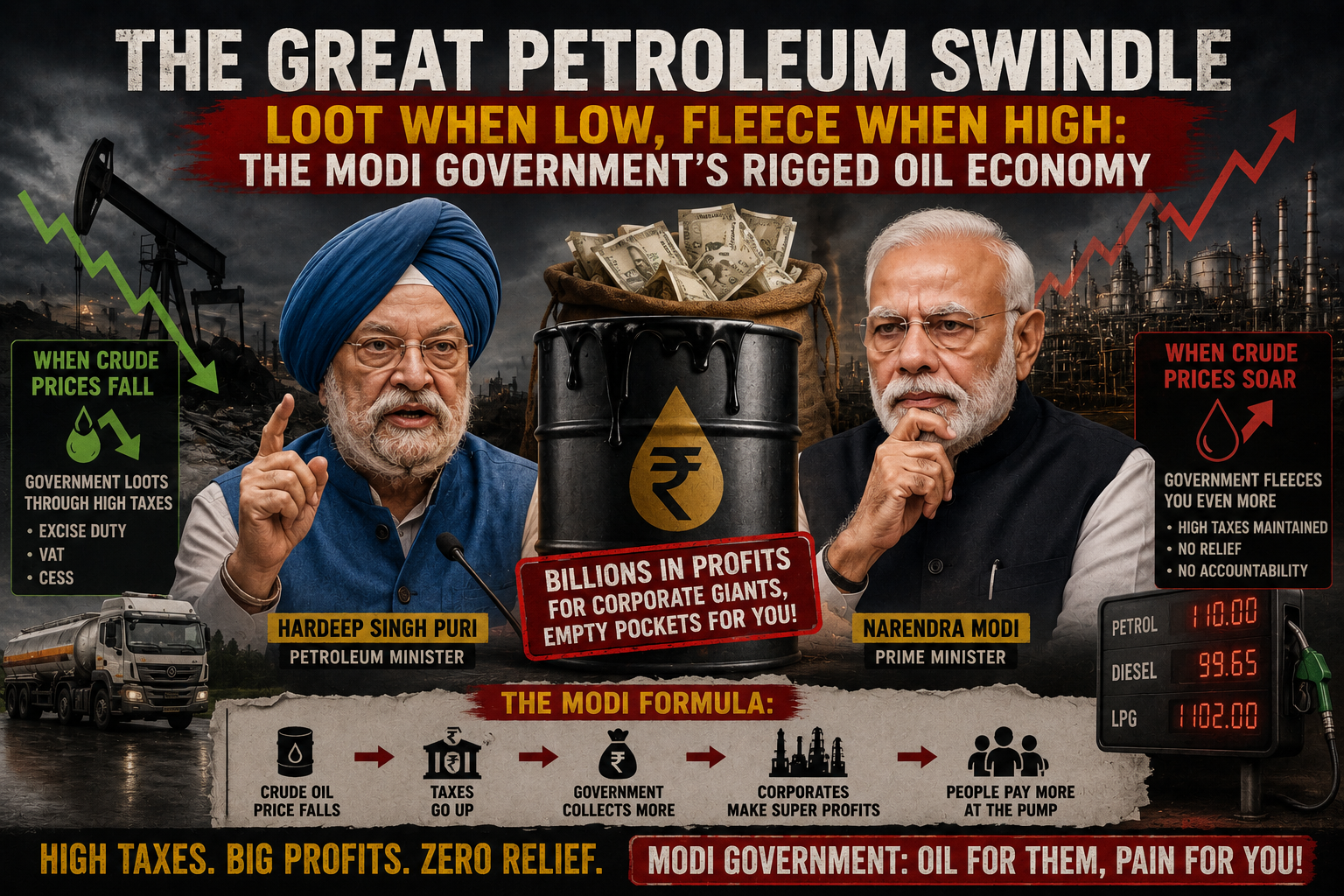
Loot When Low, Fleece When High: The Modi Government’s Rigged Oil Economy
Fuel prices up INR 7.5 in eleven days, INR 3.35 lakh crore pocketed in a single pandemic year, Ambani’s billions from discounted Russian crude, INR 11,000 crore of ONGC gas siphoned with impunity, and ethanol savings that never reach the pump — a comprehensive account of how India’s petroleum policy enriches the powerful and bankrupts the citizen.
On 25 May 2026, for the fourth time in less than two weeks, Indians woke up to discover that the price of the fuel that runs their lives — their commutes, their tractors, their deliveries, their livelihoods — had gone up again. Petrol rose by INR 2.61 per litre and diesel by INR 2.71. Since 15 May, when state-owned fuel retailers broke a prolonged price freeze, the cumulative hike has touched nearly INR 7.50 per litre. In Delhi, petrol breached the INR 100 mark. Across India, truck drivers, auto-rickshaw operators, farmers, and middle-class families absorbed the blow in silence — because in this country, fuel price hikes are treated not as policy failures but as acts of nature, as inevitable as the monsoon.
They are nothing of the sort. They are choices — choices made by a government that pocketed lakhs of crores in excise duties when global oil prices crashed, refused to pass those savings to consumers, and now, the moment international crude rises, passes every single rupee of the increase directly to the pump. This is not a pricing mechanism. It is a one-way valve: the government profits on the way down, and the consumer pays on the way up. Meanwhile, India’s richest man, Mukesh Ambani, has built a multi-billion-dollar windfall from discounted Russian crude — a benefit the Indian citizen has never seen — and his company stands accused in the Supreme Court of effectively stealing over INR 11,000 crore worth of gas from state-owned ONGC fields, with the government doing virtually nothing about it for a decade.
This blog is an attempt to map the full architecture of India’s petroleum betrayal — from the excise duty heist, to the Ambani-Russia pipeline, to the KG Basin gas scandal, to the ethanol savings mirage — and to hold the Modi government and Petroleum Minister Hardeep Singh Puri accountable for a system that is designed, from top to bottom, to serve everyone except the ordinary Indian.
I. The Excise Heist: Pocketing Lakhs of Crores While Citizens Paid Full Price
When Oil Fell, Taxes Rose — and StayedTo understand the current fuel price hikes, you have to understand the swindle that preceded them. When the Modi government took office in 2014, global crude oil prices were in freefall — from over $100 per barrel during the UPA years to below $30 per barrel by early 2016. This was a windfall for any oil-importing nation. The logical, pro-citizen response would have been to pass on the savings at the pump. The Modi government did the opposite.
Between 2014 and 2021, the Centre hiked excise duty on petrol from INR 9.48 per litre to a staggering INR 32.90 — and on diesel from INR 3.56 to INR 31.80. These were not small adjustments. They were a systematic, multi-year programme to capture the entirety of global oil price declines into the government’s coffers, while leaving retail prices virtually unchanged for the consumer. In 2020-21, with crude at pandemic-era lows, the Centre collected INR 3.35 lakh crore in excise duty from petrol and diesel — an 88 per cent jump over the INR 1.78 lakh crore collected in 2019-20. Compared to 2014-15, when the BJP’s first term began, central excise collections on petrol tripled, and on diesel they increased more than fivefold.
The total central tax revenue from crude oil and petroleum products over the Modi years is estimated at over INR 22 lakh crore. That is not a typo. Twenty-two lakh crore rupees extracted from one of the most price-inelastic goods in the Indian economy — fuel that a truck driver cannot choose not to buy, that a farmer cannot run his tractor without, that a delivery rider cannot substitute with anything else. The government treated its citizens as a captive revenue source, and the global oil price collapse as its personal windfall.
And now? The moment crude prices climbed — driven by the West Asia conflict, the US-Israeli military actions on Iran, and the resulting disruption of the Strait of Hormuz — the government suddenly rediscovered the concept of “passing on international prices to consumers.” In May 2026, after years of frozen pump prices, retailers were unshackled to raise prices four times in eleven days. The same government that absorbed every rupee of the downside into its treasury now passes every rupee of the upside to the citizen. The arithmetic is devastating in its simplicity: heads the government wins, tails the citizen loses.
The Excise Duty Shell Game
There is another layer to this deception. Over the years, the Modi government has quietly restructured how fuel taxes are classified. It has progressively reduced the share of basic excise duty — which must be shared with state governments under constitutional provisions — and shifted the equivalent amount into cesses such as the Agriculture Infrastructure and Development Cess and the Road and Infrastructure Cess. These cesses go entirely to the Centre, never shared with states. The result: the overall tax rate on fuel remains the same or rises, but the states’ share shrinks, and the Centre keeps a larger piece. It is a fiscal sleight of hand that would be impressive if it were not so deeply cynical.
When confronted, the government invokes the UPA-era “oil bonds” — securities issued by the previous government to compensate oil marketing companies for selling fuel below cost. The Modi government has paid approximately INR 70,000 crore in interest on these bonds since taking office. But the fuel excise collected in a single year — FY21 alone, at INR 3.35 lakh crore — is roughly five times the total oil bond interest paid across seven years. The oil bond defence is not an explanation. It is a deflection.
II. May 2026: The Bill Finally Arrives — For the Consumer Alone
OMC Losses Socialised, OMC Profits PrivatisedThe May 2026 fuel price hikes require closer examination because they reveal the full hypocrisy of the government’s pricing philosophy. Since 2022, oil marketing companies — Indian Oil Corporation, Bharat Petroleum, and Hindustan Petroleum — had been absorbing “under-recoveries” by selling fuel below cost, to keep retail prices artificially stable ahead of multiple state elections. The government took credit for “shielding” consumers. In reality, it was loading losses onto the balance sheets of publicly owned companies for electoral convenience.
When the West Asia conflict sent crude rocketing to approximately $122 per barrel, those accumulated losses became unsustainable. The government’s response, announced on 27 March 2026, was to slash excise duty on petrol to INR 3 per litre and bring it to zero on diesel — but crucially, not to reduce retail prices. As The Wire reported, the excise cut was not a price cut at the pump; it was a bailout for the OMCs. The government itself acknowledged that under-recoveries stood at approximately INR 26 per litre on petrol and a staggering INR 81.90 per litre on diesel, with combined daily OMC losses of approximately INR 2,400 crore.
Minister Hardeep Singh Puri framed this as a sacrifice, declaring that PM Modi had “decided to take a hit on government finances to safeguard the Indian citizen.” But this narrative collapses under the weight of historical context: the very same government made INR 3.35 lakh crore in a single year when oil was cheap, refused to lower prices for consumers, and is now presenting the loss of that inflated revenue as an act of generosity. The citizen never received the benefit when prices fell. The citizen now receives the full cost when prices rise. The “sacrifice” is the government forgoing excess profits it should never have been collecting in the first place.
Then came the May 2026 hikes — four in eleven days, totalling INR 7.50 per litre. Delhi petrol crossed INR 100. Diesel pushed past INR 90 in most metros. And the cascading impact — on trucking costs, food prices, auto fares, and the daily arithmetic of survival for hundreds of millions of Indians — was immediate and brutal.
III. The Ambani Windfall: Discounted Russian Crude, Exported American Profits
Billions In, Nothing Out — to the Indian ConsumerWhile the Indian consumer was paying full price at the pump, Mukesh Ambani’s Reliance Industries was building one of the most profitable arbitrage machines in global energy history — buying cheap Russian crude, refining it at the world’s largest refinery in Jamnagar, and exporting high-margin fuel products to the United States and Europe.
The numbers, documented by the Centre for Research on Energy and Clean Air (CREA), The Washington Post, and maritime intelligence agencies, are extraordinary. Between 2022 and 2024, India as a whole saved an estimated $33 billion on purchases of discounted Russian oil. But the distribution of those savings was radically unequal. Two private refiners — Reliance Industries and Rosneft-backed Nayara Energy — accounted for over 40 per cent of the average 1.5 million barrels per day that India sourced from Russia during this period. In 2025, Reliance alone accounted for 71 per cent of India’s fuel exports. Its Jamnagar refinery quickly reoriented toward Russian crude — from 5 per cent of feedstock in April 2022 to 27 per cent by May 2022. In June 2025, Russian crude made up a record 45 per cent of all India’s imported oil.
Reliance’s financial performance reflected the bonanza. The company recorded refining margins exceeding $12.5 per barrel. Its revenue reached $71.7 billion in 2025, compared to $57.2 billion in 2021. In December 2024, Reliance signed a ten-year supply deal with Russia’s Rosneft worth $12–13 billion annually, for up to 500,000 barrels per day — roughly half of all Rosneft’s seaborne shipments.
Russia invades Ukraine. Western sanctions create discounted Russian crude. Reliance’s Jamnagar refinery pivots to Russian oil within weeks. Reliance purchases: $3.6 billion (Washington Post calculations).
Reliance’s Russian oil purchases peak at $11.7 billion. Refining margins exceed $12.5/barrel. India saves billions; consumers see no price reduction at the pump.
Reliance signs 10-year, $12–13 billion annual supply deal with Rosneft — covering up to 500,000 barrels/day. Russia receives €750 million in tax revenue from Reliance’s exports of Russian-origin fuel to the US.
Reliance accounts for 71% of India’s fuel exports. Revenue: $71.7 billion. Indian consumers still pay INR 95+ per litre. Not a rupee of Russian oil savings passed on.
Meanwhile, the fuel made from this cheap Russian crude was exported profitably to the United States and Europe. CREA calculated that between early 2024 and January 2025, the US alone spent €2.8 billion importing fuel from Indian and Turkish refineries, of which €1.3 billion was for products made from Russian crude. Reliance’s Jamnagar refineries accounted for €2 billion of these exports, with €724 million specifically from Russian-origin fuel.
Let that sink in. The Indian government facilitated the purchase of discounted Russian crude. The discount was not passed to Indian consumers. Instead, it flowed into the profit margins of a private refiner, which then exported the refined product to America at market rates. The citizen whose tax money funded the diplomatic framework for this arrangement — the one standing at the petrol pump in Mumbai — received nothing. As the NCP’s Mahesh Tapase noted, despite the global petroleum crisis, no public sector oil company is in loss because the entire burden has been shifted onto the common man — while the private refiners operating the same arbitrage have become fabulously wealthier.
And the political links are undeniable. As The Washington Post documented, Ambani attended President Trump’s inauguration festivities in January 2025. He and Trump exchanged words at a state dinner. Trump’s daughter and son-in-law were guests at an Ambani family wedding. Reliance’s real estate unit has paid $10 million to license the Trump name in Mumbai. And Reliance’s refinery sits in Gujarat, the home state of Prime Minister Modi, whose government has never once questioned the asymmetric distribution of Russian oil savings between the private refiners and the Indian public.
IV. The KG Basin Gas Theft: INR 11,000 Crore Stolen, No Consequences
“Virtually Committed a Theft” — The Attorney General’s Own WordsIf the Russian oil story illustrates how the Modi government enables private profiteering from public resources, the KG Basin gas dispute illustrates something worse: how the government can accuse a private company of outright theft of national assets and still fail to pursue meaningful consequences for over a decade.
The facts: Reliance Industries operates the KG-D6 block in the Krishna-Godavari basin off the Andhra Pradesh coast under a Production Sharing Contract with the government. Adjacent blocks are operated by state-owned ONGC. From 2009 onward, natural gas from ONGC’s blocks migrated into Reliance’s wells. ONGC first flagged the issue in 2013. A petitioner alleged that from 2004 to 2013-14, Reliance drilled wells within 50 to 350 metres of ONGC’s block boundary, effectively siphoning gas from state-owned reserves. The initial estimated value of the migrated gas: approximately INR 11,000 crore.
In 2016, the government-appointed Justice A.P. Shah Committee concluded that Reliance and its partners had received “unjust enrichment” from the production of migrated gas. The Shah panel also found that Reliance had prior knowledge — as early as 2003 — about the connectivity of reservoirs, and did not bring this to the notice of the Directorate General of Hydrocarbons. The government’s own oil ministry, under then-minister Dharmendra Pradhan, slapped an arbitration notice and initiated a probe into “acts of omission and commission.” The Directorate General of Hydrocarbons calculated a penalty in the range of $1–1.5 billion.
And then? The matter went to arbitration. Reliance won the arbitral award. The Delhi High Court overturned it in February 2025. Reliance appealed to the Supreme Court, where hearings began in May 2026. Before the three-judge bench headed by Chief Justice Surya Kant, Attorney General R. Venkataramani used the most extraordinary language ever deployed by the government’s top law officer against a private corporation: “You virtually committed a theft of my gas and you are accountable for that.”
Meanwhile, a separate PIL seeking a CBI probe against Reliance and Mukesh Ambani personally for the gas theft was dismissed by the Bombay High Court in March 2026. The court found it would not escalate a civil energy dispute into a criminal matter — which may be legally sound, but leaves the Indian public with a bewildering picture: the government’s own Attorney General says theft was committed, the government’s own committee found unjust enrichment, the government’s own regulator calculated a billion-dollar penalty, and yet — a decade later — no criminal investigation, no penalty collected, no accountability.
The question that must be asked is: why? Why has a government that boasts of “zero tolerance for corruption” allowed a case involving INR 11,000 crore of national gas assets to drift through arbitration, appeal, and counter-appeal for over a decade without resolution? Why was no FIR registered? Why has the CBI — which is quick to raid opposition politicians at the drop of a hat — never been directed to investigate? The answer, critics argue, lies in the same power dynamic that shapes every other aspect of India’s petroleum economy: Reliance is too big, too connected, and too intertwined with the ruling dispensation to be held to the same standards that apply to everyone else.
V. The Ethanol Savings Mirage: Blending Profits, Consumer Losses
E20 Promised Cheaper Fuel. It Delivered Damaged Engines.When the Modi government championed its ethanol blending programme — hitting the 20 per cent E20 target in 2025, five years ahead of schedule — it sold the policy to the Indian public on two promises: cheaper fuel at the pump, and reduced oil imports. The government claims the programme has saved INR 1.06 lakh crore in crude oil imports and avoided 54.4 million tonnes of carbon emissions over a decade.
But none of those savings have reached the consumer. Not a single rupee. Petrol prices in India have only gone up, not down, since ethanol blending began. The theoretical cost reduction from blending cheaper ethanol into expensive imported crude should, in a transparent market, translate into lower pump prices. Instead, the savings have been absorbed entirely by the OMCs and the government’s tax machinery. The consumer sees no benefit; in fact, as documented extensively, the consumer suffers measurably: reduced mileage, damaged engines, and increased repair costs — particularly for the millions of vehicles sold before 2023 that were never designed for 20 per cent ethanol blends.
As a PIL in the Supreme Court noted: engines are corroding, fuel efficiency is dropping, repair bills are mounting, and insurance companies are rejecting claims for damage caused by ethanol fuel. One in two pre-2023 vehicles surveyed reported mileage drops. Owners report rough idling, hard starts, clogged filters, fuel-line deterioration, and injector damage. And unlike the US and the EU, where ethanol-free fuel remains available and pumps clearly label ethanol content, India offers only blended fuel with no disclosure of composition and no consumer choice.
The ethanol blending story, when placed alongside the excise duty heist, the Russian oil arbitrage, and the KG Basin gas theft, completes a pattern that is now unmistakable: every layer of India’s petroleum economy is structured to extract value from the citizen and channel it upward — to the government treasury, to the private refiners, to the politically connected ethanol producers, and to the crony ecosystem that operates at the intersection of policy and profit.
VI. Puri, Modi, and the Architecture of Petroleum Plunder
Hardeep Singh Puri, the Minister for Petroleum and Natural Gas, has framed every one of these decisions as an act of statesmanship. The excise hikes were “fiscal prudence.” The price freeze was “shielding consumers.” The E20 rollout was “green transition.” The Russian oil purchases were “energy security.” And the price hikes of May 2026 are simply “aligning with international market conditions.”
Each of these statements, taken in isolation, has a superficial plausibility. Taken together, they describe a system in which the government wins at every turn, the consumer loses at every turn, and the politically connected private sector profits at every turn. When oil is cheap, the government raises taxes. When oil is expensive, the government raises prices. When Russian crude is discounted, private refiners capture the margin and export the product. When ONGC’s gas migrates into Reliance’s wells, a decade of legal proceedings produces no penalty and no FIR. When ethanol is blended, the savings disappear into the system while the engine damage materialises in the mechanic’s bill.
Prime Minister Modi’s government has earned over INR 22 lakh crore in petroleum taxes since 2014. India’s crude oil import dependence has risen from 77 per cent to 88 per cent. Fuel prices for the common citizen have only increased. The richest Indian is measurably richer because of a discounted crude oil strategy whose benefits were never shared. And the government’s own Attorney General stands in the Supreme Court and says its own gas was “virtually stolen” — and yet the accused faces no criminal investigation.
There is a word for a system in which the state extracts maximum revenue from its citizens during downturns, passes every cost to them during upturns, enables private monopolists to capture the difference, protects those monopolists from legal consequences, and presents this entire arrangement as reform and good governance. That word is not “governance.” It is extraction. And the citizens of India — filling their scooters at INR 100-plus a litre, watching their engines corrode from mandated ethanol, and reading about Reliance’s record-breaking quarterly earnings — know it, even if the Ministry of Petroleum and Natural Gas does not.