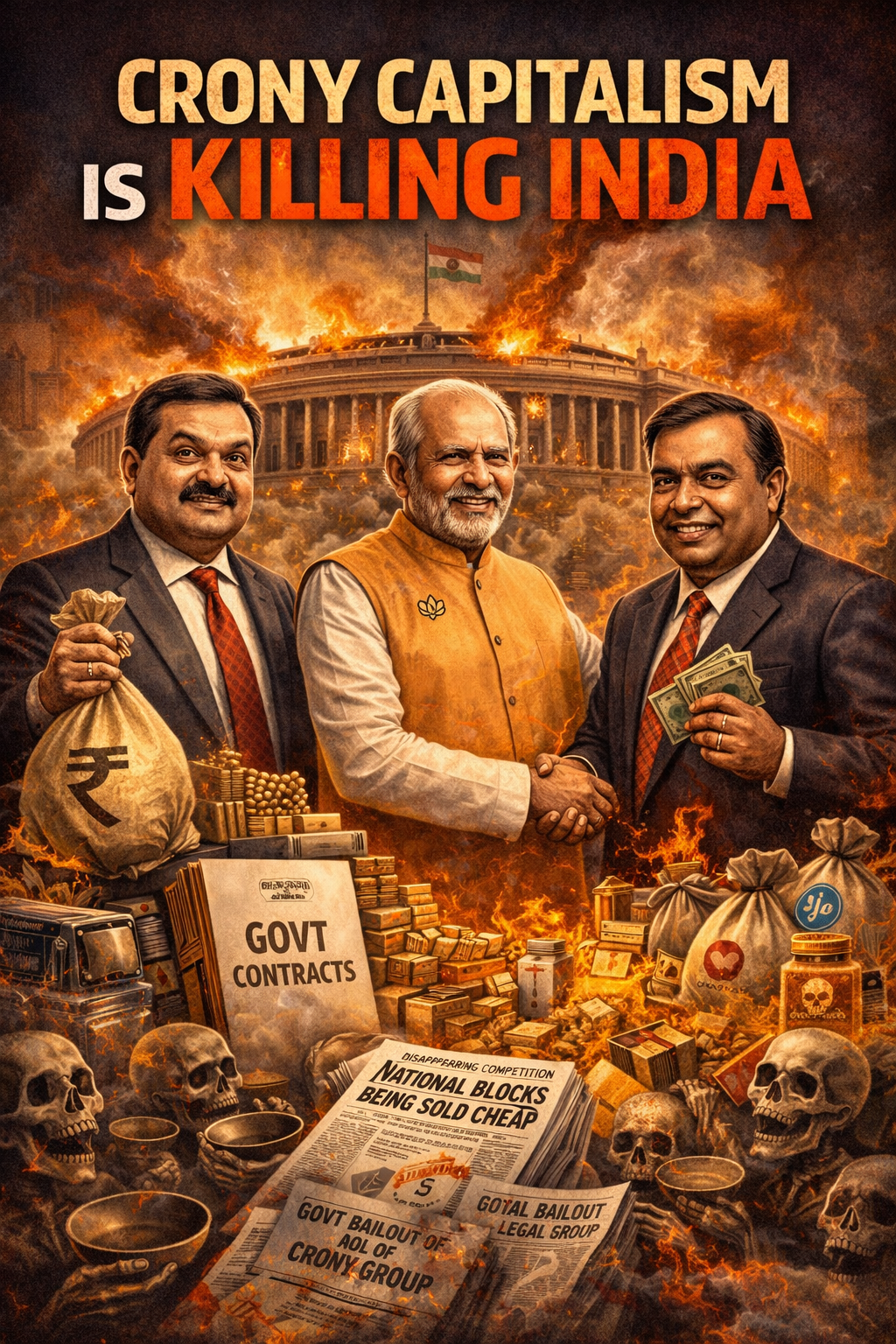
A nation does not collapse only through war or invasion.
Sometimes, it collapses quietly—
when power, money, and politics fuse into a closed circuit called crony capitalism.
Crony capitalism is not capitalism.
It is not free markets.
It is not entrepreneurship.
It is state-sponsored favoritism, where a few corporates grow not because they are the best—but because they are closest to power.
And India is increasingly being accused—by economists, opposition leaders, former bureaucrats, and even global observers—of walking dangerously down that road.
What Is Crony Capitalism?
Crony capitalism exists when:
- Government policy favors select businesses
- Public resources are allocated to a few players
- Competition is crushed through regulatory bias
- Political funding and corporate benefits form a quid pro quo
In such systems:
- Profits are privatized
- Losses are socialized
- Democracy becomes decorative
How Crony Capitalism Slowly Kills a Country
1. It Destroys Competition
When one or two conglomerates dominate entire sectors, innovation dies.
Small and medium enterprises—India’s real job creators—are suffocated.
2. It Weakens Institutions
Regulators become submissive.
Investigative agencies turn selective.
Public watchdogs lose their teeth.
3. It Concentrates Wealth Dangerously
Economic power pools into a few hands, increasing inequality and social instability.
4. It Converts Elections into Investments
Politics becomes a business expense.
Democracy turns transactional.
India Today: The Adani–Ambani Question
Whether one supports or opposes the current government, one fact is undeniable:
No two business houses have expanded across as many critical sectors in such a short time as Adani and Ambani.
Their rise may include genuine business acumen—but critics argue it is impossible to separate this rise from state patronage.
Key Allegations Raised by Critics and Opposition
Note: The following points reflect public allegations, parliamentary debates, investigative reports, and journalistic scrutiny—not judicial convictions.
1. Preferential Access to National Assets
Critics point to:
- Airports
- Ports
- Power transmission
- Coal blocks
- Telecom spectrum
- Oil and gas infrastructure
…being increasingly controlled by a very narrow corporate group.
The concern is not ownership—it is concentration.
When strategic assets are monopolized, national risk increases.
2. Regulatory Bias and Rule Flexibility
Questions repeatedly raised:
- Why are rules frequently modified to suit large players?
- Why do environmental and land clearances appear faster?
- Why do debt-laden conglomerates continue to receive public-sector bank exposure?
In a true free market, failure has consequences.
In crony capitalism, failure is postponed using public money.
3. Killing Competition Through Scale and Influence
Small competitors allege:
- Predatory pricing
- Uneven access to capital
- Policy changes that favor giants
When competition dies, consumers pay the price—
through higher costs, fewer choices, and lower quality.
4. Political Funding and Electoral Support
India’s opaque political funding system—especially electoral bonds—has intensified suspicion.
The allegation:
Big corporates fund the ruling party
In return, policies remain favorable
Even if legal, the optics are deeply damaging.
Democracy should never look like a shareholder meeting.
5. Elite Access and Nepotism Allegations
Critics allege:
- Proximity of corporate leadership to political elites
- Benefits extended to politically connected individuals
- Revolving doors between power, contracts, and influence
When power and privilege circulate within closed circles, merit becomes irrelevant.
This Is Not New: Congress-Era Crony Capitalism
Crony capitalism did not begin in 2014.
India has a long and shameful history of it.
Notable Allegations During UPA Rule
- 2G Spectrum Allocation Scam
Allegations of undervaluation and favoritism in telecom licenses. - Coal Block Allocations (“Coalgate”)
CAG estimated massive notional losses due to non-transparent allocation. - Commonwealth Games Scam
Infrastructure contracts inflated, accountability absent. - Land and Mining Scandals
Particularly in states where political-business nexuses flourished.
In many cases:
- Politicians changed
- Parties changed
- Corporates changed
But the system stayed the same.
Different Parties, Same Disease
The tragedy of Indian politics is not that one party practices crony capitalism.
The tragedy is that every party, once in power, eventually does.
The difference today, critics argue, is scale and centralization.
Earlier:
- Cronyism was fragmented
- Benefits were spread among multiple groups
Now:
- Benefits appear highly concentrated
- Institutions appear more subdued
- Dissent appears riskier
Why This Is Dangerous for India
- Investors lose faith in fair markets
- Youth lose faith in meritocracy
- Entrepreneurs stop dreaming
- Democracy weakens from within
A nation cannot become a global power if:
- Wealth decides policy
- Power decides markets
- Institutions serve the few
Crony Capitalism Is the Enemy of Nationalism
True nationalism means:
- Fair opportunity
- Strong institutions
- Competitive markets
- Equal law
Crony capitalism undermines all four.
A country where billionaires grow exponentially while:
- MSMEs collapse
- Jobs stagnate
- Public debt rises
…is not developing sustainably.
It is accumulating future instability.
Final Warning
Crony capitalism does not announce itself loudly.
It creeps in quietly—through policy tweaks, regulatory silence, and political funding.
By the time citizens realize it,
the economy is captured, and democracy is compromised.
India must decide:
- A nation of equal opportunity
or - A marketplace run by proximity to power
History is clear:
Countries that ignore this choice
eventually pay for it—
economically, socially, and politically.