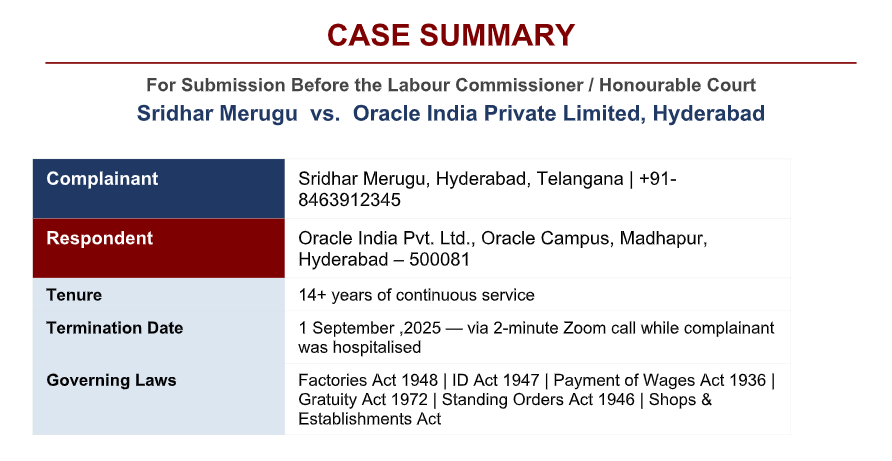
Sridhar Merugu vs. Oracle India Private Limited, Hyderabad
📍 The Story That Exposes Everything
This is not just one employee’s complaint.
This is a systemic failure.
Sridhar Merugu, a former employee of Oracle India Pvt. Ltd., has filed formal complaints with multiple authorities — including the Labour Commissioner and NHRC — alleging inhuman working conditions, illegal labour practices, and retaliatory termination.
You can reach out to him! – Click Here
⚠️ What He Faced (According to Official Complaint)
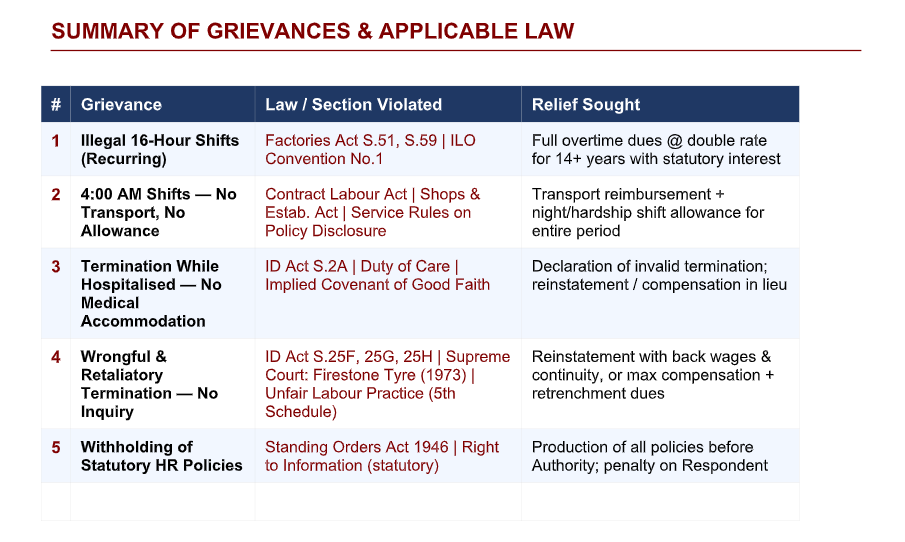
- Forced to work 16-hour shifts regularly
- Asked to report as early as 4:00 AM
- No overtime pay for years
- No transport or allowances
- Ignored for 6+ months despite complaints
- Faced intimidation after raising concerns
- Finally terminated while hospitalised — in a 2-minute Zoom call
Let that sink in.
⚖️ Potential Legal Violations
The case alleges violations under multiple Indian labour laws:
- Factories Act, 1948
- Industrial Disputes Act, 1947
- Payment of Wages Act, 1936
- Gratuity Act, 1972
- Shops & Establishments Act
Key allegation:
👉 Illegal overtime for 14+ years without compensation
💥 The Breaking Point
After raising internal complaints and getting zero response, he escalated the matter legally.
And what happened next?
👉 He was terminated.
👉 While hospitalised.
👉 Without any formal inquiry.
This is now being called a clear case of retaliatory termination.
📰 The Story Has Gone Public
This is no longer hidden.
The issue has been covered by major media outlets including:
- Times of India
- Mint
- Economic Times
- Zee News
- Regional & international platforms
This means:
👉 The issue has now entered national and global public discourse
🔥 Why This Case Matters (Bigger Than One Person)
This case exposes a deeper reality:
1. The “Silent Normalisation” of Overwork
16-hour shifts in IT are not rare — they’re just rarely reported.
2. Fear Culture in Corporates
Employees often stay silent due to:
- Job insecurity
- Internal pressure
- Lack of accountability
3. Weak Enforcement of Labour Laws
India has strong laws — but enforcement remains inconsistent.
🧠 His Statement (Core Message)
“This is not just my fight — it is about protecting labour rights across the IT sector.”
⚖️ What He Is Demanding
- Full overtime compensation (14+ years)
- Reinstatement or fair compensation
- Accountability for labour law violations
- Transparency in corporate HR policies
🚨 What Could Happen Next
Depending on the outcome, the case may escalate to:
- PMO
- Enforcement Directorate
- Income Tax Department
This is not just about Oracle.
This is about a pattern.
If proven, this case could become:
👉 A landmark moment for labour rights in India’s IT sector
👉 A wake-up call for corporate accountability
Why Do Global Companies Follow the Law Abroad — But Exploit in India?
The Question Nobody Wants to Answer
Let’s ask this directly:
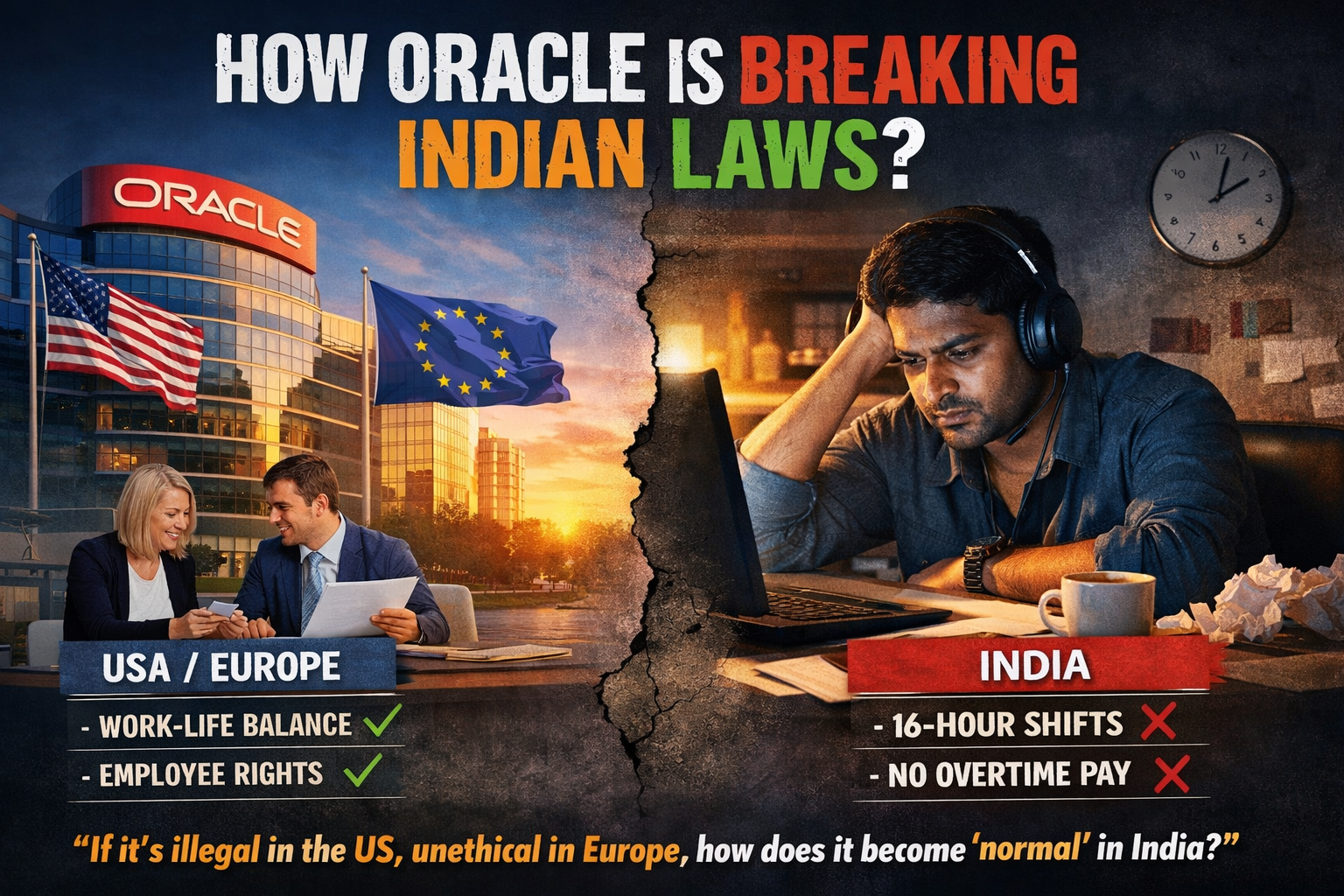
👉 Will a company like Oracle force 16-hour workdays in the US or Europe?
👉 Will they terminate an employee on a 2-minute call while hospitalised there?
No. They won’t.
Because they can’t.
So the real question is:
Why does the same company behave differently in India?
🌍 Two Faces of the Same Company
In countries like the US, UK, or across Europe:
- Strict enforcement of labour laws
- Heavy penalties for violations
- Strong employee unions
- Real fear of lawsuits
- HR systems that actually protect employees
Result?
👉 Employees get:
- Work-life balance
- Overtime pay
- Medical protections
- Due process before termination
🇮🇳 And Then There Is India…
When it comes to India, the script flips.
Suddenly:
- 12–16 hour workdays become “normal”
- Overtime becomes “expected”
- Complaints go unanswered
- Terminations happen without process
- Policies become opaque
And worst of all:
👉 Exploitation gets normalised.
⚖️ But Here’s the Truth No One Talks About
India does NOT lack laws.
We already have:
- Factories Act
- Industrial Disputes Act
- Shops & Establishments Act
- Wage protections
So the problem is NOT law.
👉 The problem is enforcement.
🧠 Why Do Companies Take Advantage in India?
1. Weak Enforcement = Low Risk
In the West:
- One violation → massive lawsuits + reputation damage
In India:
- Complaints drag for years
- Penalties are minimal
- Enforcement is inconsistent
👉 For companies, the calculation is simple:
“Low risk, high gain.”
2. Fear-Driven Work Culture
Employees often hesitate to speak up because of:
- Job insecurity
- Family responsibilities
- Competitive job market
So companies know:
👉 Most people won’t fight back.
3. “Gratitude Economy” Mindset
There’s a subtle narrative pushed:
“You should be grateful you have a job.”
This leads to:
- Acceptance of overwork
- Silence on violations
- Internal guilt for demanding rights
4. Lack of Strong Collective Voice
Unlike Europe:
- Trade unions in IT are weak
- Collective bargaining is rare
- Employees fight alone
👉 And individuals are easier to suppress than groups.
5. Cost Optimization at Human Expense
Let’s be blunt:
👉 India is seen as a cost center.
And cost-cutting often means:
- More work per employee
- Fewer benefits
- Minimal compliance
🔥 The Hypocrisy
The same company that promotes:
- “Employee wellbeing” globally
- “Diversity and inclusion”
- “Ethical workplace culture”
…can operate very differently in India.
👉 Because they know they can get away with it.
⚠️ The Bigger Danger
If this continues:
- Exploitation becomes industry standard
- Ethical companies get undercut
- Talent burnout increases
- India becomes a cheap labour hub — not a respected workforce
🧩 This Is Not About One Company
This is important.
👉 This is NOT just about Oracle.
👉 This is about a pattern across the industry.
The case we discussed is just a visible example of a hidden system.
🗣️ The Question We Must Ask
Not just as employees — but as a country:
Are Indian professionals worth less than their global counterparts?
Because that’s exactly how the system is behaving.
⚖️ What Needs to Change
- Stronger enforcement of labour laws
- Faster grievance redressal
- Corporate accountability with real penalties
- Cultural shift from “survival” to “rights”
✊ Final Thought
Global companies don’t exploit India because they are different here.
👉 They exploit India because they are allowed to.
And until that changes:
The same company will continue to have
two standards — one for the world, and one for India.
“If it’s illegal in the US, unethical in Europe, how does it become ‘normal’ in India?”