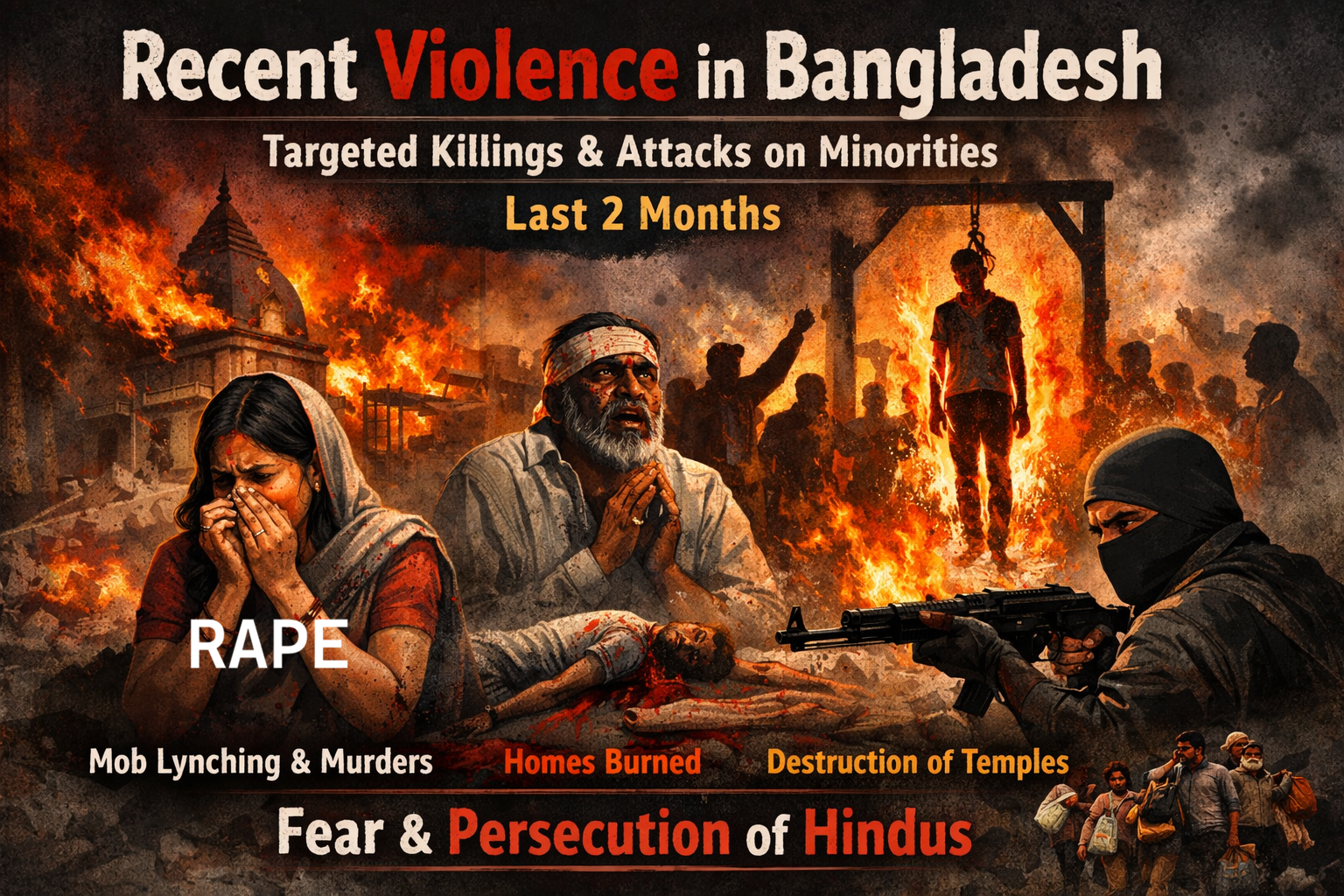
In the last two months, Bangladesh has experienced a wave of violent incidents, including mob lynchings, arson attacks on minority homes, and escalating tensions surrounding political unrest. These events have drawn international attention and criticism, raising serious concerns about the protection of minorities, freedom of expression, and the rule of law.
MURDERS & LYNCHING & DESTRUCTION OF PROPERTIES OF MINORITIES
LIST OF VICTIMS – – Click Here
Victim: Prantos Karmakar, Date : 2nd December, Location: Narsingdi district, Bangladesh
Victim: Utpal Sarkar, Date : 5th December, Location: Faridpur district, Bangladesh
Victims: Jogesh Chandra Roy and Suborno Roy, Date : 7th December, Location: Rangpur district, Bangladesh
Victim: Shanto Das, Date : 12th December, Location: Comilla district, Bangladesh
Victim: Dipu Chandra Das, Date : 18th December, Location: Mymensingh district, Bangladesh – Click Here
Victim: Amrit Mondal, Date : 24th December, Location: Rajbari district, Bangladesh
Victim: Pintu Akanda, Date : 24th December, Location: Bogura district, Bangladesh – Click Here
5 Houses belonging to 2 Hindu families were burnt down to the ground in West Dumuritala Village of Pirojpur Sadar District in #Bangladesh during the early hours of 27.12.2025 – Click Here
300 year old Durga Temple has Demolished – Click Here
Numbers tell the story of a dwindling demography – Click Here
1947 : Hindus were about 22-28% in what is now Bangladesh.
2025 : Hindus are an endangered 7.5% minority.
Between August 4-20, 2024, 2,010 attacks on minorities were documented, including 69 temples directly targeted. By mid-2025, that number swelled to 2,326, with 23 Hindu killed, and 152 temples defiled.
Major Hindu temples have come under premeditated attack. From the 200-year-old Jagannath Mandir in Noakhali to the ISKCON Temple in Dhaka.
In just the first quarter of 2025, 342 cases of rape of Hindu women were recorded, with nearly 9 out of 10 victims being under 18.
Islamists attack Bangladesh’s biggest rockstar James’s concert – Click Here
How Institutions are targetting the Hindus who are the citizens of Bangladesh – Jamaat’s newspaper “Amar Desh” has published news branding Hindus as terrorists, while Bangladesh itself is widely known worldwide as a state associated with extremist violence, Terrorism and mass killings of Hindus – Click Here
11 Hindus killed in the last 22 days
Name list :
1/12: Dilip Bormon
3/12: Prantosh Kormokar
6/12: Utpol Sarkar
7/12: Zogesh Chandra Roy & Suborna Roy
12/12: Shanto Das
15/12: Ripon Kumar Sarkar
16/12: Pratap,Swadhin,Polash Chandra
18/12: Dipu Das
Christian Minority Target – Click Here
Ancestral Home of Satyajit Ray Demolished – Click Here
RAPES & ATROCITIES
Incident 1 – Click Here
Incident 2 – Click Here
Incident 3 – Whipping women for not wearing Burka – Click Here
This article outlines what has been reported, the context of these events, and how the interim government’s role has been viewed by different observers and governments.
Bangladesh at a Crossroads: Rising Radicalism, Pakistan’s Shadow, and the Challenge to Regional Stability
For decades, Bangladesh stood apart in South Asia as a nation founded on linguistic identity, secular ideals, and cultural pluralism—a sharp contrast to religion-centric statehood models in the region. Its birth in 1971 was not merely a geopolitical event, but a rejection of religious nationalism imposed by Pakistan.
Yet today, serious questions are being raised by analysts and regional observers: Is Bangladesh slowly losing its secular anchor? Is Pakistan—through ideological, intelligence, and proxy networks—re-entering the Bangladeshi space? And does this convergence pose a growing challenge to India and regional peace?
This article examines these concerns through a strategic and security lens.
Erosion of the Secular Fabric
Bangladesh’s constitution originally enshrined secularism as a foundational principle. Over time, however, this commitment has been weakened by political compromises, ideological shifts, and the growing influence of religious hardliners.
Key indicators cited by observers include:
- Increasing visibility and influence of Islamist groups in public life
- Normalization of religious rhetoric in political discourse
- Shrinking space for secular voices, journalists, and minority communities
- Periodic communal violence and intimidation with limited accountability
While Bangladesh remains formally secular, the ground reality appears more fragile than the constitutional promise.
Rise of Islamic Radical Networks
Security analysts have long warned that Islamist radical groups—some domestic, some transnational—have sought to exploit political instability and governance gaps in Bangladesh.
Concerns frequently highlighted include:
- Dormant extremist networks reactivating under political cover
- Radical preachers and organizations operating through charities, madrasas, and online platforms
- Softening of enforcement against groups previously designated as extremist
- Ideological alignment with broader Islamist narratives in South Asia
The danger is not only terrorism, but the slow radicalization of social and political norms, which erodes democratic resilience from within.
Pakistan’s Re-Engagement: Ideological and Strategic
Perhaps the most alarming development for regional strategists is Pakistan’s apparent re-entry into Bangladesh’s strategic and ideological landscape—something unimaginable in the immediate decades after 1971.
While there is no official alliance, analysts point to:
- Renewed diplomatic warmth and intelligence engagement
- Revival of Pakistan-linked Islamist organizations once marginalised
- Shared narratives on religion-centric identity over secular nationalism
- Coordinated messaging on regional issues involving India
The role of Pakistan’s intelligence establishment (ISI) is frequently mentioned in security discussions—not as a proven fact in every instance, but as a credible risk factor based on historical patterns in Afghanistan, Kashmir, and elsewhere.
Strategic Implications for India
From India’s perspective, these developments raise serious red flags.
1. Eastern Flank Vulnerability
India’s eastern border with Bangladesh is long, porous, and densely populated. Any radicalization or intelligence activity across this border:
- Complicates internal security in eastern and northeastern India
- Increases risks of cross-border infiltration, smuggling, and radical propaganda
- Undermines stability in sensitive regions like Assam, Tripura, and West Bengal
2. Two-Front Asymmetric Pressure
If Pakistan and Bangladesh—intentionally or unintentionally—become aligned through ideological or security networks, India faces:
- A western front challenged by Pakistan
- An eastern neighborhood increasingly unpredictable
This does not require conventional military alignment; asymmetric threats are sufficient to strain regional stability.
Regional Peace at Stake
South Asia is already one of the world’s most fragile regions. The convergence of:
- Political instability
- Religious radicalism
- Intelligence competition
- Weak regional institutions
creates a volatile mix.
Bangladesh’s drift away from secularism does not only endanger minorities or internal cohesion—it reverberates across the region, affecting India, Myanmar, Nepal, and even maritime security in the Bay of Bengal.
Bangladesh, External Influence, and the Geopolitics of Regime Change: Examining the Allegations and Strategic Fallout
Bangladesh is once again at the center of intense geopolitical debate. Following political upheaval and the installation of an interim administration under Muhammad Yunus, questions are being raised across South Asia about external influence, regime engineering, and strategic realignment.
Among critics, a particularly strong narrative has emerged: that the United States, through its broader geopolitical playbook and intelligence ecosystem, has played a role—directly or indirectly—in destabilizing Bangladesh’s internal political order. Whether grounded in evidence or driven by regional anxieties, these perceptions themselves have become strategically significant.
This article examines why such allegations exist, what historical precedents shape them, and how they impact regional stability, especially for India.
The U.S. Track Record: Why Suspicion Exists
Skepticism about U.S. involvement does not arise in a vacuum. Over the past seven decades, the United States has been documented as influencing political outcomes in multiple regions, including:
- Iran (1953)
- Chile (1973)
- Afghanistan, Iraq, Libya
- Latin America and parts of Africa
Often justified under banners such as democracy promotion, human rights, or stability, these interventions have sometimes resulted in long-term instability rather than institutional strengthening.
For many observers in South Asia, this history shapes how current developments in Bangladesh are interpreted.
Bangladesh’s Sudden Political Shift and External Pressure
In the period leading up to the political transition in Bangladesh, several developments drew attention:
- Sustained Western criticism of Bangladesh’s electoral processes
- Sanctions, visa restrictions, and diplomatic pressure
- Increased engagement by Western diplomats with opposition and civil society groups
- Public narratives emphasizing “democratic correction”
While none of this proves covert intervention, critics argue that intense external pressure can function as a force multiplier, weakening incumbent governments and accelerating internal fractures.
Muhammad Yunus: Reformer, Technocrat, or Transitional Figure?
Muhammad Yunus is internationally respected see:
- Nobel Peace Prize laureate
- Pioneer of microfinance
- Strong ties with Western institutions, academia, and policy circles
Supporters view him as:
- A neutral, globally credible administrator
- A stabilizing technocratic figure
- A bridge between Bangladesh and international institutions
Critics, however, raise concerns:
- His worldview aligns closely with Western economic and political frameworks
- His elevation coincides with Western strategic preferences
- His legitimacy stems more from international acceptance than domestic mandate
It is this perception gap, rather than proven orchestration, that fuels claims of external influence.
The CIA Question: Evidence vs. Inference
No publicly available evidence confirms direct CIA orchestration of Bangladesh’s political transition.
However, intelligence agencies rarely operate in overt ways. Critics argue that:
- Influence does not require coups or assassinations
- Narrative shaping, elite alignment, funding ecosystems, and diplomatic pressure can be equally effective
- “Soft power regime change” is harder to detect but strategically potent
Importantly, absence of proof is not proof of presence—but the perception of intelligence involvement alone can destabilize trust in institutions.
Strategic Consequences: The Pakistan–Bangladesh–U.S. Triangle
One of India’s primary concerns is not merely Western influence, but the downstream realignment it may enable.
Observers point to:
- Renewed Pakistan–Bangladesh engagement
- Softening of historical hostility rooted in 1971
- Revival of Islamist networks previously suppressed
- Converging narratives on regional security
If Bangladesh’s strategic orientation shifts—even subtly—it could:
- Weaken India’s eastern security calculus
- Open space for intelligence coordination hostile to India
- Undermine regional counterterrorism frameworks
In this context, U.S. indifference to India’s security sensitivities becomes a source of friction.
Destabilizing Effects on Bangladesh Itself
Regardless of external actors, the greatest risk is internal:
- Erosion of secular identity
- Empowerment of radical or illiberal forces
- Decline in minority protections
- Governance legitimacy crisis
When an interim administration is perceived—rightly or wrongly—as externally favored, it loses domestic trust, making it vulnerable to manipulation by radical and opportunistic groups.
India’s Dilemma: Caution Without Confrontation
India faces a delicate challenge:
- Confrontation risks alienating Bangladesh
- Silence risks normalization of destabilizing trends
New Delhi must:
- Engage diplomatically without endorsing instability
- Support democratic institutions, not personalities
- Protect its security interests without interventionism
The lesson of South Asia is clear: external engineering rarely produces stable outcomes.
Perception Is Power
Whether or not the U.S. or its intelligence agencies have directly influenced Bangladesh’s political transition, the perception of such influence is already shaping realities.
For Bangladesh, the challenge is reclaiming:
- Political legitimacy
- Secular balance
- Sovereign decision-making
For the region, the warning is stark:
When great-power geopolitics intersect with fragile domestic politics, smaller nations often pay the highest price.
Bangladesh’s future must be decided in Dhaka—not Washington, Islamabad, or any foreign capital.
The Irony of History
There is a tragic irony in Bangladesh’s current trajectory.
The nation was born from:
- Resistance to religious authoritarianism
- Rejection of Pakistan’s ideological project
- A mass movement rooted in cultural pluralism
Any return—direct or indirect—to the very forces it once rejected betrays the spirit of 1971 and risks undoing decades of hard-won progress.
A Moment of Reckoning
Bangladesh today stands at a critical crossroads.
The choice is not between religion and irreligion, but between:
- Pluralism and polarization
- Sovereign decision-making and external ideological capture
- Regional cooperation and strategic destabilization
For India, vigilance without hostility is essential. For Bangladesh, reclaiming its secular, inclusive identity is not just a moral imperative—it is a strategic necessity.
South Asia cannot afford another front of instability driven by radicalism and historical revisionism. The stakes—for peace, democracy, and regional order—are simply too high.
1. Rise in Violence Amid Political Instability
Bangladesh’s political landscape has been volatile since the ousting of former Prime Minister Sheikh Hasina in August 2024. Following this change, a series of clashes, protests, and communal tensions have occurred. In late 2025, particularly around December, multiple incidents brought violence against civilians — especially minorities — into sharp focus.
Recent events include:
- Lynching of Dipu Chandra Das: On 18 December 2025, a 27-year-old Hindu man named Dipu Chandra Das was beaten, hanged, and burned by a mob in Bhaluka Upazila, Mymensingh after allegations of blasphemy. The violence took place amid broader unrest following the assassination attempt and subsequent death of youth leader Sharif Osman Hadi, which had already triggered protests and clashes. Police arrested multiple suspects, and the interim government condemned the killing while denying it was communal in nature.
- Arson Attacks on Minority Homes: In Chittagong’s Raozan area, at least two homes belonging to Hindu families were set on fire in late December, forcing residents to flee. Authorities acknowledged the attacks and investigations were reported to be underway.
These incidents have been widely reported as part of an upsurge in mob violence and communal attacks, particularly against minority communities.
2. Government and Law Enforcement Responses
The interim government of Bangladesh, led by Muhammad Yunus, has officially condemned some of the violence and arrested suspects in individual cases. In the case of Dipu Chandra Das’s lynching, authorities stated arrests were made and rejected religious motivation as a central factor, emphasizing law enforcement’s investigative efforts.
However, critics — both domestic and international — argue that law enforcement responses have been inadequate. Some human rights observers and political opponents of the interim administration assert that security forces have been slow to intervene or prevent mob violence, especially when communal tension rises in politically charged contexts.
There are claims in some commentary circles (not all independently verified) suggesting that the interim government’s approach to maintaining order has not sufficiently protected minority communities, leading to perceptions of tacit negligence in certain regions. At the same time, official government responses publicly condemn such violence and emphasize investigations.
3. Minority Rights and Community Impact
While specific incidents like the lynching of Dipu Chandra Das have attracted widespread attention, broader trends reported by some commentators include:
- A significant number of violent incidents reported against minorities in the past year. Some sources mention thousands of incidents of hostility toward minority communities under the interim government’s tenure, including Hindus, Christians, and Buddhists, though these figures are often disputed and vary depending on source methodology.
- Protests across Bangladesh and abroad — including in Dhaka and in neighboring India — calling for better protection of minorities. Groups such as the National Hindu Mahajot have publicly protested atrocities and demanded state action to ensure safety and justice.
Minority communities have voiced insecurity and concern over rising violence, prompting some civil society representatives to appeal for greater protections and accountability.
4. Diplomatic Reactions and Regional Tensions
The violence has not only affected local communities but also triggered regional diplomatic reactions:
- Protests in India: Demonstrations took place outside the Bangladesh High Commission in New Delhi, condemning the lynching and alleged pattern of attacks on Hindus. Authorities strengthened security around diplomatic missions amid rising tensions.
- Official Condemnations: The Indian government publicly expressed concern about what it described as “hostility” toward minority communities in Bangladesh and called for justice and protective measures.
These incidents have contributed to heightened diplomatic sensitivity between the two countries, with both sides calling for restraint and dialogue.
5. Context: Political Violence and Wider Civil Unrest
It is important to situate the recent violence within the broader political unrest in Bangladesh:
- The assassination attempt on Sharif Osman Hadi, a prominent activist, and his subsequent death in December 2025 sparked widespread protests, some of which turned violent. Attacks on media offices, cultural institutions, and political clashes have been documented alongside community targeting.
- Other incidents — such as arson attacks on political figures’ homes — demonstrate the degree of broader instability linked to political factionalism and unrest.
This environment of tension — political, social, and communal — complicates assessments of individual incidents and makes attribution of motive and state responsibility contentious.
6. Terminology and International Perspectives
While some commentators use terms like “genocide” or “targeted ethnic cleansing” to describe the pattern of attacks on minorities, international law defines genocide in very specific legal terms that require proof of intent to destroy, in whole or in part, a protected group. As of now:
- There is no internationally accepted determination that the recent violence qualifies legally as “genocide.”
- Independent human rights organizations and international bodies have not issued official genocide findings for these events as of late 2025.
Most reporting frames the incidents instead as mob violence, communal attacks, and political unrest with serious human rights implications.
October 2023 – A group of radicals of local Bangladeshi MP Bahauddin Bahar attacked Hindus of the area – Click Here
The recent months in Bangladesh have seen serious episodes of violence, including lynchings and arson attacks affecting minority communities amid broader national unrest. These events have drawn domestic protests, diplomatic concern, and international media attention.
The interim government has publicly condemned specific attacks and taken some law enforcement actions, but critics argue that more systemic protection and prevention measures are necessary. At the same time, claims of state-supported genocide remain unverified by international legal bodies and should be distinguished from the repeated documented incidents of mob violence and minority targeting that have undeniably occurred.
Continued monitoring, human rights reporting, and careful use of terminology are crucial in analyzing and responding to these developments.
The persecution of Hindus in what is today Bangladesh is not a recent phenomenon, nor is it confined to isolated incidents. It is a tragic continuum rooted in colonial legacies, religious nationalism, political upheaval, and state failure to protect minorities. The most catastrophic episode occurred during the 1971 Bangladesh Liberation War, when Hindus were deliberately targeted for extermination, displacement, and dispossession, amounting to what many scholars and human rights observers describe as genocide.
Understanding this history is essential—not to inflame hostility, but to acknowledge suffering, preserve memory, and strengthen global commitments to minority rights and genocide prevention.
The Genocide and Systematic Persecution of Hindus in Bangladesh: A Historical and Human Rights Perspective
Historical Background: From Partition to East Pakistan
Partition of 1947 and Its Consequences
The Partition of British India in 1947 divided the subcontinent along religious lines, creating India and Pakistan. Pakistan itself was bifurcated into West Pakistan and East Pakistan (present-day Bangladesh), separated by over 1,600 kilometers.
Hindus, who formed a significant minority in East Pakistan, immediately became vulnerable. Partition violence, discriminatory policies, and communal riots triggered the first major wave of Hindu migration from East Pakistan to India. Despite this, millions of Hindus remained.
Institutional Discrimination Before 1971
The Enemy Property Act
One of the most damaging tools of persecution was the Enemy Property Act (1965), which allowed the state to confiscate property belonging to individuals deemed “enemies”—a label disproportionately applied to Hindus.
This legalized economic dispossession, stripped Hindus of land and assets, and incentivized forced migration.
Social and Political Marginalization
Hindus faced:
- Underrepresentation in government and military
- Religious discrimination
- Periodic communal violence with little accountability
- Social pressure to convert or flee
These conditions laid the groundwork for mass violence.
The 1971 Genocide: Targeting of Hindus
Context of the Liberation War
In 1971, following electoral victory by the Awami League in East Pakistan and refusal by West Pakistan’s military rulers to transfer power, a brutal military crackdown—Operation Searchlight—was launched.
While Bengali Muslims were targeted for political reasons, Hindus were targeted for both political and religious reasons, making their persecution uniquely genocidal in nature.
Why Hindus Were Specifically Targeted
The Pakistani military and allied militias viewed Hindus as:
- “Pro-India”
- “Un-Islamic”
- Supporters of Bengali nationalism
- Legitimate targets for elimination or expulsion
This ideological framing justified mass violence.
Forms of Atrocities Committed
1. Mass Killings
Hindu men were systematically rounded up and executed. Entire villages were wiped out.
Eyewitness accounts and survivor testimonies describe selective identification of Hindus before massacres.
2. Sexual Violence Against Hindu Women
Rape was used as a weapon of war. Hindu women were:
- Abducted
- Repeatedly raped
- Forced into sexual slavery
- Sometimes forcibly converted and married off
These acts were intended to destroy community honor and continuity.
3. Forced Displacement
An estimated 8–10 million refugees fled to India during the war—the majority of them Hindus.
This was one of the largest forced migrations of the 20th century.
4. Destruction of Religious and Cultural Sites
- Temples were demolished
- Idols desecrated
- Sacred texts burned
These acts aimed to erase Hindu presence and heritage.
Death Toll and Genocide Classification
While exact figures remain contested, widely cited estimates indicate:
- Up to 3 million people killed
- A disproportionate number were Hindus
Numerous scholars, journalists, and human rights advocates argue that the systematic targeting of Hindus meets the legal definition of genocide under international law.
Post-1971: Continued Vulnerability of Hindus in Bangladesh
Demographic Decline
- Hindus constituted ~23% of East Pakistan’s population in 1951
- Today, they are less than 8% of Bangladesh’s population
This decline is not explained by natural causes alone but by persistent emigration driven by fear and insecurity.
Ongoing Issues
Post-independence Bangladesh has seen:
- Periodic communal riots
- Attacks on temples
- Land grabbing
- Political violence targeting Hindu neighborhoods during elections
- Inadequate prosecution of perpetrators
While Bangladesh’s constitution proclaims secularism, implementation has been inconsistent.
International Silence and Inadequate Recognition
Despite the scale of atrocities:
- The 1971 genocide is still not universally recognized
- The specific targeting of Hindus is often underreported
- Survivors rarely received justice or reparations
Geopolitical interests during the Cold War contributed to this silence.
Why Recognition Matters
Acknowledging the genocide is important for:
- Honoring victims
- Combating historical denial
- Strengthening minority protections
- Preventing future atrocities
- Promoting genuine reconciliation
Denial does not heal wounds—truth does.
The genocide and persecution of Hindus in Bangladesh, particularly during the 1971 Liberation War, represent one of the most painful and under-acknowledged human rights tragedies of South Asia. It was not merely collateral damage of war, but a targeted campaign of elimination, displacement, and terror.
Remembering this history is not about blaming present generations—it is about learning, accountability, and ensuring that “Never Again” is more than a slogan.
Only through honest reckoning can societies move toward justice, coexistence, and lasting peace.