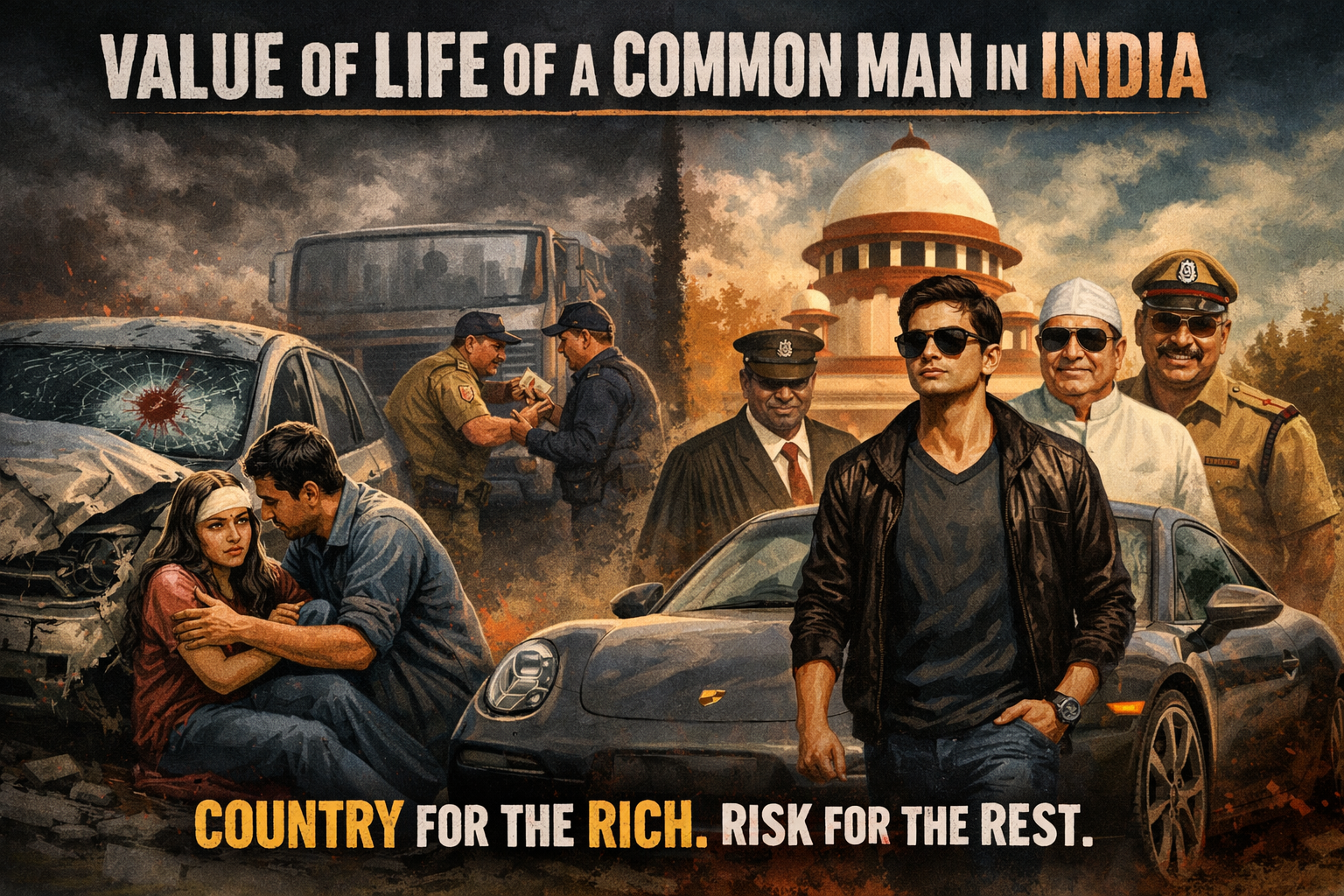
In India, the value of a human life is not measured by innocence, effort, or law. It is measured by power, money, and proximity to the system. If you are ordinary—if you live without escorts, influence, or inherited privilege—your life is expendable.
This is not rhetoric. This is lived reality.
When Survival Isn’t Enough
In Bengaluru, my sister and her friend did what the law-abiding are told to do: they stopped at a red light. A drunk mini-truck driver didn’t. He rammed into them from behind. – Click Here for the whole story
Everyone knew the truth.
They knew it.
The highway police knew it.
The truck owner knew it.
No arrest was made.
No driver appeared at the station. No owner was summoned. Instead, two injured, shaken young people were made to run in circles—repeating their story, begging for a report, asking for the bare minimum acknowledgment that a crime had occurred.
The police response was chillingly casual:
- “If nobody died, an FIR doesn’t make sense.”
- “Just claim first-party insurance.”
- “Third-party insurance doesn’t pay much anyway.”
And then, the honest whisper from within the rot:
“These truck mafia bribe us. Nothing will happen.”
Nothing did.
The truck’s number—KA04 AE6550—was noted. The police themselves admitted that had my sister been on a two-wheeler, she would likely be dead. Yet survival disqualified her from justice.
Law on Paper, Law in Practice
The law is clear: rear-end collisions place fault on the driver behind. A red light is not a suggestion. A truck driver does not “miss” a stationary car at a signal unless intoxicated, reckless, or protected.
Still, the insurance claim—despite 100% coverage—was rejected by Reliance General Insurance, citing “misrepresentation of facts.” Injured victims showing up repeatedly to state the facts were told, effectively, that truth is optional when denial is convenient.
This isn’t about money. Repairs can be managed. Medical bills can be paid. Loans can be taken. Savings exist.
Fear is what remains.
Fear that the next impact might kill.
Fear that the system will shrug again.
Fear that law, police, and institutions exist—but not for people like us.
How do you tell someone to trust a system that just taught them they are alone?
Justice for Sale
We’re often tempted to ask officials, “What if this were your daughter?” But that question is pointless. Their daughters move with security. Their sons live behind walls of privilege. They will never experience the vulnerability of being ordinary.
So let’s speak plainly—to ordinary people.
You stop at a red light.
A drunk truck driver hits you.
Your loved one is inside, terrified.
And then you discover the truth:
- The truck owner pays.
- The police look away.
- The insurance company denies.
- The system moves on.
This is Bengaluru in 2025.
This is India in 2025.
This is what your life is worth.
Merit Means Nothing Without Power
The friend in the car is 23. A top-ranker in IIT-JEE. An AI engineer at a leading global data company. He earns more in a year than the cost of several trucks—in India. He pays taxes. He is patriotic. He stays back despite constant offers from the US.
This is how India treats someone who is clearly an asset—for the sake of a drunk truck driver protected by bribes.
What message does that send?
That merit is optional.
That honesty is naïve.
That staying back is foolish.
When the Rich Kill, the System Kneels
And if Bengaluru shows us indifference, Pune shows us surrender.
In the infamous Porsche case, three accused—charged with switching blood samples through bribery—were granted bail by the Supreme Court of India. The teen driver, now an adult, walks free after destroying two families.
Let that sink in.
Evidence tampered.
Lives erased.
Families shattered.
Bail granted. Life continues—for the rich.
This is not justice. This is capitulation.
A Country Tilted Against Its Own People
We like to say “India is a nation of laws.” On paper, perhaps. In practice, it is a nation of exceptions—written for the powerful and enforced against the powerless.
Police who won’t file FIRs.
Bureaucrats who delay until you give up.
Judges who grant relief where outrage demands accountability.
Politicians who look away—because the donors are watching.
This is not a system that fails accidentally.
This is a system that works exactly as designed—to protect itself.
To the Ordinary Reader
This isn’t my story. It’s yours.
If you are common, your life is cheap.
If you are rich, your crimes are negotiable.
That is the social contract we are living under.
And until we confront this truth—loudly, collectively, and without fear—the red light you stop at might be the last rule you ever followed.
Yuvraj Mehta: Drowned Not by Water, but by Negligence
In January 2026, Yuvraj Mehta, a 27-year-old software engineer, died in Noida—not because of recklessness, not because of crime, but because the State failed to perform its most basic duty: to keep a road safe.
Yuvraj was returning from work in Gurgaon late at night. Dense fog reduced visibility, a common winter condition in North India—predictable, recurring, and well known to authorities. Near Sector 150, his car plunged into a 20-foot-deep, unguarded, water-filled construction pit that lay open beside a public road.
No barricades.
No warning lights.
No signage.
No accountability.
What followed is not just tragic—it is unforgivable.
Two Hours of Hope. Then Silence.
After the fall, Yuvraj did not die instantly.
He climbed onto the roof of his partially submerged car and waited.
For nearly two hours, he remained alive—calling his father, asking for help, hoping someone would arrive.
No emergency response reached him in time.
No rapid disaster protocol was activated.
No coordinated rescue effort materialised.
Eventually, his calls stopped.
Days later, his car was pulled out.
The post-mortem confirmed what the system already knew but failed to act upon:
anti-mortem drowning asphyxia followed by cardiac arrest.
In plain words: he died slowly, while help should have been possible.
The Aftermath: Action Only After Death
Only after Yuvraj’s death did the machinery of the state wake up.
- A Special Investigation Team (SIT) was constituted
- A builder was taken into custody
- A Junior Engineer was terminated
- The Noida Authority CEO was removed
These actions were presented as accountability.
But the real question remains unanswered:
Why did it take a young man’s death for basic safety norms to be enforced?
Why was a lethal pit allowed to exist unguarded in a developed urban sector?
Why was fog—an annual certainty—never factored into safety planning?
Why did emergency response fail so completely that a man could wait for hours and still die alone?
What This Death Actually Reveals
Yuvraj Mehta did everything right.
He was educated.
Employed.
Returning home after work.
Driving on a public road in a planned city.
Yet none of that protected him.
Because in India:
- Infrastructure is built without responsibility
- Maintenance exists only on paper
- Safety audits are ceremonial
- Urban authorities operate without fear of criminal liability
Negligence is normalised.
Deaths are collateral.
And accountability is posthumous theatre.
If This Were Someone Else’s Son…
Had Yuvraj been the son of a powerful politician, senior bureaucrat, or influential business figure:
- The pit would have been sealed
- The road would have been barricaded
- The fog would have triggered diversions
- The rescue would have been immediate
But he was a common man.
And so, like countless others, he was left to fight for his life against a system that never showed up.
The Question India Refuses to Ask
This was not an accident.
This was criminal negligence layered with institutional apathy.
And every educated Indian watching this unfold understands one brutal truth:
If a young, working professional can drown on a public road in a planned city—and the system reacts only after he is dead—then no one is safe.
This is why Indians leave the moment they can.
Not for luxury.
Not for comfort.
But to live in a country where open pits are barricaded, emergency calls are answered, and survival is not a matter of luck.
Yuvraj Mehta didn’t die because of fog.
He died because in India, the life of a common man is always an afterthought.
Country for the rich. Risk for the rest.
Why Indians are leaving the country? – Click Here