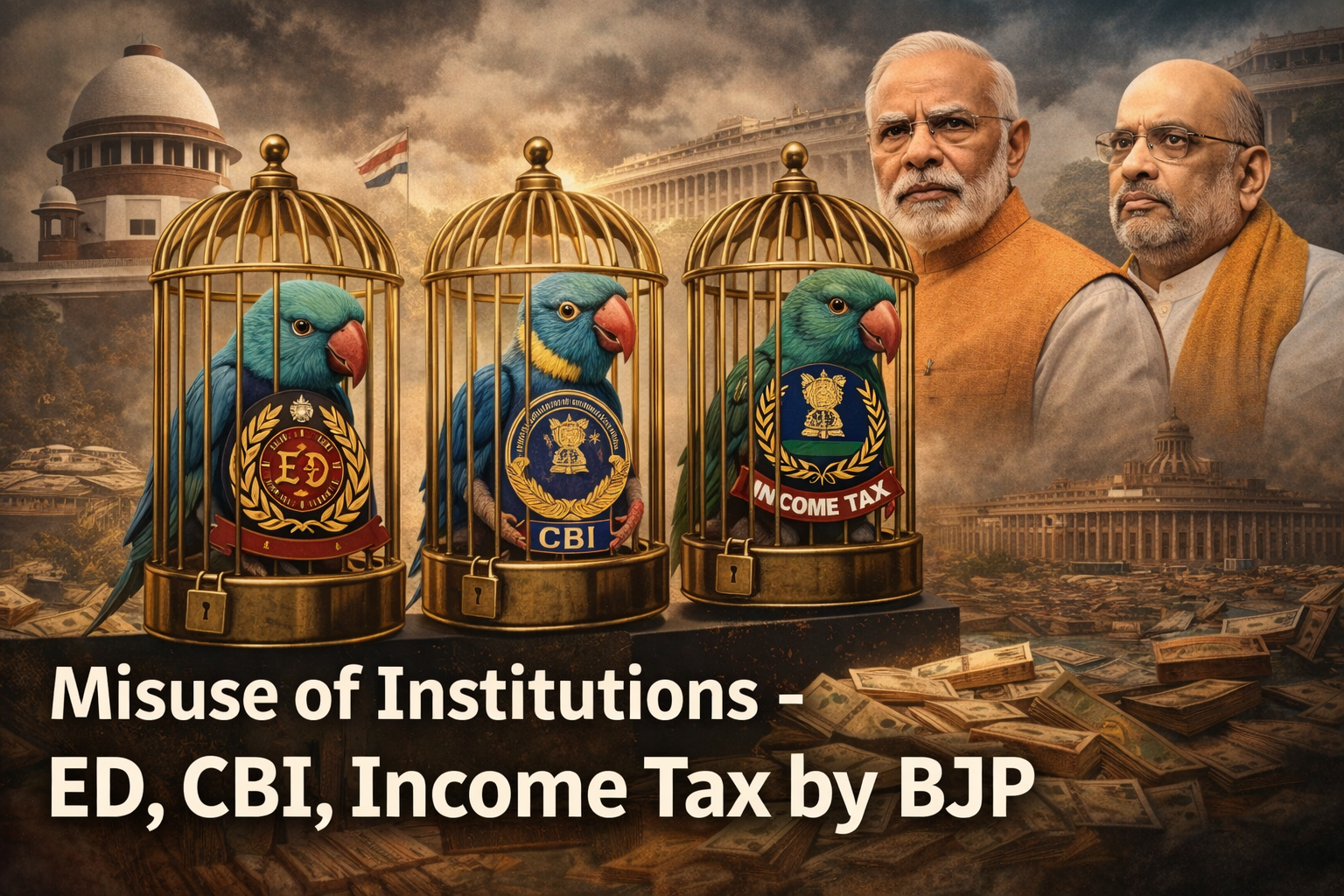
Is this the first step towards an undeclared Emergency in West Bengal?
Indian democracy is built on the independence of its institutions. Agencies such as the Enforcement Directorate (ED), Central Bureau of Investigation (CBI), and Income Tax Department were meant to act without fear or favour. Unfortunately, the growing pattern of selective enforcement raises a serious concern: Are these agencies being weaponised for political objectives rather than public justice?
Recent developments in West Bengal only deepen these fears.
Selective Raids and Convenient Blind Spots
One of the most visible patterns today is that ED raids are rarely seen in BJP-ruled states or against politically powerful families aligned with the ruling establishment.
A simple question arises in public discourse:
If corruption exists everywhere, why does enforcement appear so uneven?
Why has there been little visible scrutiny into:
- Business groups closely associated with political power centres, such as Adani and Ambani, despite massive expansion and regulatory dependence.
- Companies allegedly linked to the sons of powerful leaders — whether it is the son of the Home Minister, the son of a senior Union Minister like Nitin Gadkari, or politically influential families — whose company turnovers have reportedly seen sudden exponential growth.
- High-profile political families where commercial interests and political access intersect.
The absence of transparent investigation into these areas creates a perception that central agencies selectively apply the law based on political convenience rather than evidence.
Institutions cannot maintain credibility when enforcement appears asymmetrical.
If BJP Cannot Win Politically, Agencies Step In
Across several states, a recurring political pattern has emerged. When the ruling party struggles to defeat regional parties electorally, the pressure shifts from ballot boxes to investigation notices, raids, freezing of accounts, and arrests.
In West Bengal, where BJP has repeatedly failed to dislodge the Trinamool Congress through elections, central agencies appear increasingly active against political strategists, campaign managers, and party-linked organisations.
This gives rise to a dangerous impression:
If electoral victory cannot be secured democratically, institutional pressure becomes the alternate route.
This is not healthy competition — it is administrative domination.
Mamata Banerjee’s Resistance: Wrong or Necessary?
Many critics ask: Why should a Chief Minister interfere in the functioning of central agencies? Ideally, political executives should not obstruct investigations.
However, another uncomfortable reality exists. If central agencies begin functioning like politically guided “caged parrots,” then public resistance becomes inevitable.
When institutions lose neutrality, moral authority collapses. Public humiliation of agencies, while undesirable, is a symptom of a deeper institutional trust deficit.
Is This a Precursor to Emergency Politics?
One cannot ignore the broader political trajectory. The systematic weakening of opposition governments, erosion of federal autonomy, and concentration of power at the Centre often precede authoritarian consolidation.
This environment indirectly strengthens narratives favouring extraordinary measures — including potential arguments for imposing Emergency-like controls under the guise of law and order or governance breakdown.
If political instability is manufactured through institutional pressure, it becomes easier to justify drastic central interventions later. This possibility cannot be dismissed lightly.
The IPAC Question: Proportion or Political Theatre?
IPAC is essentially a political consultancy and election management firm. Realistically, what could be its maximum annual revenue or profit? A few crores? Tens of crores at most?
If agencies allege money laundering running into thousands of crores, the burden of proof must be extraordinarily strong. Otherwise, it raises questions of disproportionate deployment of national investigative resources.
If massive financial crime truly exists, it must be proven transparently. If not, the action risks appearing more like political theatre than genuine enforcement.
Meanwhile, glaring examples elsewhere remain untouched:
- Politicians allegedly spending crores on personal celebrations and firecrackers.
- Leaders reportedly owning fleets of luxury cars exceeding 100 vehicles.
- Sudden unexplained turnover jumps in companies owned by relatives of netas.
If these are not worthy of investigation, the public naturally questions the fairness of the system.
Why Only Opposition Under the Scanner?
ED raids rarely touch BJP-controlled political ecosystems. No major BJP-linked business house appears under sustained investigative pressure. No politically connected corporate expansion seems questioned. No high-profile political family faces the same intensity of scrutiny.
Selective justice is not justice.
Judiciary Must Intervene Before Institutions Collapse
The Supreme Court has a constitutional responsibility to safeguard institutional neutrality. When misuse of agencies becomes systemic rather than incidental, judicial oversight becomes necessary.
Suo moto intervention, independent audits of agency conduct, transparent accountability of agency chiefs, and strict punishment where political influence is established must be considered urgently.
If agencies are allowed to function as political instruments without consequence, the erosion of democratic balance becomes irreversible.
Democracy Cannot Survive on Fear and Selective Enforcement
This debate is not about supporting or opposing any political party. It is about protecting the foundational principle that law must operate independently of political power.
When agencies become tools of intimidation, democracy becomes hollow. When opposition is pressured through raids instead of defeated through ideas, governance loses legitimacy. When institutions serve power instead of constitution, citizens lose faith.
India’s strength lies not in centralisation of authority but in strong, neutral institutions.
If that neutrality collapses, no election victory can compensate for the long-term damage to the republic.