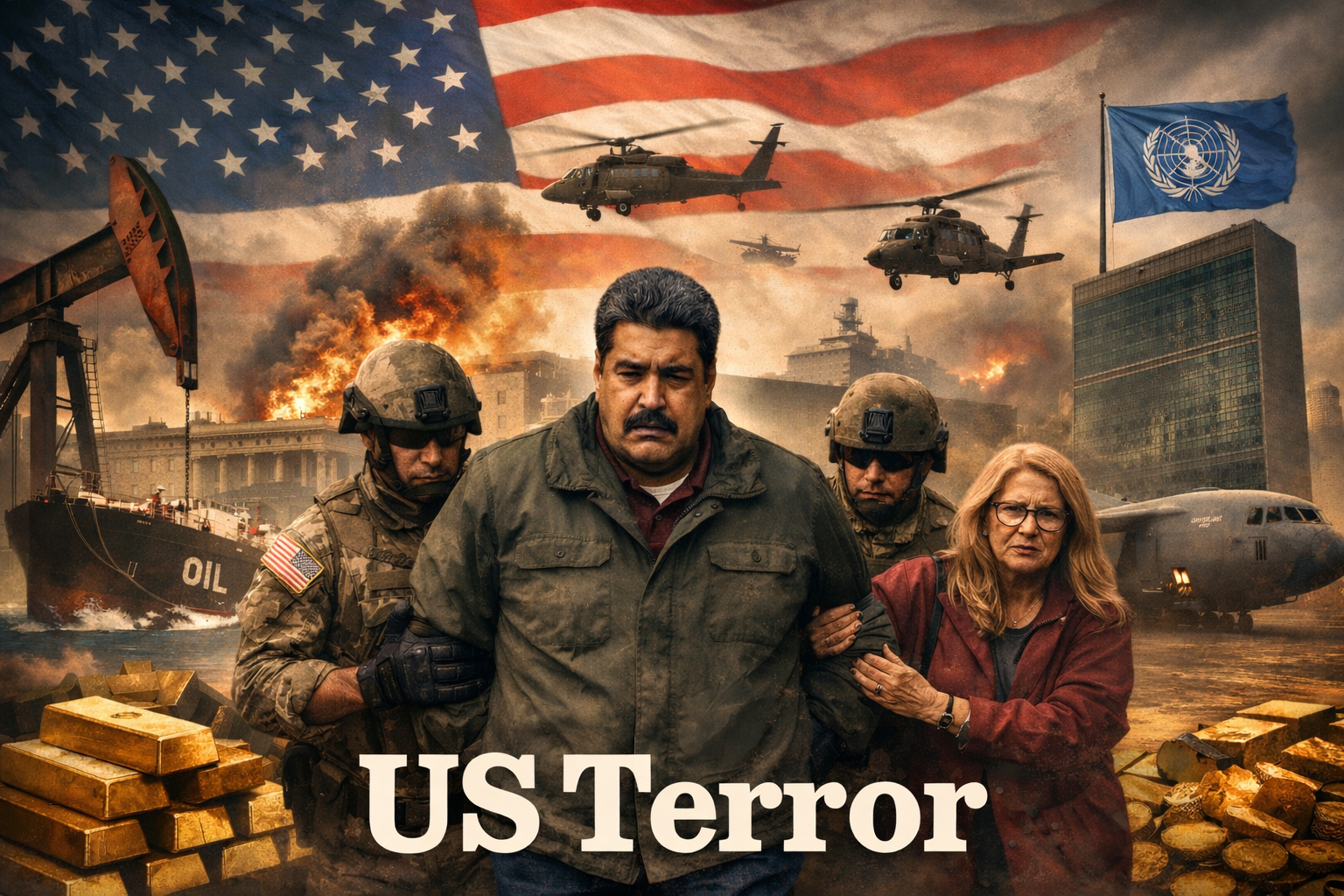
In early January 2026, the United States mounted a dramatic military operation against Venezuela — striking Venezuelan territory, capturing President Nicolás Maduro and his wife, and transporting them to the United States to face criminal charges. President Donald Trump’s government describes this as a law-enforcement action against narcotrafficking. But the scale and nature of the operation — involving strikes, seizures of oil tankers, and unprecedented extraterritorial detention — have sparked sharp global criticism and raised fundamental questions about sovereignty, resource control, and the impotence of international institutions.
The Operation and Its Stated Justifications
The Trump administration framed the assault on Venezuela as a response to alleged “narco-terrorism” and a means to hold Maduro accountable for drug trafficking. The White House insists the action is not an invasion but a targeted extraction of a criminally indicted individual, justifying use of force as self-defense under international law.
Yet this narrative contrasts sharply with the reality on the ground: U.S. forces struck military infrastructure, targeted vessels linked to Venezuela’s oil exports, and have since established a de facto blockade on sanctioned oil tankers — moves that critics say directly serve U.S. strategic interests in Venezuelan natural resources.
Oil and Strategic Interests: The Elephant in the Room
Venezuela sits atop some of the largest proven oil reserves in the world. Control of those reserves — and access for Western oil firms — has long been a geopolitical priority for the United States and its allies. Even before the January military operation, Washington had expanded sanctions against Venezuelan oil companies and naval quarantines designed to choke Caracas’s petroleum revenues.
Following the capture of Maduro, U.S. officials signaled they intend to facilitate oil exports destined for American markets and open the door to major investments by U.S. energy companies, moves that could reshape global oil flows and realign Venezuela’s economic partnerships.
Critics see this not as a fight against drug trafficking but as a modern projection of power to control vital commodities — echoing historical patterns of resource-driven intervention. Even analysts who accept the seriousness of drug trafficking point out that drug smuggling alone is not legally sufficient to justify military invasion under international law, which traditionally requires either Security Council approval or clear evidence of an armed attack.
Trump could not save America legally because of debts, so he chose illegal tariffs and terror!
Why the United Nations Has Been Largely Ineffective
At first glance, the United Nations should be the body best placed to mediate this crisis. It was founded to prevent unilateral use of force and defend sovereign equality of states. Yet the reality has been starkly different.
An emergency UN Security Council session in early January revealed deep international unease. Countries including China, Russia, Brazil, and others condemned the U.S. action as a “crime of aggression” and a breach of the UN Charter. The UN Secretary-General and High Commissioner for Human Rights described the escalation as a dangerous precedent that weakens global norms.
But despite these criticisms, no decisive action has emerged from the Security Council — and for a simple reason: the United States holds veto power. Any attempt to formally censure Washington for violating international law can be blocked by its veto, rendering the council unable to act.
This structural reality — where powerful states can act with impunity and shield themselves from accountability — exposes a fatal flaw in the multilateral system. Rather than a forum where global law is upheld, the UN becomes an echo chamber where the most powerful actors set the terms.
The Silence and Ambiguity of Global Governance
Even institutions tasked with defending human rights and international law have responded with cautious language. Calls for restraint and respect for sovereignty are commonplace, but there has been no effective enforcement mechanism — no international tribunal, no collective security action to restrain the U.S. conduct.
Meanwhile, Western governments that share concerns about Maduro’s governance have mostly refrained from categorically condemning the U.S., often couching their statements in calls for de-escalation or respect for international law without pointing fingers.
This ambiguity points to an unsettling truth: international institutions lack both the will and the means to check unilateral power when it suits the interests of powerful states. The result is a fractured global order, where norms like sovereignty and non-intervention risk becoming optional rather than foundational.
A Dangerous Precedent for the World
The implications extend far beyond Venezuela. If a superpower can use force to arrest a sitting president and effectively control another nation’s resources without accountability, what stops others from doing the same? The UN’s inability to act strengthens the hand of states that choose unilateralism over cooperation. As the UN High Commissioner for Human Rights warned, such actions make the world “less safe” and erode the very principles meant to prevent conflict.
Sovereignty Under Siege
The U.S. intervention in Venezuela — whatever its stated justifications — has underscored a painful reality: great powers can still override international norms with strategic motives masked as legal rationales. Oil and geopolitical leverage remain central drivers of global conflict. And in the corridors of international institutions, a muted response to blatant breaches of sovereignty reveals both structural constraints and political compromise.
For the global community — and especially smaller nations — this is a clarion call to rethink how international law is upheld. If power remains above principle, then the idea of a rules-based order may be more fragile than ever.