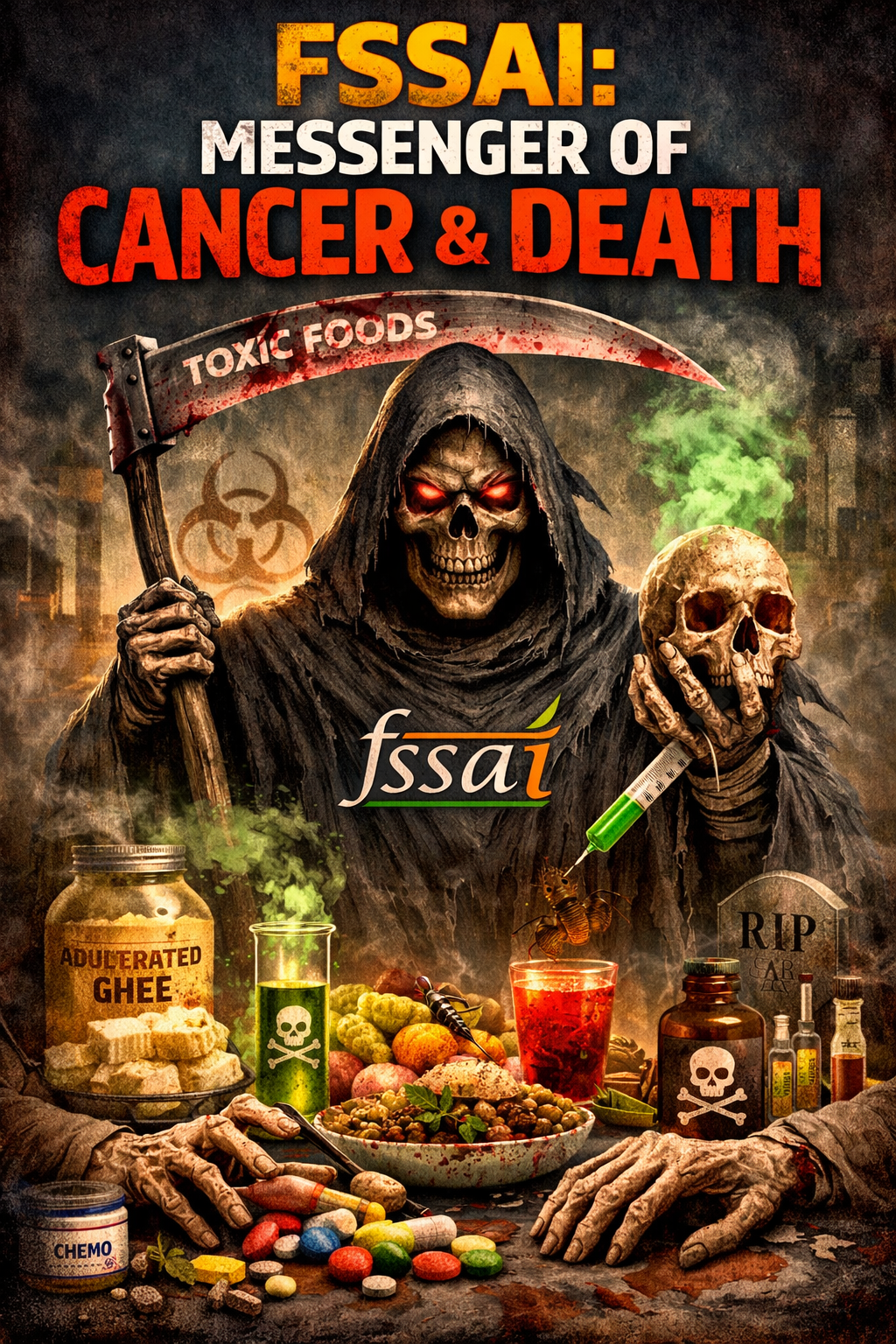
India is not just fighting poverty, pollution, or unemployment.
India is fighting something far more intimate, far more lethal—
the food on our plates.
Watch this before you dig in further – Click Here
What we eat every day—fruits, vegetables, milk, sweets, snacks, tea, ice cream, street food—is increasingly laced with poisons. Not by accident. Not by negligence. But by systemic greed, regulatory failure, and criminal apathy.
This is not exaggeration.
This is not fear-mongering.
This is a slow-motion mass poisoning.
From Farms to Factories: A Nation Fed with Chemicals
Recent viral videos, sting operations, and ground investigations have exposed horrifying practices across India:
- Papaya, carrots, green grapes, bananas, cucumbers, tomatoes, brinjals, gourds
→ injected or sprayed with toxic chemicals to enhance color, size, shine, and shelf life. - Green gram, peas, cabbage, meat
→ colored or preserved using industrial dyes and poisonous sprays. - Fake and synthetic paneer
→ made using chemicals instead of milk, capable of causing liver damage and cancer. - Duplicate ghee
→ where a single drop of chemical is used to make 20 kg of fake ghee.
Just imagine the toxicity of something so concentrated—and then imagine consuming it daily. - Juices and soft drinks
→ prepared using artificial colors, chemicals, acids, and counterfeit syrups instead of fruit. - Ice cream horrors
→ blades found in kulfi, worms inside machines, cloth-making dyes used for coloring, rats feeding on frozen stock. - Jelly, biscuits, rusk, cakes, sweets
→ loaded with toxic food colors banned in the US and Europe, yet freely used in India—especially in products consumed by children. - Jaggery adulteration
→ using sodium formaldehyde (cefolide), hydro, colors, chemicals known to be hazardous.
This is not food.
This is chemical warfare disguised as nutrition.
The Filth Behind Our Favorite Foods
Even more disturbing than chemicals is the sheer filth involved in food preparation:
- Leafy vegetables washed in gutter water
- Gol gappa water made using garbage water
- Rice, curry, noodles, biryani, chowmein stored inside toilets with open seats
- Momos and spring rolls prepared with chemicals in utterly unhygienic conditions
- Samosa potatoes mashed by stomping with bare feet
- Train food scandals
- Tea prepared using toilet water
- Utensils washed inside railway toilets
- Aluminium plates reused and served without proper sanitation
This is not street food culture.
This is institutionalized contamination.
Cancer Is Not Random — It Is Being Cooked
India is witnessing a terrifying rise in cancers—especially stomach, liver, colon, kidney, and blood cancers.
Doctors quietly admit it.
Epidemiologists warn about it.
But regulators remain silent.
These chemicals:
- Formaldehyde
- Industrial dyes
- Non-food-grade acids
- Synthetic preservatives
- Minerals used in oil
- Non-edible grade ingredients
…are known carcinogens.
Cancer is not falling from the sky.
It is being served daily—with chutney.
Foreign MNCs and the Hypocrisy of Double Standards
Perhaps the most enraging part of this crisis is the blatant double standards of multinational corporations.
The same brand.
The same product.
Two different realities.
- In the US and Europe:
- High-quality ingredients
- Strict food safety laws
- Zero tolerance for toxic colors and chemicals
- Transparent labeling
- In India:
- Low-grade raw materials
- Ingredients banned in the West
- Excess sugar, salt, chemicals
- Weak enforcement and cosmetic penalties
India is treated as a dumping ground—
a market where profits matter more than human lives.
Why?
Because they know:
- Regulators are toothless
- Penalties are laughable
- Consumers are uninformed or helpless
This is corporate colonialism through food.
Regulatory Failure: When the Watchdog Is Asleep
India has laws.
India has agencies.
India has standards—on paper.
But what we lack is:
- Ruthless enforcement
- Swift punishment
- Public accountability
When adulteration kills someone:
- No CEO goes to jail
- No factory is permanently shut
- No lifetime ban is imposed
Until fear replaces greed, nothing will change.
This Is Not Just Corruption — This Is a Crime Against Humanity
Food adulteration is not a “business malpractice.”
It is not a “small shortcut.”
It is not a “street vendor issue.”
It is:
- A public health emergency
- A crime against children
- A betrayal of trust
- A slow genocide through food
A nation cannot become strong when its people are being poisoned from breakfast to dinner.
What Must Change — Now
- Zero tolerance for adulteration
- Lifetime bans on repeat offenders
- Criminal prosecution, not fines
- Uniform standards for MNCs—India must get what the West gets
- Mandatory public disclosure of offenders
- Consumer awareness at war-level intensity
Because if food becomes poison, nothing else matters.
We lock our doors at night to protect ourselves from thieves—
but we open our mouths every day to poison.
And the tragedy is:
We pay for it ourselves.
If this does not enrage us,
if this does not wake us up,
then nothing ever will.
FSSAI: India’s Food Safety Regulator or a Silent Partner in Poisoning the Nation?
India has a food safety regulator on paper.
In reality, it has a spectator authority.
The Food Safety and Standards Authority of India (FSSAI) was created to protect 140 crore citizens from unsafe, adulterated, and toxic food. Instead, what India has today is an institution that issues licenses, collects fees, releases press notes—and looks the other way while poison is served daily.
If food adulteration is a national crisis, then FSSAI’s failure is not accidental.
It is systemic, chronic, and deeply compromised.
When the House Is on Fire, the Watchman Is Missing
Across the country, shocking videos repeatedly surface:
- Fruits injected with chemicals
- Fake paneer and synthetic ghee
- Industrial dyes in sweets and ice creams
- Garbage water used for street food
- Toilets doubling as food storage rooms
- Toxic colors banned abroad freely used in India
These are not isolated incidents.
They appear from every corner of the country, across states, cities, and food categories.
And yet—
Where is FSSAI?
No nationwide crackdowns.
No emergency alerts.
No mass license cancellations.
No fear among adulterators.
A regulator that cannot stop a visible, viral, ongoing crime has lost its purpose.
Licenses for Sale, Safety for None
One of the biggest open secrets in India’s food ecosystem is this:
FSSAI licenses are easy to obtain, easier to renew, and almost impossible to lose permanently.
- Vendors with filthy kitchens proudly display FSSAI numbers
- Factories caught adulterating resume operations within weeks
- Repeat offenders pay small fines and continue business as usual
The message is clear:
Adulterate freely. If caught, settle quietly.
When licenses become revenue instruments instead of safety tools, corruption doesn’t need to be proven—it becomes obvious.
Inspections That Exist Only on Paper
A country of India’s size needs:
- Surprise inspections
- Independent testing
- Decoy sampling
- Regular audits
What it gets instead:
- Prior-intimated visits
- Understaffed labs
- Overworked inspectors
- Reports that rarely lead to convictions
How can one inspector monitor thousands of establishments?
How can food safety be ensured without manpower, intent, or autonomy?
This is not incompetence.
This is designed inefficiency.
Soft on Corporates, Cruel to Consumers
Small vendors are occasionally raided for optics.
Big players, especially large FMCG brands and foreign MNCs, are treated with velvet gloves.
Despite:
- Excessive sugar and chemicals
- Ingredients banned in the West
- Different formulations for India vs developed countries
FSSAI rarely:
- Names and shames large brands
- Orders mass recalls
- Suspends licenses permanently
Why?
Because regulatory capture is real.
Because challenging corporate giants requires spine—and independence.
Double Standards Allowed, Even Endorsed
Foreign brands follow strict rules abroad because regulators there bite back.
In India, the same brands:
- Dilute quality
- Use cheaper, inferior ingredients
- Push chemical-heavy formulations
And FSSAI allows it—
under the excuse of “permissible limits.”
Permissible for whom?
Children?
Cancer patients?
Future generations?
India should not be the global laboratory for unsafe food.
When Cancer Rises, Silence Reigns
India is seeing:
- Younger cancer patients
- Digestive cancers exploding
- Lifestyle diseases at epidemic levels
Food is a primary suspect.
Yet FSSAI rarely:
- Links adulteration to long-term health outcomes
- Issues strong public warnings
- Works with health ministries proactively
A regulator that reacts only after outrage is not a regulator—it is a press management agency.
No Fear, No Accountability, No Justice
The biggest failure of FSSAI is this:
There is no fear.
- No life imprisonment for mass poisoning
- No personal liability for factory owners
- No permanent blacklisting
When the cost of crime is lower than the profit from crime, crime becomes business.
This Is Not Just Corruption — This Is Institutional Abdication
FSSAI’s failure is not about a few bad officers.
It is about:
- Weak laws
- Weaker enforcement
- Zero urgency
- Political and corporate pressure
And the result?
A nation eating slow poison while being told everything is “within limits.”
What India Desperately Needs
- Independent food safety watchdogs
- Criminal liability for adulteration deaths
- Public disclosure of offenders
- Uniform global standards—no India discount
- Citizen-led food testing initiatives
- Fear-based deterrence, not symbolic fines
Final Verdict
If FSSAI cannot protect the most basic human necessity—
safe food—
then it has failed its constitutional duty.
A government that cannot ensure clean water and safe food
has no moral authority to speak about development.
Because no economy grows on poisoned stomachs.